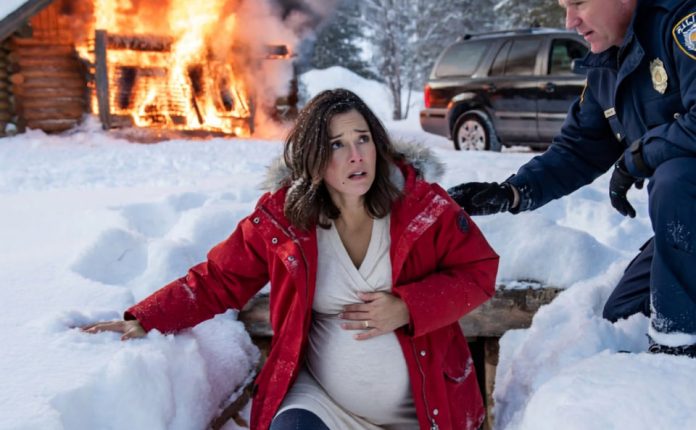
The bedroom door wouldn't open.
I pulled harder, thinking the heat had warped the frame.
Then I heard metal scrape against metal outside.
Somebody had locked me in.
“Grant?”
Smoke rolled across the ceiling.
“Grant, where are you?”
No answer came.
I was thirty-five years old, eight months pregnant, and standing barefoot in our mountain cabin with a fire spreading through the hallway.
My husband was nowhere in sight.
The bedside clock read 2:17 a.m.
Five days later, I would watch Grant conduct my memorial service.
But that night, I still believed he might be trying to save me.
Our Cedar Ridge cabin stood on twelve wooded acres north of the valley. My mother had bought the property long before she founded Northstar Air Rescue.
It had three bedrooms, a stone fireplace, and enormous windows overlooking the pines.
When I was little, Evelyn brought me there whenever she needed to escape the company.
She taught me to make pancakes on the old iron stove.
She showed me where deer sheltered during snowstorms.
And she told me that courage wasn't always loud.
Sometimes it meant knowing exactly where the nearest exit was.
I didn't understand that last lesson until the night my husband tried to kill me.
Grant had suggested the trip on Thursday evening.
“One quiet weekend,” he'd said, leaning against our kitchen counter. “Before diapers and sleepless nights take over.”
I was folding tiny cotton clothes.
At thirty-four weeks pregnant, I could barely see my feet.
“My doctor wants me close to the hospital.”
“We're only an hour away.”
“An hour on dry roads.”
He smiled and touched my stomach.
“You've been working too hard, Mara.”
That part was true.
Northstar had recently expanded its neonatal transport division, and three regional hospitals were considering long-term contracts.
I owned sixty-eight percent of the company.
My mother had built it from one leased helicopter and a borrowed maintenance hangar.
After her death four years earlier, I inherited her controlling interest.
Grant handled the finances as chief financial officer.
I oversaw operations, clinical partnerships, and strategy.
We had been married six years.
Until recently, I'd believed our marriage was one of the few things in my life that didn't require constant supervision.
Grant knew how to seem dependable.
He remembered birthdays.
He brought tea when I worked late.
He could stand beside a grieving family at an airport and find precisely the words they needed.
People trusted him.
So had I.
But in the weeks before the trip, small things had begun to bother me.
He changed his computer password.
He stopped taking calls when I entered his office.
Brooke Ellis, our director of strategic planning, suddenly attended meetings that had nothing to do with her department.
Whenever I questioned the arrangement, Grant said I was worrying unnecessarily.
“You need to concentrate on Noah.”
Noah was the name we'd chosen for our son.
I loved it because it sounded gentle.
Grant said it sounded strong.
I used to think those things belonged together.
We arrived at Cedar Ridge shortly before sunset on Friday.
Grant carried our bags inside.
I stood on the porch watching snow settle on the railing.
The cabin smelled faintly of cedarwood and old books.
My mother's blue ceramic mug still hung beside the kitchen sink.
I touched it before making tea.
Grant watched me.
“Still miss her?”
“Every day.”
He nodded.
“Then she'd be proud of what we're doing with Northstar.”
I glanced toward him.
“What do you mean?”
“The expansion. The new financing arrangements.”
“We haven't approved new financing.”
His expression hardly changed.
“I'm talking generally.”
I should have pursued that conversation.
Instead, Noah kicked, and I pressed Grant's hand against my stomach.
For a moment, he looked genuinely moved.
I would remember that expression long after I learned what he intended.
At dinner, he barely ate.
His phone vibrated twice.
Both times he turned the screen downward.
“Work?” I asked.
“Just Brooke checking the hospital contract numbers.”
“At nine at night?”
“She doesn't know when to stop.”
He gave a small laugh.
I didn't.
Afterward, he insisted on preparing hot chocolate.
I usually drank peppermint tea before bed, but he said he'd bought something special.
The drink tasted unusually bitter.
I set it aside after several sips.
Grant noticed.
“Don't like it?”
“It's strange.”
“Probably too much dark chocolate.”
He carried the mug to the sink.
That was the last clear memory I had before falling asleep.
Later, investigators would ask whether I remembered dizziness or confusion.
I remembered feeling unusually tired.
I remembered Grant turning down the bedroom lamp.
And I remembered him kissing my forehead.
“Sleep well, sweetheart.”
When I woke, the room was filling with smoke.
I searched for my phone.
It wasn't charging beside the bed.
My slippers had been moved.
The door wouldn't open.
I grabbed the brass handle with both hands.
“Grant!”
Something heavy struck the outside of the door when I pulled.
I backed away.
The hallway ceiling had begun to glow around the frame.
I hurried to the balcony doors.
The handle turned, but the doors didn't move.
Through the glass I saw a metal security bar fastened across the exterior.
Grant had installed it the previous autumn, supposedly to protect the cabin when it was empty.
The securing mechanism was outside.
My stomach tightened.
Not from labor.
From understanding.
I moved to the smaller bedroom window.
Outside, snow reflected the pale orange light from the cabin.
Our SUV was parked near the gate.
Its headlights were off.
But exhaust drifted from the tailpipe.
Two figures stood beside it.
Grant.
And Brooke.
I pushed the window until its weather seal separated slightly.
Cold air rushed against my face.
“She woke up,” Brooke said.
Her voice shook.
“You told me she wouldn't.”
Grant didn't look frightened.
“They'll rule it an equipment failure.”
“Are you sure?”
“The propane system has been unreliable for years.”
I gripped the window frame.
He continued speaking.
“Once the thirty-million-dollar policy pays, we'll have enough to manage the transition.”
“What about Northstar?”
“Her shares go through probate. I'll present the board with the documents. They'll want continuity.”
Brooke stepped closer.
“And the baby?”
For one desperate second, I thought Grant might change his mind.
Instead, he said something I would hear in nightmares for months.
“If they die together, there won't be a separate investigation.”
Brooke stared at him.
“You said she'd be asleep.”
“She should be.”
“You promised she wouldn't suffer.”
Grant opened the SUV door.
“Get in.”
“Grant—”
“Now.”
I struck the window.
“GRANT!”
He looked toward the house.
Our eyes met.
There was no confusion on his face.
He knew exactly where I was.
I struck the glass again.
“PLEASE!”
Brooke covered her mouth.
Grant held my gaze another second.
Then he climbed into the driver's seat.
The SUV reversed through the snow.
I watched its taillights disappear.
Behind me, something cracked overhead.
Burning insulation landed beside the bed.
I didn't have time to understand that my husband had abandoned me.
I only had time to move.
I grabbed a towel from the bathroom and soaked it under the faucet.
Water pressure was already falling.
Smoke burned my eyes.
I wrapped the towel around my nose and mouth.
“Noah,” I whispered.
My son shifted beneath my ribs.
“Stay with me.”
I tried the bedroom door once more.
Impossible.
So I knelt beside the old cedar chest beneath the window.
Inside lay winter blankets, spare pillowcases, and a pair of rubber-soled boots.
I pulled them on without socks.
My mother had hated bare feet in mountain cabins.
“Always be ready to run,” she used to tell me.
I had thought she meant splinters.
I opened the bathroom window.
Too narrow.
The bedroom balcony stood almost twenty feet above frozen rocks.
Jumping could kill us.
Then I remembered the pantry.
Not the food.
The wall behind it.
When I was nine, Mother had shown me a passage built into the cabin's foundation.
It dated from the Cold War era, when the property's original owner had designed a concealed route through the hillside.
Mother called it the emergency exit.
She made me memorize the release mechanism.
“Ordinary doors can fail,” she told me. “Never depend on only one.”
I hadn't thought about that passage in twenty-six years.
Now it was our only chance.
I wrapped another blanket around my shoulders and forced myself toward the hallway.
The bedroom door opened inward.
Its hinges were old.
I searched the cedar chest for something solid and found the steel poker from the small bedroom fireplace.
I drove its pointed end into the wood beside the lower hinge.
The first blow accomplished nothing.
The second split the door frame.
Smoke surged through the crack.
I coughed until black spots crossed my vision.
I struck again.
The hinge screws began pulling free.
By the fifth blow, I could force the lower portion of the door outward enough to crawl through.
My belly barely fit.
A burning fragment fell behind me.
I scrambled forward.
The hallway rug had caught fire.
I pressed the wet towel over my face.
The smoke was thicker near the ceiling, so I stayed low.
Every movement hurt.
At the kitchen entrance, a beam collapsed behind me.
Sparks scattered across the floor.
I reached the pantry on my hands and knees.
The shelves looked exactly as they had when I was little.
Canned peaches.
Flour tins.
Old jars of blackberry preserves.
I pushed the lowest shelf.
Nothing moved.
I searched behind the wooden trim.
Mother had once shown me a spring-loaded latch hidden beside the wall stud.
My fingers found rough wood.
Then a narrow metal tab.
I pressed it.
The panel shifted.
I pulled until the opening widened.
Beyond it was blackness.
A breath of cold air touched my face.
I nearly cried.
The tunnel was much smaller than I remembered.
Of course it was.
I had been a thin nine-year-old child.
Now I was heavily pregnant.
I lowered myself into the opening.
My shoulders scraped the stone.
The blanket caught on a nail.
I abandoned it.
Behind me, flames began consuming the pantry shelves.
I crawled with one arm pressed protectively against my stomach.
The passage angled downward beneath the foundation.
It smelled of damp earth and rust.
My knees slipped on loose gravel.
I heard the cabin groan overhead.
For several seconds, I became trapped at a narrow turn.
My breath came in short, frightened bursts.
I tried shifting backward.
The way behind me was filling with smoke.
“No.”
I pressed my forehead against the cold stone.
“No, not here.”
Noah moved again.
I twisted my hips sideways and pulled with both arms.
Pain shot across my lower abdomen.
Then I slipped through.
At the tunnel's end stood a rusted ventilation grate.
Snow had drifted against it.
I shoved.
Nothing.
I kicked.
The grate rattled but held.
Another contraction tightened around my stomach.
I couldn't straighten my legs.
I pressed both palms against the metal and pushed with everything I had.
One hinge broke.
Then the other.
The grate fell into the snow.
I crawled after it.
Cold air struck my lungs.
I rolled onto my side beneath the spruce trees.
Above the roofline, flames were climbing into the night.
I could hear the fire now.
Not a steady roar.
A series of sharp cracks and collapsing beams.
Then the windows exploded.
I covered my head as glass scattered across the snow.
For a while, I couldn't move.
My chest burned.
My forearm blistered beneath a tear in my sleeve.
I tasted ash.
Somewhere far away, a siren sounded.
I tried standing.
My legs collapsed.
A contraction tightened again.
“Please, Noah.”
I began dragging myself toward the road.
Each movement left a shallow trail through the snow.
I had traveled perhaps thirty yards when a pale beam swept across the trees.
My heart stopped.
Grant had returned.
I tried pulling myself behind a fallen branch.
Then I heard an engine grinding steadily over the frozen terrain.
It wasn't our SUV.
It was a tracked rescue vehicle.
The machine emerged from the trees with a bright searchlight mounted above its windshield.
A man climbed down.
He was broad-shouldered, with silver hair beneath a wool cap.
“Hello!”
His voice carried through the woods.
“Can you hear me?”
I tried answering.
Only a cough came out.
He spotted me and hurried over.
“Oh, good Lord.”
He knelt beside me and immediately checked my breathing.
“What's your name?”
“Mara.”
“Mara, I'm Samuel. I'm a rescue volunteer. We're going to get you warm.”
He pulled a silver thermal blanket from his emergency bag.
His hands moved with practiced efficiency.
He checked my pulse, examined my burns, and pressed a radio button.
“Rescue Seven to dispatch. I have a live female patient, approximately thirty-five, third-trimester pregnancy, smoke inhalation, possible labor. Request helicopter and neonatal support.”
A voice crackled through the radio.
“Copy, Rescue Seven. Fire units approaching from the south road.”
Samuel wrapped the blanket around me.
“How far along?”
“Thirty-four weeks.”
“Any bleeding?”
“No.”
“Contractions?”
I nodded.
He checked his watch.
“Let's concentrate on breathing.”
He reached toward my neck to loosen the collar of my shirt.
His glove caught the chain of my locket.
It opened.
Inside was a small photograph of Evelyn, taken in front of Northstar's first helicopter.
Samuel froze.
His thumb brushed the picture.
“Where did you get this?”
“My mother.”
“What was her name?”
“Evelyn Vale.”
His expression changed.
The radio continued crackling.
Samuel didn't seem to hear it.
“Evelyn?”
I nodded.
He leaned closer.
“Your mother had a little scar beside her left eyebrow.”
I stared at him.
“How do you know that?”
“She got it repairing a rotor assembly in terrible weather.”
My mouth went dry.
He looked at the photograph again.
Then at me.
“What's your birthday?”
I told him.
He closed his eyes.
For several seconds, the only sound between us was the distant fire.
When he opened them, his hand was trembling.
“Your mother told me our baby never survived.”
I couldn't understand the words.
“What?”
“Thirty-five years ago.”
He touched my cheek.
“She told me our daughter died.”
Another contraction seized me.
I doubled forward.
Samuel caught my shoulders and called for help over the radio.
A dispatcher interrupted him.
“Rescue Seven, firefighters have located human remains in the outbuilding adjoining the cabin. Identification pending. Possible female victim.”
Samuel looked toward the burning property.
Then he looked at me.
“There's another person in there?” he asked.
“I don't know.”
His expression hardened.
“Who locked you inside?”
I caught his sleeve.
“My husband.”
Samuel stared at me.
I forced out the rest.
“He thinks I'm dead.”
The rescue vehicle's spotlight illuminated the snow around us.
Beyond the trees, flames reached the cabin's roof.
I was shaking too violently to hold the blanket.
Samuel gripped my hand.
“Listen carefully, Mara. I'm not going to tell anyone who you are until the doctors know you're safe and we can speak to the authorities.”
I nodded weakly.
“And whoever that body belongs to,” he said, “deserves an answer.”
Above us, helicopter blades began beating against the winter sky.
I looked toward the fire one final time.
My mother had left me a passage out of the cabin.
She had also left me a question about the man holding my hand.
But the worst question was waiting inside that ruined building.
If I was alive, who had died in my place?
END PART 1