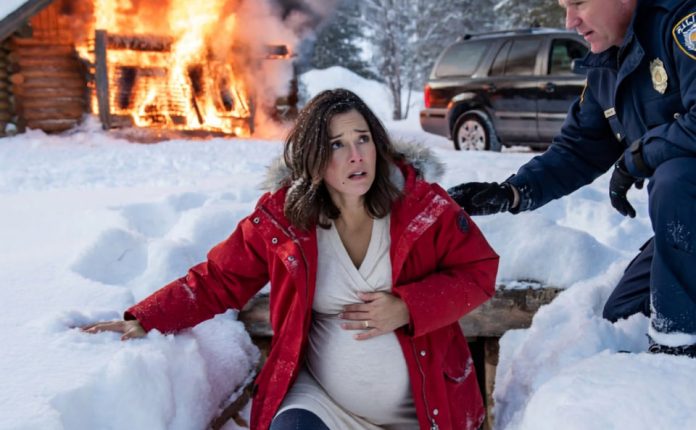
The first thing I heard in the helicopter was my son's heartbeat.
A medic held a monitor against my stomach while the aircraft climbed over the dark mountains.
The sound was rapid and regular.
I kept my eyes on the screen.
“Is he all right?”
“For now, his heart rate is reassuring,” she answered.
“For now?”
“We need to get you examined. Smoke exposure and contractions this early are serious.”
I turned toward the window.
Below us, Cedar Ridge disappeared into the darkness.
Somewhere in those trees stood a man who had just told me he might be my father.
Samuel sat opposite me, his hands folded between his knees.
He hadn't asked another question about Evelyn.
I hadn't either.
We were both watching the medic.
When the helicopter landed, hospital staff moved me directly into an examination room.
The next several hours became a procession of unfamiliar faces.
A respiratory therapist placed oxygen over my nose.
A doctor examined my burns.
An obstetrician monitored Noah's heart rate and checked for signs of premature labor.
My contractions gradually slowed.
The baby's heartbeat remained steady.
I cried when the doctor told me he was still safely inside me.
Then she explained that I needed careful observation.
Smoke inhalation could create complications even when the initial examination looked reassuring.
The burns on my arm needed treatment.
My breathing was still compromised.
“And you're under extreme stress,” she added.
I nearly laughed.
She sat beside the bed.
“Mara, is there anyone you feel safe contacting?”
I thought about Grant.
My husband.
The man who had deliberately trapped me inside a fire.
“No.”
Then I glanced toward Samuel standing near the door.
“Maybe him.”
The doctor followed my gaze.
Samuel stepped closer.
“You can trust me to stay,” he said.
I studied his face.
There was something familiar about his eyes.
Not their color.
The way they narrowed when he concentrated.
My mother used to look exactly like that when reviewing flight reports.
“Why?” I asked.
Samuel understood the question.
“Because I should have been looking for you a long time ago.”
I turned away.
I couldn't carry that conversation yet.
By morning, the contractions had stopped.
My doctors remained cautious but encouraged.
I was moved to a private room under restricted access.
A hospital administrator explained that my identity would be protected from general inquiries, while the necessary medical and legal reports would be made.
I insisted on speaking directly to law enforcement before my name appeared anywhere public.
A county investigator and a detective came to the hospital.
I told them what Grant had done.
Everything.
The locked bedroom door.
The barred balcony.
The conversation about the propane system.
Brooke's presence.
The thirty-million-dollar insurance policy.
And Grant's final glance through the window.
The detective, a woman named Lena Ortiz, listened without interrupting.
When I finished, she asked whether Grant knew about the concealed passage.
“No.”
“You're certain?”
“My mother showed it to me when I was nine. I never mentioned it to him.”
“Did anybody else know?”
“Possibly the original builder's family. Maybe old property records.”
Ortiz wrote something down.
“Did you see either your husband or Ms. Ellis start the fire?”
“No.”
“Did you hear them admit they started it?”
“Not directly. Grant said investigators would blame the propane system.”
She nodded.
“That's important. I need you to distinguish what you witnessed from what you believe happened.”
I appreciated that she didn't pretend the distinction was unnecessary.
She asked about the drink Grant had prepared.
I told her how unusually tired I'd become afterward.
The hospital arranged appropriate toxicology testing, although doctors warned that not every substance could be reliably identified after treatment and elapsed time.
Ortiz requested my clothing and preserved everything medical staff had collected.
Then she raised the question I'd been dreading.
“The remains found near the cabin have not been identified.”
“Was it a woman?”
“The preliminary assessment suggests an adult female. The medical examiner will confirm.”
“What about the baby?”
Ortiz's mouth tightened.
“Someone at the scene reported that the property belonged to a pregnant woman. That information was repeated as though there were two confirmed deaths.”
“There weren't.”
“No. At this point, there is one set of remains.”
I stared at her.
“Does Grant know?”
“He's been informed there was a fatality. He has not been informed that you're alive.”
“Please don't tell him yet.”
“We can coordinate your protection while we investigate. But I can't promise your survival will remain confidential indefinitely.”
“I understand.”
She looked toward the window.
“We've already arranged an officer near the hospital. Your husband won't be allowed access.”
For the first time since escaping, I felt something loosen in my chest.
Not safety.
Not yet.
But the possibility of it.
After Ortiz left, Samuel returned with coffee.
He had brought me warm water and a small packet of crackers.
“You need something in your stomach,” he said.
I accepted the crackers.
He sat in the chair across from my bed.
Neither of us spoke for a while.
Then I asked the question.
“Were you really involved with my mother?”
He nodded.
“We met when she was twenty-six. She was flying medical supply deliveries in Alaska. I was working rescue medicine.”
“How long?”
“Three years.”
I watched him turn his coffee cup between his hands.
“She was impossible to intimidate,” he said. “And impossible to convince she needed help.”
That sounded like Evelyn.
“She built her first air-ambulance service because a boy died waiting for ground transportation during a blizzard. She never forgot him.”
I knew that story.
My mother had told it whenever someone suggested cutting rural coverage because it wasn't profitable.
“Why did you leave?”
Samuel looked down.
“I took an overseas rescue assignment. Evelyn told me not to go. We argued.”
“Was she pregnant?”
“She hadn't told me yet.”
He rubbed the rim of the cup with one finger.
“When I learned, I returned as soon as I could.”
“And?”
“She told me the child had died.”
My stomach tightened.
“She said there had been complications. She wouldn't let me see any medical records.”
“Why did you believe her?”
“Because I loved her.”
I waited.
He exhaled slowly.
“And because I was young enough to mistake grief for proof.”
“Did you try contacting her again?”
“Yes.”
“Did you ever meet the man who raised me?”
“Once. Briefly.”
Richard Vale had married my mother when I was three.
He never made me feel like anything less than his daughter.
He taught me to ride a bicycle.
He attended every school concert.
He had died when I was twenty-two.
“Richard was a good father,” I said.
Samuel nodded.
“I hope he was.”
“He was.”
“Then I'm grateful.”
I didn't know what to say.
There was no space in my life for another father.
Not yet.
Samuel seemed to understand.
“You don't owe me anything, Mara.”
I looked toward the monitor beside my bed.
“And you don't owe me a performance.”
He gave a small, sad smile.
“Fair enough.”
That afternoon, I asked him to retrieve something from our company records.
He knew Northstar's original crews and had remained in contact with several former employees.
I needed somebody who understood the company but wasn't part of Grant's current management circle.
“Can you reach Priya Nair?”
Samuel frowned.
“Compliance analyst?”
“Yes.”
“I met her at an aviation safety conference.”
“She's been reviewing insurance renewals. I wanted to speak with her last week, but Grant kept postponing it.”
Samuel took out his phone.
Within an hour, Priya called.
I could hear traffic behind her.
“Mara?”
Her voice broke.
“Oh my God.”
“I'm alive.”
For several seconds, she said nothing.
Then I heard her crying.
“I saw the news.”
“I know.”
“They said—”
“I know.”
She drew a shaky breath.
“Where are you?”
“Somewhere safe. Don't ask.”
“All right.”
“Priya, what were you trying to tell me about the insurance?”
Her professional composure returned.
“Six weeks ago, Northstar increased the key-person life insurance coverage on you.”
“How much?”
“From eight million to thirty million.”
I sat upright.
“Who authorized it?”
“The approval file lists you, Grant, and the insurance committee.”
“I never approved that.”
“I was afraid you'd say that.”
The policy was payable to Northstar, not directly to Grant. That distinction mattered.
The money was intended to help the company survive the loss of a critical executive.
But Grant controlled the finance department.
If he also gained voting authority over my shares, he could influence how those proceeds were used.
Priya continued.
“There are also governance documents attached to the emergency succession file.”
“What kind?”
“A shareholder voting proxy. Supposedly signed by you.”
“I haven't signed any proxy.”
“That's what I thought.”
She explained that Grant had circulated paperwork proposing temporary voting authority over my majority stake if I died or became incapacitated.
There were unsigned versions, a scanned page displaying my supposed signature, and an internal note referring to a new will.
The legal validity of those documents was questionable.
But if nobody challenged them immediately, the paperwork could still create chaos.
Grant could use the confusion to pressure directors into accepting his authority.
“Can you preserve everything?” I asked.
“I copied the original audit trail before my access was suspended.”
“When?”
“Yesterday.”
“Why was it suspended?”
“Grant said the investigation was now a board matter.”
A cold sensation spread through me.
“Does he know what you found?”
“Not everything.”
“Good.”
She hesitated.
“Mara, there's another problem.”
I waited.
“The board received an invitation this morning. Friday's memorial is being held at the Northstar Aviation Center.”
“Why there?”
“Grant says he wants to honor you where your mother started the company.”
I closed my eyes.
Priya continued.
“Immediately after the memorial, he's requesting an emergency board session.”
“About what?”
“Interim leadership, insurance proceeds, and voting control.”
I stared at the ceiling.
My husband was arranging my funeral and his corporate takeover on the same afternoon.
“Priya, who else has the documents?”
“Only me.”
“Keep them somewhere secure and give copies to Detective Ortiz through an attorney.”
“I will.”
“And don't confront Grant.”
“I wasn't planning to.”
She paused.
“There's something I didn't tell you.”
My hand tightened around the phone.
“Go on.”
“June Alvarez came to my office last Tuesday.”
June managed payroll administration and vendor reconciliations.
She was fifty-two, careful with numbers, and famous for bringing homemade cinnamon rolls to early meetings.
“What did she want?”
“She'd found unusual reimbursements connected to Cedar Ridge.”
“What reimbursements?”
“Maintenance invoices. Security hardware. An emergency generator inspection.”
I remembered Grant claiming the cabin's propane system was unreliable.
“Who approved them?”
“Grant.”
Priya inhaled.
“June said someone had been charging private-property expenses to Northstar's facilities budget.”
“Did she file a report?”
“She was going to.”
“Where is she now?”
Silence.
“Mara, nobody has been able to reach her since Friday.”
I looked toward Samuel.
He had heard everything.
I asked Priya another question.
“Was June supposed to be at work this weekend?”
“No. She said she had to meet someone about the missing invoices.”
“Where?”
“Cedar Ridge.”
I felt the blood drain from my face.
Priya's voice became distant.
“She said Grant had offered to explain the expenses in person.”
I closed my eyes.
The unidentified body.
The shed adjoining the cabin.
The missing payroll administrator.
“Priya, tell Detective Ortiz everything.”
“I will.”
After the call ended, Samuel remained motionless.
I looked at him.
“June was there.”
“We don't know that yet.”
“But you think it.”
He didn't answer.
I pressed my palms against the blanket.
My husband hadn't merely risked killing me and our son.
He might have killed another woman because she'd discovered what he was doing.
That evening, Detective Ortiz returned.
I told her about June.
She already knew the name.
Her team had discovered that June's car had been recorded entering the mountain access road before midnight.
It hadn't been found at the cabin.
“We're trying to locate it,” Ortiz said.
“Do you think the remains are hers?”
“We're pursuing that possibility.”
I described the reimbursements.
Ortiz took notes.
Then she told me the fire investigators had found indications inconsistent with an accidental propane malfunction.
They were examining more than one area of origin.
“We're not ready to announce conclusions,” she said.
“But you don't believe Grant.”
“I believe we have enough reason to investigate him.”
That night, sleep came in fragments.
I dreamed of June standing in the snow, asking why I'd invited her to the cabin.
I woke reaching for her.
The room was dark.
A nurse entered to check Noah's heartbeat.
While she worked, I watched the steady green line on the monitor.
My son was alive.
A woman might have died because she knew too much.
And Grant was preparing to stand before two hundred people and pretend that grief had made him helpless.
The next morning, I asked Samuel for my laptop.
“What are you going to do?”
“Watch what Grant does next.”
He hesitated.
“The doctors want you resting.”
“I can rest after I know whether he's going to steal the company.”
Samuel placed the laptop beside me.
Then he pulled up a chair.
“All right,” he said. “But you're not doing it alone.”
END PART 2