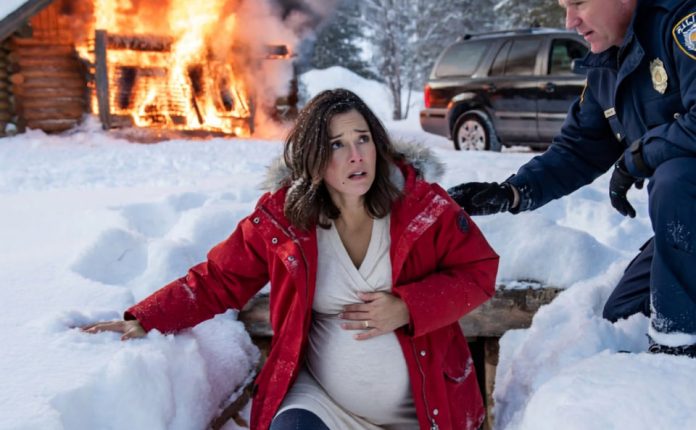
Six weeks after the fire, I walked into Northstar's aviation center holding my newborn son.
Nobody applauded.
That was exactly what I wanted.
The hangar smelled of jet fuel and cold metal.
Mechanics worked beneath an open engine panel.
A pilot hurried past carrying weather reports.
Life had continued.
I stood near the entrance and listened.
Then a familiar voice called my name.
“Mara?”
Thomas Bell was walking toward me.
He stopped when he saw Noah.
For several seconds, he couldn't speak.
Then he removed his cap.
“Well,” he said quietly. “Look at you.”
I smiled.
“This is Noah.”
Thomas leaned closer.
“Hello, little fellow.”
Noah slept through the introduction.
Thomas looked at me.
His eyes were wet.
“We thought we'd lost you.”
“I know.”
He swallowed.
“I stood at your memorial.”
“I watched it.”
Thomas lowered his head.
“I should have known something was wrong.”
“You couldn't have known.”
He looked up.
“Grant was convincing.”
I nodded.
“He was.”
We stood together in silence.
Then Thomas touched Noah's blanket.
“Your mother would have loved him.”
I looked toward the aircraft.
“Yes,” I whispered.
“She would.”
Noah had been born twelve days after Grant's arrest.
He arrived earlier than expected, but not dangerously early.
My doctors had monitored us carefully.
When labor began, I was frightened.
Not of the pain.
Of losing control again.
I kept remembering the contractions in the snow.
The smoke.
The tunnel.
But the delivery room was warm and brightly lit.
People explained what they were doing.
Nobody restrained me.
Nobody ignored my questions.
When Noah cried for the first time, I cried harder.
Samuel stood outside until the nurses said he could enter.
He looked through the glass at my son.
Then he covered his mouth.
“Are you all right?” I asked.
He nodded.
“It's just that I never thought I'd see this.”
I understood what he meant.
Thirty-five years earlier, somebody had told him his child was dead.
Now he was holding that child's baby.
He asked permission before touching Noah.
I placed my son in his arms.
Samuel held him awkwardly at first.
Then his shoulders relaxed.
“Hello, Noah.”
He studied the tiny face.
“You've had quite a beginning.”
Noah yawned.
Samuel laughed softly.
It was the first uncomplicated sound I'd heard from him.
The legal investigation continued after the birth.
Grant remained in custody pending proceedings.
Prosecutors charged him with attempted murder, arson, offenses connected to June Alvarez's death, and financial crimes arising from the forged documents and company records.
The final charges and their legal outcomes would depend on the evidence presented in court.
Brooke eventually entered a cooperation agreement.
Her statements helped investigators reconstruct the events before the fire.
She admitted she knew Grant intended to make the cabin fire appear accidental.
She said he'd assured her I would be unconscious.
She admitted helping him prepare records intended to give him influence over Northstar after my supposed death.
What she'd known about June's presence became an important part of the investigation.
According to the evidence investigators developed, June had arrived at Cedar Ridge expecting to review suspicious invoices.
Grant had directed her to the adjoining outbuilding, where he claimed additional records were stored.
She was still there when the fire began.
The forensic findings showed that the fire had multiple origins.
Investigators recovered damaged locking hardware consistent with the devices Priya had traced through Northstar's expense records.
Electronic records, witness accounts, and Brooke's testimony helped establish the sequence of events.
June's car had been moved away from the property.
Her jewelry had been removed.
My mother's missing bracelet had been placed near her body.
Grant apparently believed those fragments, along with the destroyed cabin and the absence of any known survivor, would encourage investigators to identify the remains as mine.
But the plan failed because it depended on people accepting a conclusion before completing the evidence.
June's remains were identified through forensic testing.
Her daughter received the truth no mother should have to leave behind.
Grant could no longer persuade investigators that my absence proved my death.
The funeral program became one more record of his actions.
When I learned the details, I asked Helen whether Elena wanted to speak with me.
Helen said she would find out.
Three days later, Elena came to the hospital.
She carried a paper bag.
Inside were cinnamon rolls.
“My mother used to make these for your staff,” she said.
I stared at the bag.
“Yes.”
“I thought you might remember.”
“I do.”
We sat together near the window.
Elena was wearing a plain black sweater.
She had her mother's hands.
I wanted to apologize for everything.
For employing Grant.
For trusting him.
For not noticing the missing money sooner.
But Elena spoke first.
“Please don't tell me you're sorry because she worked for your company.”
I looked at her.
“She came to that cabin because she thought she was doing the right thing,” Elena said. “She believed somebody was stealing money.”
“She was right.”
“I know.”
Her eyes filled.
“She always said numbers tell the truth eventually.”
I began crying.
Elena reached across the table.
“My mother wasn't killed because she made a mistake,” she said. “She was killed because she wouldn't ignore one.”
I couldn't answer.
We sat quietly until the tea went cold.
Later, Northstar established a memorial fund in June's name to support employees seeking professional accounting and compliance training.
I insisted that Elena be consulted before anything was announced.
She approved the idea but declined a public ceremony.
“She hated speeches,” Elena said.
That made me smile.
June had always complained when meetings ran long.
The company itself survived the crisis.
Arthur Wynn served as interim chair while the board conducted an independent review.
Helen coordinated the legal work surrounding my ownership and the forged documents.
Priya's preserved records became essential to separating legitimate corporate transactions from the questionable payments.
The thirty-million-dollar insurance policy was never paid.
There had been no covered death of the insured executive.
The disputed proxy and estate documents were rejected as unauthorized.
My mother's original trust remained controlling.
Grant lost his position and access to Northstar's accounts.
The company cooperated with investigators and repaired the weaknesses that had allowed him to conceal expenses.
But I discovered that protecting a company wasn't the same as running it well.
For months, I'd treated my mother's legacy as something that could break if I stepped away.
The fire changed that.
I appointed an experienced operations executive to handle daily management while I recovered.
Priya received additional authority and an independent reporting channel to the board.
I stopped allowing financial decisions to concentrate in one person's hands.
Nobody would ever again be able to tell an employee that questioning an invoice was disloyal.
The hardest work happened away from Northstar.
I had to return to my mother's past.
Samuel and I opened the blue storage box together in Evelyn's old office.
It contained flight logs, photographs, letters, and a small leather notebook.
Some of the papers were forty years old.
Others had been written shortly before she died.
Near the bottom, we found an envelope addressed to me.
My mother's handwriting covered the front.
Mara, when you're ready.
I sat on the carpet with the envelope in my lap.
Samuel settled into a chair nearby.
“You don't have to open it today,” he said.
“I know.”
But I did.
Inside were six pages.
My mother wrote about the years before my birth.
About loving Samuel.
About being young and afraid.
About Charles Hartwell's control over her finances and his determination to keep Samuel away.
She described the threats he made when he learned she was pregnant.
Charles had told her he would destroy Samuel's career and use his influence to fight for control of the child if she refused to end the relationship.
Mother believed him.
She had seen him ruin people for smaller acts of defiance.
When Samuel left for his overseas assignment, Charles intercepted messages between them.
Mother thought Samuel had chosen his career over her.
Samuel thought she had stopped answering because she wanted him gone.
Neither knew the full truth.
When he returned, Mother told him the baby hadn't survived.
She admitted that in the letter.
She didn't excuse it.
She wrote that fear had made her cruel.
Then she wrote something I read three times.
I thought I was protecting you from a man who could take everything. Instead, I let that fear take away someone who might have loved you.
I lowered the pages.
Samuel was watching me.
“Do you want me to leave?” he asked.
“No.”
I handed him the letter.
He read slowly.
When he reached the part about the supposed death, he closed his eyes.
His shoulders began shaking.
I moved beside him.
Neither of us spoke.
We were grieving different losses.
He had lost thirty-five years with his daughter.
I had lost the chance to know him while my mother was alive.
And Evelyn had carried a decision she couldn't undo.
I wanted to be angry at her.
For a while, I was.
But I also remembered every good thing she'd done.
The nights she stayed beside my bed when I was sick.
The flights she canceled to attend school performances.
The way she'd taught me to question authority, even while hiding a terrible truth about her own life.
People could be loving and flawed.
My mother had been both.
Samuel eventually handed the letter back.
“She was afraid,” he said.
“Yes.”
“I wish she'd trusted me.”
“I wish she'd trusted us both.”
We sat with that for a long time.
Later, Samuel asked whether I'd consider a DNA test.
Not because he doubted Evelyn's account.
He wanted us both to have certainty.
I agreed.
The results confirmed that he was my biological father.
The report couldn't give us the missing years.
But it removed the last question about who we were to each other.
I still called him Samuel.
He never complained.
Sometimes he came over for dinner.
Sometimes he walked Noah around the garden while I worked.
He learned that I disliked coffee, preferred old jazz records, and became impatient when people arrived late.
I learned that he couldn't cook rice without burning it.
That he kept a notebook of every rescue mission he'd flown.
And that he still carried a small photograph of Evelyn in his wallet.
One evening, he found me watching him rock Noah to sleep.
“What?” he asked.
“Nothing.”
He smiled.
“That's the least convincing answer I've heard all week.”
I hesitated.
Then I said, “You can come tomorrow too, Dad.”
He stopped moving.
Noah made a small sound against his shoulder.
Samuel looked at me.
“Are you sure?”
I nodded.
His eyes filled.
“All right,” he whispered.
He looked down at Noah.
“I'll come tomorrow.”
We didn't discuss the moment again.
We didn't need to.
Grant's criminal proceedings moved slowly.
I eventually gave my formal testimony.
I described the bedroom door.
The barred balcony.
The conversation outside.
The flames.
I told the court about June.
I described the tunnel my mother had shown me.
When Grant's attorney questioned my memory, I answered as precisely as I could.
There were things I knew.
Things I had seen.
Things I had heard.
And things investigators had established afterward.
I refused to confuse them.
I also refused to look toward Grant whenever he shifted in his chair.
During one hearing, he tried to catch my attention.
“Mara,” he said as officers led him away.
I kept walking.
He called again.
“Mara, please.”
I stopped.
For a moment, I remembered the man who had once brought me tea at two in the morning.
The man who had held my hand during ultrasound appointments.
The man who'd helped choose Noah's name.
Then I remembered him looking up at the burning window.
He'd heard me scream.
He'd seen me inside.
And he'd driven away.
I turned toward him.
“You had every chance to come back.”
He opened his mouth.
I didn't wait for an answer.
The proceedings continued without any further conversation between us.
By the time Noah was three months old, I had begun thinking about Cedar Ridge again.
The cabin had been destroyed.
Investigators released the property after completing their work.
The land remained in my name.
For several weeks, I considered selling it.
Every time I saw photographs of the ruins, my stomach tightened.
Then Samuel asked me a question.
“What did you love about that place before Grant?”
I looked at him.
“My mother.”
“What else?”
“The trees. The quiet. The sound of the creek in spring.”
He nodded.
“Those things are still there.”
I thought about that.
A fire had destroyed the building.
It hadn't destroyed the mountain.
I decided not to rebuild immediately.
Instead, we cleared the dangerous debris and stabilized the land.
We planted young spruce trees along the damaged slope.
I kept the old stone steps.
And I saved one small piece of charred cedar from the pantry wall.
Not as a trophy.
As a reminder of the passage my mother had shown me.
The first time I returned, Samuel came with me.
Noah slept in a carrier against my chest.
Snow remained beneath the trees.
The air smelled clean.
We walked toward the foundation.
I stopped where the kitchen had stood.
There was no roof.
No doorway.
No furniture.
Just stone, ash, and the beginnings of new growth beneath the snow.
Samuel waited quietly.
I touched Noah's back.
For months, I'd thought returning would feel like surrendering to the past.
Instead, I felt the difference between remembering something and remaining trapped inside it.
The fire belonged to Grant.
The cabin had belonged to my mother.
The land still belonged to me.
I turned toward Samuel.
“Will you help me plant something here in spring?”
“What would you like?”
“A tree.”
He smiled.
“What kind?”
“An apple tree.”
“Your mother hated apples.”
I laughed.
“She hated peeling them.”
“She said it was unnecessary work.”
I looked at the place where the pantry had once stood.
“She was right about some things.”
Samuel nodded.
“And wrong about others.”
“Yes.”
We stood in silence for a moment.
Then Noah stirred.
I unfastened the carrier and lifted him into my arms.
His eyes opened.
He looked around with the serious expression newborn babies sometimes wear, as though the world is an enormous problem they haven't decided how to solve.
“Hello, sweetheart,” I whispered.
He moved his tiny hand against my coat.
I kissed his forehead.
Five days after my husband tried to kill us, I had watched my own memorial.
I had seen an empty casket.
Heard my husband describe a future in which I no longer existed.
Watched him claim ownership over the company my mother had built.
For a long time afterward, I thought the most important thing about that day was that I'd survived.
But standing on the mountain with Noah in my arms, I understood something more specific.
Surviving had allowed me to make choices Grant believed he had taken away.
I could raise my son.
I could protect the company.
I could grieve June honestly.
I could learn who my father was.
I could remember my mother without pretending she'd been perfect.
And I could decide what happened to this land.
Noah began fussing.
Samuel reached for the diaper bag.
“He's hungry.”
“I know.”
“Should we go?”
I looked toward the pines.
The wind moved softly through their branches.
There were no flames now.
No locked doors.
No headlights disappearing down the road.
Only my son, the cold mountain air, and the man who had found us in the snow.
“Yes,” I said.
“Let's go home.”
Samuel walked beside me down the old stone steps.
And this time, when I looked back at Cedar Ridge, I didn't see the place where my husband had tried to end my life.
I saw the place where my mother had once shown a little girl how to find her way out.
THE END
END PART 5
Disclaimer: This fictional story was created with AI assistance for entertainment. Names, characters, dialogue, and events are fictional. Any resemblance to actual people or events is coincidental.