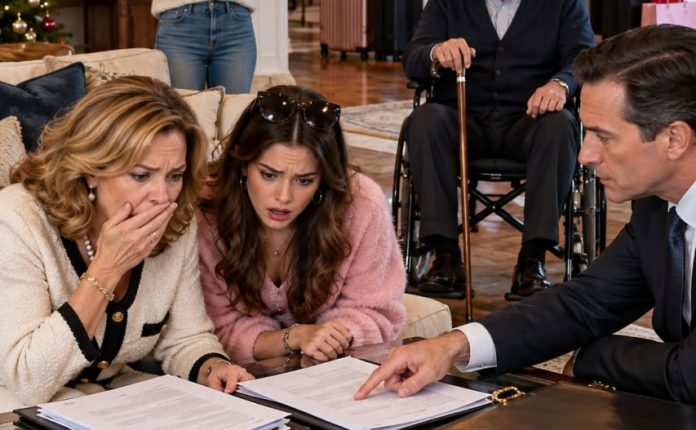
My mother arrived at our Raleigh home carrying three suitcases and an attitude that suggested she had never spent fourteen years refusing to acknowledge my existence.
“We'll need the room with the largest bathroom,” she said.
It was a Tuesday morning in early October.
I had been reviewing shipping schedules at the kitchen island when the doorbell rang.
Through the security camera, I recognized her immediately.
Patricia Hayes.
Sixty-nine years old.
Perfectly arranged blond hair.
Pearl earrings.
A cream-colored traveling coat I suspected cost more than my first month's salary after leaving the Army.
Beside her stood my father, Arthur.
He looked smaller than I remembered.
His shoulders slumped beneath a gray jacket, and he held a thick brown envelope against his chest.
Three suitcases occupied the porch between them.
For several seconds, I simply watched the camera.
Then I opened the door.
“Gabriella!”
My mother smiled brightly.
She leaned forward, expecting an embrace.
I didn't move.
Her expression faltered.
“Well. That's quite a welcome.”
I looked at my father.
“Is something wrong?”
“Your mother thought we should—”
“Arthur, please.”
She turned back toward me.
“We've had an exhausting morning, sweetheart. May we come in?”
Sweetheart.
I couldn't remember the last time she had called me that.
Not during our argument before my wedding.
Not in any of the messages I'd left afterward.
Not once during the fourteen years that followed.
She looked over my shoulder.
“Oh, Gabriella. This house is beautiful.”
Her gaze traveled across the foyer.
The pale oak floors.
The wide staircase.
The tall windows overlooking the backyard.
Then she noticed the brass company plaque mounted on the wall near my home office.
BENNETT LOGISTICS ADVISORY.
She smiled again.
“Five bedrooms, isn't it?”
“How do you know?”
“I've seen the photographs.”
“What photographs?”
“The real estate website. Your home is quite impressive.”
My stomach tightened.
Our property wasn't listed for sale.
She must have found the older photographs from when we purchased it.
She stepped forward.
“Which bedroom are you giving us?”
I held my position.
“I'm not giving you a bedroom.”
For the first time, her smile disappeared completely.
“Don't be ridiculous. You have plenty.”
“Mom, why are you here?”
She glanced at the luggage.
“Isn't that obvious?”
Before I could answer, I heard Daniel's cane striking the floor behind me.
A familiar rhythm.
Two steady footsteps.
A light tap.
Another step.
Then the tap again.
He had developed that rhythm after years of rehabilitation.
I could identify it anywhere.
“Gabby?”
He appeared beside me.
My husband was forty-five, tall, broad-shouldered, with dark hair beginning to gray near his temples.
He wore navy trousers and a faded Army T-shirt.
His left hand rested on the handle of his cane.
He took one look at our visitors.
Then he looked at me.
“Everything okay?”
My mother examined him without disguising her disappointment.
“Oh. You're still having trouble walking.”
Daniel's jaw tightened.
“Good morning, Patricia.”
She didn't return the greeting.
“I thought perhaps things had improved.”
“They have,” he answered.
“Yet you still need that?”
“On some days.”
“How unfortunate.”
I heard the familiar carefulness in Daniel's breathing.
It was the sound he made when deciding whether an argument deserved his energy.
For years, people had looked at him and seen only an injured leg.
They never saw the man who could untangle a transportation crisis in minutes.
Or the former Army staff sergeant who had helped coordinate relief supplies through a flooded coastal county.
Or the husband who stayed beside me through every exhausting setback we encountered.
My mother was particularly determined not to see those things.
“Daniel has nothing to prove to you,” I said.
She lifted one hand.
“Must everything become a confrontation?”
“You showed up without calling.”
“We're your parents.”
“You stopped acting like that fourteen years ago.”
My father flinched.
My mother rolled her eyes.
“Surely you don't intend to punish us forever over one disagreement.”
One disagreement.
I felt the words settle between us.
Then I remembered the evening that had started everything.
I was twenty-eight when I introduced Daniel to my parents.
At the time, I was an Army captain preparing to transition into civilian life.
Daniel was already out of active service.
His military career had ended after a severe injury during a hurricane-relief operation.
He had been helping move emergency supplies when a damaged loading platform collapsed.
His left leg sustained extensive injuries.
Multiple operations followed.
He regained his ability to walk, but nerve damage left him with chronic pain and limited stability.
Some mornings were better than others.
Some nights he slept with a heating pad under his knee.
None of that explained his character.
We met at a professional training program focused on military logistics and civilian supply chains.
He was studying operations management.
I had volunteered to speak about transportation coordination during disaster response.
After my presentation, he approached with a question about inventory tracking.
His question was better than anything I'd heard that afternoon.
We spent forty minutes arguing cheerfully about warehouse redundancy.
He invited me to coffee.
I told him I preferred tea.
He found a place that served both.
Three months later, he knew how I liked my eggs, which songs I sang badly while driving, and why I hated being interrupted when I was reading.
Six months after we met, he proposed.
He did it in his small apartment.
No expensive restaurant.
No dramatic audience.
Just dinner, a modest diamond ring, and a nervous man who had rehearsed his words so carefully that he forgot them.
“I can't guarantee life will be easy,” he said.
I laughed softly.
“Neither can I.”
He took my hand.
“But you won't have to carry the difficult things alone.”
That was enough.
I said yes.
My father initially seemed pleased.
He asked about Daniel's military service.
He complimented his plans for civilian work.
My mother remained quiet until our engagement dinner.
We were sitting in my parents' dining room in Charlotte.
The table was covered with embroidered linen.
Crystal glasses stood beside silver candlesticks.
My mother had invited no one else.
Later, I understood why.
She wanted an argument without witnesses.
She started pleasantly enough.
“So, Daniel, what exactly do you expect to do after finishing your studies?”
“Operations consulting,” he said.
“That's rather broad.”
“It is. I'm especially interested in emergency supply systems.”
“And how much does that pay?”
“Depends on the position.”
She tilted her head.
“Does Gabriella know that?”
“Mom.”
“What? It's a reasonable question.”
Daniel answered patiently.
He explained the certifications he was completing.
He described possible employment opportunities.
He mentioned savings from his military service.
My mother listened with the expression she used when a waiter explained an unfamiliar menu item.
Then she asked about his disability benefits.
“How much are you receiving?”
Daniel paused.
“That's personal financial information.”
“Well, you're marrying my daughter.”
“And we're comfortable discussing our finances with each other.”
She put down her wineglass.
“Gabriella has a future ahead of her. A very promising future.”
“I agree,” Daniel said.
“She shouldn't have to spend that future supporting a man who can barely walk.”
The room went silent.
I remember the hum of the refrigerator.
I remember Daniel's hand resting beside his plate.
I remember the way my father studied the tablecloth.
“Take that back,” I said.
My mother seemed genuinely surprised.
“I'm being practical.”
“You're being cruel.”
“Someone has to consider the consequences.”
Daniel pushed his chair back slightly.
“Patricia, I don't expect Gabriella to become my caretaker.”
“Of course you don't expect it now. But these things happen.”
“That's enough,” I said.
She leaned toward me.
“Darling, you could marry someone successful. Someone who could give you the kind of life you've always deserved.”
I looked at Daniel.
He had stopped eating.
His face was composed, but his ears had turned red.
My mother continued.
“You'll be taking on a burden before you've even begun your marriage.”
I stood.
“Apologize to him.”
“No.”
“Mom.”
“I won't apologize for loving my daughter.”
I turned toward my father.
“Dad?”
He folded his napkin.
“Let's not make things worse.”
“She's insulting the man I'm going to marry.”
He looked away.
My mother delivered her ultimatum without raising her voice.
“If you go through with this wedding, we will not attend.”
For a moment, I thought she expected me to negotiate.
Perhaps she thought I would cry.
Or apologize.
Or ask Daniel to leave while we discussed my future without him.
Instead, I reached for his hand.
“Then we'll get married without you.”
My father said nothing.
My mother looked wounded.
“You're choosing him over your family?”
“I'm choosing the family I'm building.”
We left before dessert.
In the car, Daniel stared through the windshield.
After several miles, he spoke.
“You don't have to lose your parents because of me.”
I pulled into an empty parking lot.
Then I turned toward him.
“I'm not losing them because of you.”
He said nothing.
“They're making a decision. I'm making mine.”
He held my hand for a long time.
Four months later, we married in a small garden outside Raleigh.
Twenty-eight people attended.
Some were military friends.
Some were former colleagues.
Daniel's sister stood beside me while I adjusted my veil.
His mother cried through the ceremony.
Two front-row chairs remained empty.
I had reserved them until the last possible moment.
My parents never came.
Afterward, I sent photographs.
No response.
At Christmas, I mailed a card.
It came back unopened.
I called my father on his birthday.
He didn't answer.
Eventually, the calls stopped.
Not because I stopped caring.
Because caring without any response had become exhausting.
Daniel and I began our marriage in a two-bedroom rental.
The kitchen cabinets didn't close properly.
Rainwater collected near the back door.
Our dining table came from a secondhand store.
I found a position with a regional distribution company.
Daniel completed his studies.
He initially struggled to find work.
Several employers praised his military experience but seemed unsettled when he arrived using his cane.
One interviewer asked whether he would be able to visit warehouses.
Daniel answered that he could.
The interviewer then asked whether he could climb ladders.
Daniel pointed out that the position didn't require climbing ladders.
He never heard back.
Eventually, he secured a consulting assignment with a small medical distributor.
He discovered that the company was losing thousands of dollars through inefficient delivery routes.
Within two months, he had redesigned their distribution schedule.
The owner asked whether he could help with inventory systems.
Daniel came home excited.
“Gabby, there's a real business here.”
I was standing at the stove.
“Doing what?”
“Helping companies solve problems they can't afford to keep ignoring.”
I turned down the burner.
He spread several handwritten diagrams across the kitchen table.
“Look at this.”
He showed me how a shipment could be delayed by poor coordination between suppliers, warehouses, and carriers.
I recognized the same failures from military logistics.
Within minutes, we were discussing possible solutions.
By midnight, we had filled three notebooks.
Six months later, we registered Bennett Logistics Advisory.
Our first office was a borrowed desk in the corner of another company's workspace.
We owned two aging laptops and a printer that frequently jammed.
I handled client negotiations and contract development.
Daniel specialized in operational analysis and transportation planning.
We worked weekends.
We missed holidays.
We argued over invoices.
Once, after a client failed to pay, we had less than four hundred dollars left in our business account.
I remember sitting on the kitchen floor with our bills arranged around me.
Daniel lowered himself beside me.
“I'm sorry,” he said.
“For what?”
“This was my idea.”
“Our idea.”
“You gave up a stable job.”
“Yes.”
“For this.”
“For us.”
He looked at the bills.
Then he smiled faintly.
“Well, we're certainly learning about cash flow.”
I laughed despite myself.
We survived that month.
Then another.
Then another.
An emergency medical supplier hired us to repair its distribution process.
Our recommendations reduced delays.
The company renewed its contract.
A manufacturer called.
Then a regional hospital network.
Slowly, the work expanded.
Daniel's experience became our greatest professional strength.
He understood that supplies arriving late could be more than an inconvenience.
During disaster relief, it could mean the difference between a functioning emergency clinic and one forced to close.
He designed systems around that urgency.
His cane never prevented him from recognizing a problem faster than anyone else in the room.
Eventually, we hired employees.
We moved into a proper office.
We developed proprietary scheduling software and expanded into broader logistics consulting.
After eleven years, we signed our first national contract.
After thirteen, a business publication featured our company.
The article discussed our growth and reported an estimated company valuation in the millions.
Daniel showed it to me one morning.
“Look at that,” he said.
I read the figure twice.
Then I looked at him.
“Does it feel real?”
“Not particularly.”
He smiled.
“Maybe after payroll.”
That was Daniel.
Even when we became successful, he remembered the month we couldn't afford a replacement printer.
We eventually bought the Raleigh house.
It had five bedrooms, but we didn't purchase it to impress anyone.
We wanted space for visiting friends, a proper home office, and room for Daniel's mother when she stayed with us.
The ground floor was designed with accessibility in mind.
We installed a discreet stair lift so Daniel could use the entire house comfortably, especially on painful days.
We also built a backyard patio where he liked to sit with coffee before work.
It was our home.
Not a reward owed to anyone who shared my last name.
Now, fourteen years after our wedding, my parents stood at its entrance.
My mother had just informed me that our five bedrooms were more than enough to accommodate them.
I looked at the suitcases.
“Where are you staying tonight?”
She waved a hand.
“We'll sort that out once we're settled.”
“Settled where?”
“Gabriella, really.”
My father shifted his weight.
“Patricia.”
She ignored him.
“We're your parents. It's only reasonable that we benefit from what you've accomplished.”
I looked directly at her.
“You weren't interested in sharing our struggles.”
“That was years ago.”
“Fourteen years.”
She sighed.
“Must you keep counting?”
“Yes.”
I hadn't intended to say it so firmly.
But I realized I did count.
Not every day anymore.
Not every holiday.
Yet I knew exactly how many birthdays had passed without a call.
How many Christmas mornings had come and gone.
How many anniversaries I had spent remembering those two empty chairs.
Daniel stepped beside me.
“Patricia, Arthur, why don't you tell us what's happening?”
My mother smiled at him thinly.
“This is a family matter.”
“Daniel is my family,” I said.
My father suddenly spoke.
“We don't have an apartment anymore.”
I turned toward him.
“What?”
He rubbed his forehead.
“We surrendered the keys yesterday.”
My mother closed her eyes.
“Arthur, honestly.”
“Why?” I asked.
He lifted the envelope.
“There are debts.”
“What kind of debts?”
My mother moved between us.
“Temporary complications.”
Dad shook his head.
“Patricia, they aren't temporary.”
“Be quiet.”
“No.”
The word surprised all of us.
My father had spent most of his marriage letting my mother lead difficult conversations.
Even as a child, I knew the pattern.
She decided.
He explained.
She became angry.
He apologized.
Now he stood on my porch looking as though he had finally reached the end of his ability to cooperate.
“Gabriella,” he said, “your mother has been telling people that our families are in business together.”
I looked at Daniel.
He was watching my father carefully.
“What people?” I asked.
“Investors.”
The word landed heavily.
My mother interrupted.
“They're friends. People we've known for years.”
Dad shook his head.
“They gave us money, Patricia.”
“An arrangement that will be resolved.”
“Using Gabriella's company name.”
Daniel's posture changed.
He moved closer.
“Arthur, are you saying someone invested money believing it was connected to Bennett Logistics Advisory?”
My father nodded.
My mother reached for the largest suitcase.
“This is precisely why we need to discuss things privately.”
I blocked her way.
“You're not bringing that inside.”
Her expression hardened.
“You've become very cold.”
“Show me the envelope.”
My father started to extend it.
Mother caught his wrist.
“Arthur, think carefully.”
He pulled away.
“That's what I should have done months ago.”
He opened the envelope.
The first document carried our company logo.
A blue compass.
Our full business name.
But the address printed beneath it belonged to my parents' former condominium.
I recognized the design immediately.
Someone had copied it from our public website.
The document described a private investment opportunity linked to our company's proposed expansion.
I read the first paragraph.
Then the second.
My stomach tightened.
The proposal claimed that investors could participate through a separate family investment vehicle associated with Bennett Logistics Advisory.
It implied that my parents had privileged access to our business.
It mentioned projected returns.
It described expansion opportunities.
None of it had been authorized.
“We didn't issue this,” Daniel said.
“I know.”
I turned to my mother.
“Who wrote it?”
She looked toward the driveway.
“It's merely an informational document.”
“Who wrote it?”
“I had some assistance.”
“From whom?”
“That isn't important.”
“It is to me.”
My father cleared his throat.
“A marketing consultant prepared the layout. Patricia supplied the information.”
Mom spun toward him.
“Arthur!”
He continued.
“She sent it to several people from the club.”
I looked down at the paper.
A name appeared beside a payment reference.
Margaret Bell.
I remembered her.
A retired teacher married to a former insurance executive.
She had attended my mother's charity luncheons for years.
“How much did Margaret invest?”
My mother pressed her lips together.
Dad answered.
“Eighty thousand.”
For a moment, I couldn't speak.
Then Daniel asked the question I should have asked first.
“How many other investors?”
Dad lifted the envelope again.
“I have a list.”
My mother reached for it.
He stepped away.
I watched her expression change.
Anger.
Fear.
Calculation.
Then she turned toward me.
“Gabriella, you have to understand. We were trying to recover from a difficult financial period.”
“By telling people they were investing in my company?”
“It wasn't supposed to become complicated.”
“Did you use our name to collect their money?”
She said nothing.
Dad removed another sheet.
It was a cream invitation.
The kind my mother used for elaborate dinners and charity receptions.
Across the top, elegant lettering announced a private gathering for prospective investment partners.
Friday evening.
Seven o'clock.
The address underneath was our house.
I read it twice.
“Mom.”
She looked away.
“Did you invite investors here?”
“I was going to explain.”
“When?”
“Once we were settled.”
“Settled in my house?”
Her silence answered me.
I showed Daniel.
His face became very still.
“They were supposed to meet us?”
My father nodded reluctantly.
“That's what the invitation says.”
Daniel looked at Patricia.
“Did you tell these people Gabriella and I knew about the meeting?”
My mother lifted her chin.
“I said we'd be together as a family.”
“You used our home as proof of a business relationship that doesn't exist,” I said.
“I needed to reassure them.”
“About what?”
She didn't answer.
I looked at the three suitcases again.
Suddenly, they meant something different.
My parents hadn't simply arrived expecting charity.
They had come to occupy our home.
To make their story believable.
To stand beside us when prospective investors arrived.
To turn our reconciliation into evidence that a fraudulent arrangement was legitimate.
I looked at my father.
“Is that everything?”
He hesitated.
My mother spoke immediately.
“Yes.”
Dad shook his head.
“No.”
He reached into the envelope again.
This time, he withdrew a folded bank statement and several handwritten pages.
His fingers were trembling.
“Gabriella, there are more people involved than Margaret.”
Daniel leaned closer.
“How many?”
Dad swallowed.
“Eleven that I know of.”
My mother grabbed his sleeve.
“Arthur, please.”
He pulled away.
Then he said the words that changed our entire understanding of why they had come.
“Your mother has already promised some of them their money back by Friday. And she doesn't have it.”
END PART 1
Disclaimer: This fictional story was created with AI assistance for entertainment. Names, characters, dialogue, and events are fictional. Any resemblance to actual people or events is coincidental.