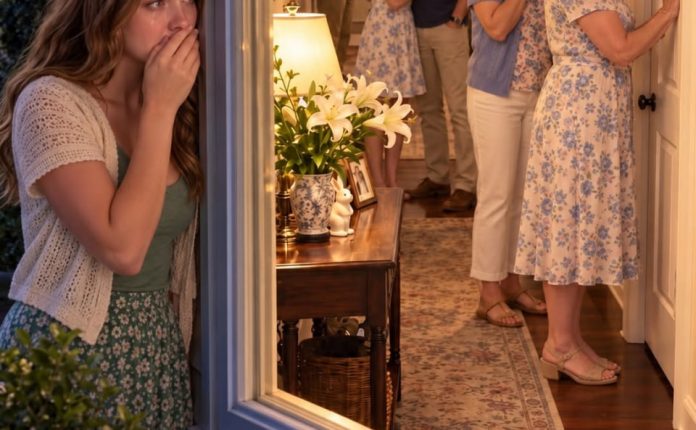
The first sign that something was wrong was the cold.
Our family home had always been too warm in winter. My mother liked the thermostat at seventy-four, regardless of what the heating bill said. My father complained occasionally, but he never touched it.
That evening, the air inside felt almost as cold as the driveway.
I had arrived expecting dinner.
Instead, I found myself standing in a dark hallway, listening to someone struggle to breathe upstairs.
“Dad?”
No answer.
I dropped my overnight bag and ran.
My name is Chelsea. I'm twenty-eight, and until that New Year's week, I genuinely believed the worst thing about my family was how easily they took me for granted.
I teach preschool at a small neighborhood school. My days involve spilled paint, missing mittens, and helping children understand why taking turns matters.
Sometimes, after spending eight hours teaching four-year-olds to consider other people's feelings, I'd drive to my parents' house and wonder why the lesson seemed harder for adults.
My younger sister, Sabrina, was twenty-four.
She had never worked at one job longer than seven months, although she described herself as ambitious.
Mom called her creative.
Dad called her young.
I called her whenever she forgot our parents' birthdays.
Being the older daughter had become less a position in the family than a permanent assignment.
I was expected to be reliable.
Sabrina was allowed to be interesting.
Whenever our family planned a gathering, Mom asked Sabrina what she wanted to eat and asked me what time I could arrive to help prepare it.
When Sabrina turned twenty-one, Dad paid for a weekend at a waterfront hotel.
When I completed my teaching certification, Mom invited me to dinner and asked whether I'd mind bringing dessert.
None of those incidents was particularly terrible by itself.
Together, they had taught me something I was only beginning to question.
My usefulness was treated as proof that I didn't need much affection.
But despite everything, I loved my parents.
Especially Dad.
Robert was sixty-two, a retired building contractor who had spent forty years repairing structures other people had neglected.
He had broad shoulders, rough hands, and an almost embarrassing fondness for old detective novels.
He also had a habit of forgiving people before they apologized.
That was how he survived being married to Diane.
Mom was charming when she wanted something.
At parties, she remembered everyone's children and sent handwritten thank-you cards. She knew which wine to serve and exactly how to make guests feel welcome.
At home, her generosity became considerably more selective.
She liked things arranged according to her preferences.
If she wanted a new sofa, the old one suddenly became unbearable.
If she wanted a vacation, Dad was unreasonable for mentioning the expense.
And if Sabrina wanted anything, the discussion was usually over before it began.
I had stopped expecting fairness.
I hadn't stopped expecting basic decency.
That was why the sight of Dad on his bedroom mattress seemed impossible.
He was bent forward, his right hand crushed against his chest.
His gray hair was wet with sweat.
His breathing came in short, ragged attempts.
“Dad!”
He lifted his head.
His lips moved, but nothing intelligible came out.
I grabbed my phone.
The emergency dispatcher answered while I was kneeling beside the bed.
“My father is having chest pain,” I said. “He's struggling to breathe. Please send someone.”
She asked for the address, his age, whether he was conscious, and whether he could answer questions.
I gave her everything I knew.
My voice sounded remarkably calm.
My hands were shaking so badly I nearly dropped the phone.
The dispatcher told me to keep him as comfortable as possible, avoid unnecessary movement, and watch his breathing while help was coming.
I hurried downstairs to unlock the front door.
When I returned, something yellow caught my attention.
A sticky note lay on the nightstand beside an empty water glass.
I recognized Mom's handwriting immediately.
“Your mother and sister went to Hawaii. Stay and take care of your father.”
I stared at it.
Hawaii.
For several seconds, the word meant nothing.
Then I remembered a conversation from two weeks earlier.
Mom had mentioned a resort package Sabrina found online.
Dad had said they should postpone any major travel until after his medical appointment.
I remembered because I'd been standing in the kitchen, washing dishes after dinner.
“Robert, you've had indigestion before,” Mom had replied.
Dad had looked uncomfortable.
He had recently complained about pressure in his chest when climbing stairs.
He had also seemed more tired than usual.
I had encouraged him to call his doctor, and he'd done so.
I thought that settled the matter.
Apparently, Mom disagreed.
The note contained no details about his symptoms.
No indication that she had arranged someone to stay.
She hadn't even called me directly.
She had written an instruction and left it on a piece of paper.
“Dad,” I whispered, “when did they leave?”
He couldn't answer.
Instead, his trembling fingers closed around my wrist.
“Chelsea.”
“Don't try to talk.”
His grip tightened.
“Will you help me teach them a lesson?”
The request frightened me almost as much as his breathing.
Dad had never spoken about Mom and Sabrina that way.
He usually defended them before anyone accused them of anything.
“Whatever you want,” I said. “Just stay with me.”
He released my wrist.
The ambulance arrived minutes later.
Two paramedics hurried upstairs carrying equipment.
I stepped aside, answering questions about his medication, recent symptoms, and medical history.
One of them noticed the untouched phone beside the bed.
“Has he been alone?”
“I don't know how long.”
The words tasted terrible.
I didn't know.
I had assumed someone was caring for him because someone always was.
Usually, that someone was me.
They brought Dad downstairs on a stretcher.
As they moved through the front door, I noticed his slippers neatly positioned beside the stairs.
One had fallen onto its side.
I remember wanting to straighten it.
The thought was absurd, but I couldn't stop looking.
There were things I could fix.
That slipper was one of them.
Whatever was happening inside my father's chest was not.
At the hospital, everything became bright lights, clipped instructions, and doors closing between us.
A nurse gave me forms.
I answered questions.
I called my school to explain that I had a family emergency.
Then I called Mom.
Straight to voicemail.
“Mom, Dad's in the hospital. Please call me immediately.”
I tried Sabrina.
No answer.
I sent messages to both.
Dad has had a medical emergency. This is serious. Call me.
I waited.
Five minutes.
Twenty minutes.
An hour.
My phone remained silent.
Shortly after dawn, Dr. Aerys approached me.
He was a middle-aged physician with dark circles beneath his eyes and a careful way of speaking.
“Your father suffered a severe heart attack,” he explained.
I gripped the edge of my chair.
“Is he going to live?”
“He received treatment quickly enough for us to stabilize him. He's still very ill, and we'll be monitoring him closely.”
I swallowed.
“What if I'd arrived later?”
Dr. Aerys hesitated.
“With his condition when the ambulance arrived, another five minutes could have made the difference.”
Five minutes.
I thought about the traffic signal near our house.
I'd nearly stopped for groceries.
I'd considered getting coffee.
If I'd chosen either, Dad might have died alone.
That realization stayed with me throughout the morning.
When I finally saw him, he was lying beneath a thin hospital blanket with wires attached to his chest.
He looked smaller.
That was the strangest part.
My father had always seemed physically substantial, even after retirement.
Now his shoulders barely disturbed the pillow.
“Hey, sweetheart,” he whispered.
I nearly cried.
“Hey, Dad.”
“Did I ruin your holiday?”
A laugh escaped me, painfully close to a sob.
“You have terrible timing.”
He smiled faintly.
Then he looked past me.
“Where's Diane?”
I couldn't speak.
He understood before I explained.
“Still away?”
I nodded.
“Sabrina too?”
“Yes.”
He closed his eyes.
I wanted to tell him they were on their way.
That Mom had booked the earliest possible flight.
That Sabrina had abandoned whatever she was doing and was waiting to hear about his condition.
But none of that was true.
Dad reached for his phone.
I helped him unlock it.
He opened the messages first.
There was nothing from Mom.
Then he looked at social media.
A photograph filled the screen.
Mom was reclining beside a resort swimming pool.
She wore an oversized straw hat, sunglasses, and a white linen dress.
A champagne glass stood beside her.
The caption described how wonderful it felt to finally take time for herself.
Another photograph showed Sabrina posing outside an expensive boutique.
She held several shopping bags, grinning at the camera.
I recognized the pale blue handbag in the largest bag.
She had shown it to me online before Christmas.
It cost more than my monthly rent.
Dad studied the pictures.
His thumb rested against the edge of the phone.
I could see the small movement of his jaw.
He wasn't angry yet.
He looked embarrassed.
As though he'd somehow been foolish for expecting his wife to be concerned.
Then he turned the phone facedown.
“Dad?”
He stared at the ceiling.
“Your grandfather once told me that a person can spend years refusing to believe what is standing directly in front of him.”
I pulled my chair closer.
“Grandpa Theodore?”
He nodded.
“He was difficult. Proud. But sometimes he understood things I didn't.”
Grandpa Theodore had died three years earlier.
He owned commercial properties and several parcels of land.
As children, Sabrina and I mostly knew him as the man who gave us crisp twenty-dollar bills at Christmas and insisted we write proper thank-you notes.
After his death, the family occasionally mentioned a complicated estate.
Dad never discussed the details.
I assumed everything had been settled.
I was wrong.
“Chelsea,” Dad said, “I need you to do something.”
“Tell me.”
“Go home. My office.”
I frowned.
“You need something from your desk?”
“Under the desk.”
He paused to catch his breath.
“Third floorboard from the wall.”
I waited.
“There's a safe.”
I stared at him.
“A safe?”
He almost smiled.
“Your grandfather believed banks were useful, but not sufficient.”
“Dad, what are you keeping under the floor?”
“Papers.”
“What papers?”
“Bring them first.”
He reached for my hand.
“And don't tell Diane or Sabrina.”
His expression made it clear that this wasn't a casual request.
“Are you sure?”
“Very.”
I left the hospital that afternoon.
The house looked different in daylight.
There were unopened Christmas cards on the sideboard.
A bowl of decorative pinecones sat on the dining table.
Mom had apparently left without putting away the holiday decorations.
Upstairs, Dad's bedroom smelled faintly of the antiseptic the paramedics had used.
The sticky note was still beside the bed.
I picked it up carefully.
For a moment, I considered throwing it away.
Then I folded it into a clean envelope instead.
I didn't know why I wanted to keep it.
Perhaps because I was beginning to understand how easily our family rewrote uncomfortable events.
Mom had a talent for making hurtful behavior sound reasonable.
I wanted something that couldn't be explained away.
Dad's office was at the back of the house.
It contained a heavy oak desk, bookshelves filled with construction manuals, and a brass desk lamp that Grandpa Theodore had given him.
The room smelled of wood polish and old paper.
I pulled the desk away from the wall.
Beneath it, the floorboards were slightly darker than the surrounding wood.
I counted from the wall.
One.
Two.
Three.
The third plank had a small gap near its edge.
I found a screwdriver in Dad's bottom drawer.
It took several minutes to lift the board.
Underneath was a shallow compartment lined with dark felt.
Inside sat a gray metal safe.
It was surprisingly heavy.
I carried it downstairs, wrapped it in a blanket, and placed it in my car.
Back at the hospital, Dad watched me set it beside his bed.
“You found it.”
“Exactly where you said.”
“Good.”
He asked me to close the door.
Then he gave me the combination.
Inside were manila folders, sealed envelopes, and several thick groups of documents.
I saw Grandpa Theodore's name immediately.
Theodore's estate.
Probate records.
Property transfers.
Bank correspondence.
An attorney's letter.
Dad took out a folder with a dark green tab.
“Grandpa left me more than the family knew.”
“How much more?”
Dad was silent for a moment.
“Enough that I should have told you sooner.”
He opened a document.
I saw figures that made me sit down.
The recently completed estate proceedings had transferred several valuable assets to him, including proceeds from commercial property sales and investment accounts.
I counted the digits twice.
“Dad.”
“I know.”
“Why didn't you tell anyone?”
“Because your mother was already spending money we didn't have, and your sister was making plans for money she hadn't earned.”
He rubbed his forehead.
“I needed to understand what I had inherited and what responsibilities came with it.”
“But why hide it?”
He looked embarrassed.
“I kept telling myself I was being prudent.”
He lifted the corner of another document.
“Truth is, I didn't trust my own judgment anymore.”
That surprised me.
My father had always seemed decisive.
He could look at a damaged house and know which wall was carrying too much weight.
Yet somehow he'd spent decades unable to recognize when his own family was taking advantage of him.
“Were you testing us?” I asked.
“No.”
He shook his head.
“I wasn't waiting for somebody to fail. I was afraid of what I'd find if I stopped making excuses.”
He explained that Grandpa Theodore's legal affairs had been unusually complicated.
Property sales had been delayed by disputes among distant relatives.
Some accounts couldn't be distributed until outstanding matters were resolved.
The final substantial transfer had arrived only recently.
Dad had consulted an attorney about establishing a trust and updating his estate plans.
He'd also started reviewing household spending.
What he discovered troubled him.
Mom had been using his credit cards far beyond what they'd discussed.
Sabrina had continued receiving monthly transfers even after promising to support herself.
And Dad had started having health problems.
“I told Diane I needed to slow down,” he said.
“What did she say?”
“That we'd talk after Hawaii.”
I looked at him.
“She knew about your chest pains?”
“Yes.”
“Did she know you had a doctor's appointment?”
“Yes.”
I remembered the kitchen conversation.
“Then why did she leave?”
He stared at his hands.
“I think she believed I'd be all right because I'd always been all right before.”
I wanted to be furious on his behalf.
Instead, I felt something worse.
I understood.
We had all treated Dad as someone who would always recover from whatever the family demanded of him.
His patience had become an excuse not to care for him.
He reached back into the safe.
“There's something else.”
He produced a thick folder labeled FAMILY PLANNING.
Inside were older versions of his estate documents.
I recognized Mom's name.
Then Sabrina's.
My own name appeared too, but in a much smaller section.
Dad turned several pages.
“I've been planning to change these for months.”
I stared at him.
“What are you planning?”
He closed the folder.
“Something I should have done before my heart forced me to stop.”
The next morning, he asked me to call Mr. Vance.
I found the attorney's number on a business card inside the safe.
Mr. Vance spoke slowly and asked several questions about Dad's condition.
Then he requested to speak directly with him.
They talked privately for nearly twenty minutes.
When Dad handed the phone back, he looked tired but relieved.
“He's coming Thursday,” he said.
“What's happening Thursday?”
Dad looked out the hospital window.
“I'm finally going to make decisions without asking permission from people who don't have to live with the consequences.”
That evening, Sabrina posted another vacation photograph.
This time she was standing on a balcony overlooking the ocean.
Her caption complained that the week was ending too quickly.
I looked at Dad sleeping beneath the hospital blanket.
Then I turned off my phone.
For the first time in my life, I wasn't going to chase my mother and sister for their attention.
Whatever happened next, they would have to face it when they came home.
END PART 1