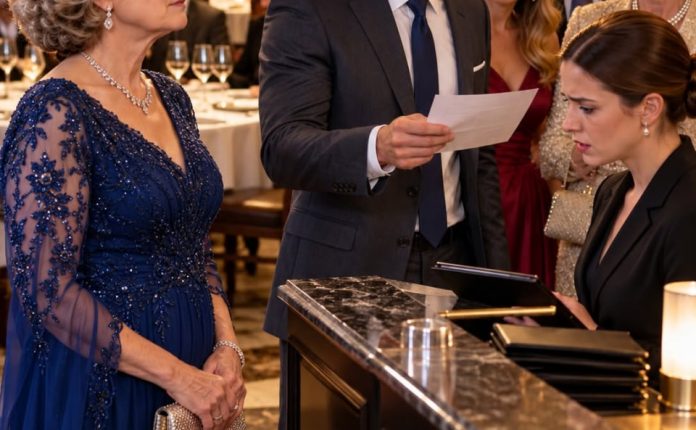
I knew something was wrong when Kristen asked me to leave my coat in the hallway instead of bringing it into the dining room.
It was a cold Tuesday evening in February, the kind of Houston cold that works its way through a wool sweater without ever producing a single snowflake. I stood beneath the entryway chandelier with a small brown parcel in my hand while my daughter-in-law looked at me as though I had arrived to deliver a package.
“Trevor's already seated,” she said. “Please don't make a scene tonight, Gloria.”
“I haven't even taken off my coat.”
“I'm just asking for one pleasant evening.”
She smiled then, a narrow expression that didn't reach her eyes, and disappeared into the dining room.
I had been invited to my son's thirtieth birthday dinner. Apparently, being welcome and being invited were two different things.
My name is Gloria Sutter. I was sixty-eight years old that winter, widowed for seven years, and the former owner of a Texas construction company that had helped build highways, bridges, and office developments across the state.
I was accustomed to difficult people.
I had dealt with contractors who submitted dishonest invoices, developers who changed their minds halfway through a project, and bankers who suddenly forgot agreements made across conference tables.
None of them frightened me quite as much as the knowledge that my own son had begun to dislike me.
The house was in River Oaks, behind a row of carefully trimmed hedges and a wrought-iron fence that Trevor had insisted on installing.
From the street, it looked like the kind of home people photographed for architectural magazines.
Cream-colored stone. Tall windows. A wide staircase visible through the front entrance. A swimming pool behind the house that changed color at night.
I knew every detail of that property.
I had paid for it.
Five years earlier, I had sold my remaining interest in a commercial construction partnership after completing one of the most profitable projects of my career. The proceeds gave me the freedom to stop working full-time and the opportunity to do something substantial for my only child.
Trevor was twenty-five then, recently married to Kristen and beginning a career at an investment consulting firm downtown.
He was ambitious, handsome in the way his father had been handsome, and endlessly concerned about what other people thought.
Kristen came from a family that had once been comfortable financially but had spent years maintaining appearances after the money began running out.
I didn't know that last part when they married.
I learned it slowly, through requests disguised as suggestions and conversations that ended whenever I walked into a room.
At first, I liked Kristen.
She was attentive to Trevor, spoke politely about my late husband, Daniel, and remembered to call me on Mother's Day.
I wanted their marriage to succeed.
And when Trevor mentioned that they were looking for a house near his new office, I made what I believed was a generous decision.
I bought them a place to live.
The purchase price had been considerable, but I paid cash. The property was acquired through Cedarline Capital, a limited liability company I owned completely.
Cedarline existed to hold a few investments and properties after I retired.
For administrative reasons, I had kept the house in the company's name. At the time, it also gave me a measure of reassurance.
I wasn't certain Trevor understood money well enough to manage such an asset responsibly. He earned a respectable salary, but his spending habits suggested that he considered every future paycheck already available.
I told him he and Kristen could make the house their home.
I told him they wouldn't need to worry about mortgage payments.
I told him I wanted them to have a better start than Daniel and I had enjoyed.
What I did not do was sign over the deed.
They signed an occupancy agreement prepared by my attorney, Elaine Mercer. It allowed them to live there without rent while Cedarline remained the owner, subject to the agreement's terms.
I went over the document with Trevor.
He barely listened.
“It's family, Mom,” he said, laughing as he signed. “We're not going to fight over a house.”
I remembered that sentence almost every time I entered the property.
That Tuesday, I had parked my blue sedan two blocks away because the driveway was filled with expensive cars.
Inside, the house smelled of roasted beef, expensive candles, and the fresh flowers Kristen ordered whenever guests came.
I could hear laughter from the dining room.
There were twelve people at the table, including Trevor and Kristen. Two couples were friends from his office. Others were acquaintances I'd met only briefly.
Trevor sat at the head of the table in a dark jacket with a gold watch showing beneath his sleeve.
He didn't stand when he saw me.
“Mom. You made it.”
“Happy birthday, sweetheart.”
I crossed the room and kissed his cheek.
He turned slightly, as though concerned that I might leave lipstick on him.
Kristen gestured toward an empty chair near the far end.
“We saved you a seat.”
It was the only chair without a place card.
I sat down and placed the parcel beside my plate.
One of Trevor's colleagues, a man named Andrew, asked whether I still worked in construction.
“Not the way I used to,” I replied. “These days I mostly tell younger people what they've done wrong.”
Andrew laughed.
Trevor didn't.
“Mom likes to remind everyone that she used to run things,” he said.
I took a sip of water.
“Only when someone asks.”
“Which is every five minutes,” Kristen added.
A few guests laughed politely.
I looked at Trevor. He was examining his wineglass.
There had been a time when my son would defend me against a stranger's smallest discourtesy.
At nine, he had refused to speak to a neighbor for a week because the man called my work boots ugly.
At fifteen, he had spent three summer mornings helping me clean up a muddy construction site after a storm.
At twenty, he had given me a handwritten card thanking me for teaching him not to be afraid of hard work.
I still had the card.
I sometimes wondered whether Trevor remembered writing it.
Dinner began with small talk.
Someone discussed a new restaurant. Another guest complained about traffic near the Galleria. Trevor described a business trip in the confident language of a man who enjoyed being listened to.
Whenever I contributed something, Kristen found a way to turn the conversation elsewhere.
She wasn't openly insulting at first.
She was too careful for that.
When I mentioned a bridge project, she asked whether I had seen the new kitchen appliances.
When someone asked about my former business, she announced that Trevor had recently been considered for a promotion.
When Andrew said he admired people who built companies from the ground up, Kristen laughed.
“Gloria certainly has plenty of stories from the old days.”
There was nothing cruel in the words themselves.
That was what made her so difficult to confront.
By the time dessert arrived, I had said very little.
I reached for the parcel.
“I brought you something, Trevor.”
He looked at it with visible disappointment.
“What's that?”
“Open it.”
Kristen leaned toward him.
“Maybe another antique from the attic.”
I watched Trevor tear the brown paper.
Inside was a small wooden box. Within the box lay an antique gold locket I had spent months restoring.
My mother, Evelyn, had loved lockets.
She wore one for most of her adult life, a simple piece containing photographs of her parents. When she died, I inherited it, but its condition was too fragile to wear.
The one I had brought Trevor was a similar antique I'd found through a dealer, then had restored by a jeweler in Houston.
Inside, I had placed two tiny photographs.
One showed my mother sitting in her garden.
The other showed Trevor at seven, leaning against her shoulder with a peach in his hand.
I thought he might remember that afternoon.
He opened the box.
For a moment, he said nothing.
Then he frowned.
“Seriously?”
I felt my smile falter.
“What?”
“You gave me a necklace?”
“It's a locket. I thought you might give it to a daughter someday, if you and Kristen have children. Your grandmother always—”
“Mom.”
His voice stopped me.
“I'm thirty years old.”
“I know how old you are.”
“Then why are you still giving me things that belong in a museum?”
Kristen laughed into her napkin.
My cheeks warmed.
“You don't have to wear it. I simply thought it might mean something.”
Trevor closed the box and pushed it away.
“I'm tired of you bringing old things here and expecting us to be grateful.”
The table became quiet.
I looked at the wooden box resting near his plate.
“Your grandmother loved you very much.”
“I know. You remind me constantly.”
He leaned back.
“Every time you visit, it's another story about the family. Another reminder of how much you've done. Another lesson.”
“I haven't given you a lesson tonight.”
“You don't have to say it directly.”
Kristen placed her hand on his arm.
“Trevor, darling, don't upset yourself.”
Then she looked at me.
“Gloria, perhaps you could allow him to enjoy his birthday without making everything about the past.”
I had spent years swallowing those comments.
I had told myself that it was better to keep the peace.
I had convinced myself that Trevor's marriage mattered more than my pride and that young people occasionally needed room to be thoughtless.
But there are moments when silence becomes an agreement.
I reached across the table and pulled the box toward me.
“I'll take it home, then.”
Trevor watched me.
“And there it is.”
I looked up.
“What?”
“The guilt.”
“I'm taking back a gift you don't want.”
“No. You're making sure everyone sees how disappointed you are.”
Andrew shifted in his chair.
Someone at the other end of the table asked whether anybody wanted coffee.
Trevor ignored the question.
“You've never accepted that this is our home now.”
I took a breath.
“I've respected your home.”
“Then stop reminding us that you bought it.”
I held his gaze.
“I hadn't mentioned that.”
“You were thinking it.”
Kristen's expression changed almost imperceptibly.
She leaned back, her eyes fixed on me.
I should have noticed.
Instead, I said something I had been holding inside for years.
“Trevor, I never asked you to repay me. But I would appreciate being treated with basic courtesy in a house I made possible.”
He pushed his chair back.
“You see? There it is.”
“Sit down,” I said quietly.
“Don't tell me what to do in my own house.”
“I am not telling you what to do. I'm asking you not to shout.”
His face reddened.
Kristen remained seated.
One of the guests lifted a hand, then lowered it.
Trevor came around the table.
I stood, partly because I didn't want him towering over me.
“Enough, Trevor.”
“You think you can humiliate me in front of my friends?”
“You are doing that yourself.”
He shoved me.
My side struck the table's wooden corner.
A plate rattled, and a glass fell over, spreading dark red wine across the white linen.
I was trying to catch my balance when his hand struck my face.
One.
The sound was so sudden that I hardly understood what had happened.
Then came another.
Two.
I raised one arm to shield myself.
“Trevor, stop.”
He struck me again.
Three.
Somewhere behind him, a woman gasped.
I remember that distinctly.
I remember Andrew pushing his chair back.
I remember Kristen saying something, but not telling him to stop.
The blows continued.
I counted them silently.
Perhaps it was an old habit from construction, where numbers helped me keep my mind steady when everything around me went wrong.
I counted because I couldn't make sense of my son's face.
I counted because the little boy I had carried through hospital corridors after he broke his arm seemed impossibly far away.
I counted because every strike made one thing clearer.
This wasn't a misunderstanding.
At some point, Trevor stopped speaking.
Only the sound of his hand remained, followed by the roughness of his breathing and the scrape of shoes as guests moved away.
My cheek burned. My lip split.
I tasted blood.
A man near the kitchen entrance finally stepped forward.
“Trevor, that's enough.”
Trevor turned toward him.
“Stay out of it.”
The man stopped.
I had no idea whether someone had called for help.
I knew only that the room had become frighteningly quiet.
Twenty-seven.
Twenty-eight.
Twenty-nine.
Thirty.
Trevor stepped away.
He adjusted his cuff.
I held a napkin against my mouth.
“Are you finished embarrassing us?” he asked.
He sounded more irritated than ashamed.
Kristen sat in her chair.
Her expression was not alarmed.
It was almost satisfied.
I looked from her to Trevor.
No one moved toward me.
The candles on his birthday cake were still unlit.
A small pool of spilled wine had reached the edge of the tablecloth and begun dripping onto the floor.
I remember thinking that Kristen would be furious about the stain.
Then I realized something.
I was thinking about whether Kristen would be upset while I was standing there bleeding.
That was what five years of trying to keep them happy had done to me.
I lowered the napkin.
“Trevor.”
He looked at me.
I wanted to ask him whether he understood what he had done.
I wanted to ask if he remembered his father, who had never raised a hand against me in thirty-six years of marriage.
I wanted to ask whether there was anything left of the boy who used to wait for me at the kitchen window after work.
Instead, I said, “Move, please.”
He stepped aside.
I picked up the wooden box from the table.
Its lid had opened during the commotion, and the locket lay in the velvet lining with its tiny clasp undone.
The photograph of my mother was visible.
I closed it carefully.
Then I walked out of the dining room.
Nobody followed me.
In the hallway, I passed the coat rack and realized I had left my coat behind.
I didn't want to go back.
Outside, the air felt sharp against my injured face.
I made it halfway down the front steps before a young woman hurried after me.
She wore a black server's uniform and held my coat folded over one arm.
“Mrs. Sutter?”
I turned.
“Your coat.”
“Thank you.”
She looked at my mouth and swallowed.
“I'm sorry.”
I shook my head.
“You didn't do this.”
She glanced toward the house.
“Someone recorded it.”
I stopped putting on my coat.
“What did you say?”
“I saw a phone pointed toward the dining table.”
“Whose phone?”
“I couldn't see. I was near the kitchen door.”
She seemed frightened of being overheard.
“Please be careful,” she whispered.
Then she went back inside.
I stood beneath the porch light with the coat hanging from one shoulder.
There had been witnesses.
There might be a recording.
I couldn't decide whether that thought brought relief or shame.
I had been humiliated in front of twelve people.
Now I had to consider the possibility that other people might watch my son hurt me.
I walked to my car.
My hands shook so badly that I dropped the keys twice before getting the door open.
For a long moment, I sat behind the steering wheel.
The house glowed beyond the hedge, every upstairs window warm with light.
I had once imagined grandchildren playing on its lawn.
I had imagined Thanksgiving dinners around that table.
I had imagined growing old while Trevor built a family of his own.
I had never imagined leaving the property with blood on my blouse.
No one came outside.
Eventually, I started the engine.
I drove carefully because my vision kept blurring with tears.
When I reached my own house, a modest brick home where Daniel and I had lived for most of our marriage, I went straight to the bathroom.
The woman in the mirror frightened me.
One cheek was swelling.
My lower lip had a deep cut.
There was a red mark beneath my jaw, and my ribs hurt when I leaned against the sink.
I took photographs with my phone.
Front view.
Left side.
Right side.
I had spent too much of my career documenting construction damage to ignore the importance of recording what had happened before the evidence changed.
Then I called a medical clinic.
The nurse advised me to seek prompt examination, especially because of the facial injuries and rib pain.
I arranged to be seen.
Afterward, I sat at my kitchen table and opened the wooden box.
The locket's hinge had survived.
I rubbed the photograph of my mother gently with one finger.
She had raised me during years when money was scarce.
She worked as a school secretary and altered dresses for neighbors in the evenings.
She had believed that family should help one another.
But she had also taught me that helping someone didn't mean allowing them to mistreat you.
I remembered something she said when I was seventeen.
“Gloria, love doesn't require you to stand still while someone hurts you.”
I had repeated those words to friends.
I had taught them to younger women on my construction crews.
Somehow, I had failed to apply them to my own son.
I stood and walked to the small study at the back of the house.
Daniel's old desk still stood beneath the window.
In the bottom drawer was a folder labeled CEDARLINE CAPITAL — RIVER OAKS.
I took it out.
Inside were the deed, the purchase records, the occupancy agreement, insurance information, and a series of letters from Trevor.
One letter was dated nearly two years earlier.
He had asked me to transfer ownership of the property to him and Kristen, suggesting it would be a wonderful anniversary gift.
I had declined.
At the time, he had called me old-fashioned.
Kristen had stopped speaking to me for nearly six weeks.
I had eventually apologized for upsetting them.
Now, looking at those documents, I felt ashamed of that apology.
The deed named Cedarline Capital as the owner.
I owned Cedarline.
Trevor and Kristen had never been given title.
The arrangement had always been written down, however casually they chose to describe it.
I sat at the desk for a long time.
I thought about Daniel.
He had been a practical man with a soft heart.
When Trevor was small, Daniel often told him that the most important thing he could leave his son was a good name.
Not money.
Not property.
A good name.
Daniel would have been devastated by what happened at dinner.
But I believed he would have asked me one question before anything else.
Are you safe?
That was the question I finally asked myself.
And the answer was no.
Not while I kept pretending Trevor's behavior was a temporary disappointment.
Not while I continued financing a life in which he believed he could treat me however he pleased.
I pulled out another file.
Several months earlier, a local property investment firm had expressed interest in the River Oaks house.
Its representative had approached Cedarline about purchasing the property as part of a small portfolio of high-end Houston homes.
I had declined then because Trevor and Kristen lived there.
The representative had left the offer open for further discussion.
I found her card.
I placed it beside Elaine Mercer's number.
It was almost midnight.
I wasn't going to make an impulsive phone call while injured and exhausted.
I wasn't going to enter into a transaction I hadn't examined properly.
But I knew what I needed to discuss with Elaine in the morning.
I needed to understand my rights.
I needed to protect myself.
And I needed to stop treating Trevor's comfort as more important than my safety.
I closed the folder.
Then I placed the locket beside it.
For the first time since entering my son's house, I allowed myself to cry.
I cried for the injuries I could feel and for the years I had spent overlooking injuries that left no visible marks.
I cried because my only child had become a man I did not recognize.
And I cried because I knew that by morning, I would have to make a decision that could change the rest of our lives.
At 7:42 the next day, I sat at my kitchen table with a cup of tea I could barely drink.
My phone was beside me.
Trevor hadn't called.
Kristen hadn't sent a message.
Neither had asked whether I was injured.
At 8:06, I dialed Elaine Mercer.
She answered on the second ring.
“Gloria? You're up early.”
“Elaine, I need your help.”
“What's happened?”
“My son assaulted me last night.”
There was a silence.
Then her voice became very calm.
“Are you somewhere safe?”
“Yes.”
“Have you seen a doctor?”
“I've arranged it.”
“Good. I want you examined, and I strongly recommend making a police report. We can discuss the property afterward.”
I closed my eyes.
“The property is why I'm calling.”
“Tell me.”
I looked at the Cedarline folder.
“I want to sell the River Oaks house.”
Elaine didn't immediately answer.
Then she said, “We can discuss that. But you need to understand something before we proceed.”
“What?”
“Your son may believe he owns that house. The documents say otherwise. Selling it, however, won't erase the occupants' legal rights or settle what happened last night.”
“I know.”
“Are you certain this isn't simply anger speaking?”
I looked at my swollen reflection in the dark window.
“No, Elaine. Anger would have made me shout back.”
“Then what is this?”
I touched the locket lying beside the phone.
“This is me finally believing what my son showed me.”
Elaine asked me to bring the Cedarline documents to her office.
Before ending the call, she told me one more thing.
“Gloria, don't contact Trevor about the sale yet. Let me review everything first.”
I agreed.
Then I reached for my coat.
By lunchtime, my son would discover that the house he considered the center of his life had never legally been his to sell, borrow against, or demand.
But as I left for Elaine's office, I knew nothing about the conversation Kristen had held in the dining room before I arrived.
I didn't know why she had been watching me so carefully.
And I certainly didn't know that a recording made during Trevor's birthday dinner would soon force me to reconsider whether the confrontation had been entirely spontaneous.
END PART 1