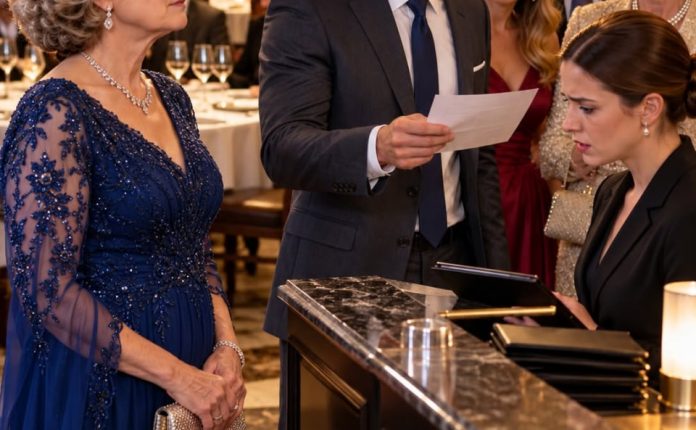
By Friday morning, the anniversary reception had been removed from Bellavita's confirmed planning schedule.
That did not mean the family celebration was canceled.
It meant Graham and Celeste Price would need to decide what they actually wished to purchase and how they intended to pay for it.
For the first time, my name was no longer part of that decision.
Sofia sent a written confirmation to Helen.
The proposed Founder's Reserve authorization had been rejected.
No charge had been made against my membership.
The attempted email redirection had been canceled.
The restaurant had retained the relevant records.
The events team had been instructed to deal directly with Graham or his authorized representative regarding any replacement booking.
I read the letter twice.
Then I put it in a folder.
The practical resolution should have brought relief.
Instead, I felt a weary sadness.
It was Friday after Mother's Day.
I had spent almost an entire week dealing with an event I had never agreed to sponsor.
The restaurant's employees had lost hours to reviewing records.
Helen had spent time untangling the attempted authorization.
My son had been forced to admit that he had written my name without permission.
And the original celebration, whatever pleasure it might have brought Graham and Celeste, now carried an uncomfortable history.
I found myself thinking about the six relatives who had accompanied them to Bellavita.
They had not participated in preparing the paperwork.
They had not asked the manager to charge my account.
Most probably had no idea anything improper had happened.
I hoped they would not become unwilling participants in a family argument.
That afternoon, Graham telephoned.
I almost let the call go unanswered.
Then I picked up.
"Margaret, it's Graham."
"Hello."
"I wanted to thank you for meeting with us yesterday."
"You're welcome."
He paused.
"Richard has advised us that the original booking cannot proceed under your membership."
"That's correct."
"We've withdrawn it."
"I appreciate the confirmation."
There was another pause.
"I'm arranging a smaller celebration."
"That sounds reasonable."
"Celeste is disappointed."
I looked toward my garden.
"I'm sorry to hear that."
He exhaled.
"She wanted something special for our fortieth anniversary."
"Forty years is worth celebrating."
"Yes."
I waited.
He seemed to be searching for a way to say something.
Finally, he asked, "Would you have helped if we'd approached you directly?"
I considered the question.
"Possibly."
"How much?"
"Graham, that isn't the point."
"I understand. I'm merely curious."
I smiled faintly.
"Then I'll give you an honest answer. I might have offered dinner for a few people or a modest contribution. I would not have agreed to a thirty-eight-thousand-dollar reception."
He was quiet.
"That's understandable."
I wondered whether it truly was.
Then he surprised me.
"Margaret, there's something you should know."
I straightened.
"Yes?"
"When Adam first suggested the arrangement, I asked him whether you'd agreed. He told me you were pleased to contribute."
I closed my eyes.
"He said that?"
"Yes. Then, when the restaurant asked for authorization, I asked him again. He told me you'd signed the paperwork."
"Thank you for telling me."
"I should have called you."
"Yes," I said. "You should have."
He accepted that without arguing.
"I've spent my career in business. I know better than to rely on someone else's assurances when a large financial commitment is involved."
I thought of the Rolex on his wrist and the confidence with which he'd stood beside Adam at the restaurant.
He was right.
He should have known better.
But I was no longer interested in humiliating him.
"What happens now?" I asked.
"We're going ahead with a smaller anniversary dinner. I'll pay for it myself."
"Good."
"Celeste wants to know whether you would attend."
That question startled me.
"Does she?"
"Yes."
I remembered Celeste looking at me near the restaurant entrance.
Some mothers have trouble accepting that their children grow up.
I could still hear the amusement in her voice.
"Thank you for the invitation, Graham."
"Will you come?"
"I don't think so."
He sighed.
"I understand."
I looked down at Thomas's old notebook.
"Please give Celeste my good wishes."
"I will."
Before ending the call, he said something else.
"Margaret, I hope Adam understands what he's done."
"So do I."
Afterward, I sat quietly.
Graham's apology did not erase his earlier carelessness.
But it mattered that he had admitted it.
He had not blamed me for refusing the charge.
He had not insisted that preserving family appearances was more important than the truth.
He had accepted responsibility for what he should have verified.
I wished Adam had done the same.
Later that afternoon, Vanessa called.
Her voice was tight.
"Margaret, you told my father you wouldn't attend the anniversary dinner."
"Yes."
"He's embarrassed."
"Why?"
"Because he invited you as a peace offering."
"I thanked him."
"You rejected him."
"I declined an invitation."
She was silent.
Then she said, "You always make everything sound so simple."
I leaned against the kitchen counter.
"Sometimes it is simple."
"Nothing about this is simple."
"Then tell me what you're worried about."
I heard her breathing.
Finally, she said, "Everyone is angry with Adam."
I closed my eyes.
"I imagine this has been difficult."
"Dad feels deceived. Mother is furious. Adam thinks they've turned against him."
"Have they?"
"They've asked him to explain himself."
"That's reasonable."
Vanessa laughed bitterly.
"You're enjoying this."
"No."
"Of course you are. You finally have everyone on your side."
I looked toward the window.
A robin had landed on the fence.
"Vanessa, I don't want sides. I want people to stop using my name without permission."
She did not answer.
I continued.
"I never asked Graham to cancel his reception. I asked the restaurant not to charge me for something I hadn't authorized."
"You knew it would fall apart."
"I knew it might have to be paid for by the people hosting it."
Her tone sharpened.
"You don't understand the pressure Adam is under."
"Then help me understand."
There was a long silence.
"He wanted my parents to think well of him."
I considered that.
"By spending money he didn't have permission to spend?"
"He thought your membership would cover it."
"That doesn't explain why he signed my name."
She sounded close to tears.
"He's been trying to prove himself for years."
I sat down.
"To whom?"
"To everyone."
I thought of Thomas.
My husband had been successful, but he had never expected Adam to follow the same path.
He used to tell our son that a good life was measured by how honestly a person lived, not by how much he earned.
Adam had always been impatient with that advice.
He wanted impressive houses, expensive dinners, and the admiration of people whose approval seemed constantly out of reach.
"Vanessa," I said, "there is nothing wrong with wanting to succeed."
"I know."
"But he cannot purchase admiration with someone else's money."
She began crying quietly.
I waited.
Part of me wanted to comfort her.
Another part remembered how easily she had described me as forgetful to Sofia.
I could feel compassion without pretending her behavior had been harmless.
Eventually, she spoke.
"Would you consider talking to him?"
"I've been willing to talk all week."
"Without Helen?"
I thought for a moment.
"About our relationship, yes. About the documents, no. Those arrangements need to remain properly recorded."
"That sounds cold."
"It sounds careful."
She ended the call shortly afterward.
I remained at the kitchen table.
For the first time, I felt something besides anger toward Vanessa.
I still disliked what she had done.
But I could see that she and Adam had built a life around impressing other people.
Perhaps they had become so concerned with appearances that neither understood what ordinary honesty looked like anymore.
That was sad.
It was not an excuse.
On Monday, Helen met with me again.
We reviewed the final confirmation from Bellavita.
Graham had accepted full responsibility for any replacement event.
The original account guarantee was void.
The submitted authorization had been retained as disputed evidence.
Adam, through an attorney, had agreed to preserve and provide the electronic files relevant to the attempt.
We discussed possible legal consequences of the false signature.
Helen explained that the precise remedies would depend on the facts, applicable law, and whether any financial loss or additional misconduct was established.
She did not pretend the situation was trivial.
Nor did she push me toward the harshest possible response.
"Margaret," she said, "what outcome do you want?"
I looked at the papers.
"I want my account protected."
"That has been addressed."
"I want the business to know its procedures worked."
"We can formally document that."
"I want my son to understand that he cannot do this again."
Helen nodded.
"And what would help you believe he understands?"
I thought for a long time.
"Honesty. Not another explanation about how I embarrassed him. Not an apology that blames me for discovering it."
"That's reasonable."
I hesitated.
"I also want to know whether he did anything similar elsewhere."
"We've checked the records available to us. So far, we haven't found another unauthorized transaction. We should continue appropriate verification."
I nodded.
That was one of the few pieces of good news.
The bank accounts were secure.
My ownership records were unchanged.
The financial advisory firm had not released confidential information.
No money had been transferred.
The attempted restaurant charge had never gone through.
Whatever Adam had intended, the damage had been stopped before it became a financial loss.
But the emotional damage was already there.
Helen asked whether I wanted to update my estate plan.
"Yes," I said.
"Have you decided how?"
"Not entirely."
We reviewed the existing documents.
Thomas and I had established arrangements that would eventually benefit Adam.
The details were private.
I had no desire to turn my estate into a weapon.
But I did want to make clear that Adam held no present authority over my finances unless I explicitly granted it.
Helen explained several options.
We agreed to revise administrative provisions, confirm independent decision-making authority, and ensure that any future assistance would require proper documentation.
I did not remove Adam from my life with a stroke of a pen.
I did not make an emotional announcement.
I simply made sure my financial arrangements reflected reality.
My son was an adult.
I was an adult.
Neither of us had the right to control the other's property without consent.
That afternoon, I returned to Bellavita.
The restaurant was preparing for dinner.
Sofia met me in the small office beside the dining room.
We discussed additional staff guidance.
I wanted employees to understand that family relationships did not replace authorization requirements.
I also wanted them protected from pressure.
"Even if someone claims to be related to an owner," I said, "the procedure remains the same."
Sofia nodded.
"We've already circulated a reminder."
"Good."
She hesitated.
"Mrs. Whitmore, may I say something?"
"Of course."
"I was frightened on Sunday."
I looked at her.
"Of what?"
"That you might think I was disrespecting your family."
I sat back.
"Sofia, you did your job."
"I know. But when Mr. Whitmore became angry, I wondered whether I should have handled it differently."
"You handled it correctly."
Her shoulders relaxed.
I continued.
"Being related to me doesn't give Adam permission to bypass the rules. If anything, that relationship makes it more important that the rules be followed."
She smiled.
"Thank you."
I looked through the office window.
Waiters were aligning glasses on the tables.
A young employee was polishing silverware.
In the kitchen, someone called for another delivery of fresh herbs.
These people depended on the business being run responsibly.
I could not allow my private family troubles to undermine that responsibility.
"Sofia," I said, "I'd also like a review of how we communicate membership benefits and ownership privileges."
"Certainly."
"Not because anyone failed. Because this experience showed how easily someone can misunderstand, or deliberately misrepresent, the difference."
She made a note.
I left the office feeling more settled.
At the entrance, I stopped beside the old photograph of Thomas and Lorenzo.
Thomas was smiling at the camera.
His brown tie was crooked.
I remembered how much he had enjoyed the restaurant's early years.
He loved sitting with Lorenzo after closing, talking about food costs, stubborn suppliers, and customers who insisted they knew more about Italian cooking than the chef.
He would have been proud of Sofia.
He would have approved of the safeguards.
And he would have been devastated that Adam had attempted to use our family investment in such a way.
I touched the edge of the frame.
Then I went home.
On Wednesday evening, Adam came to my house.
He had not called ahead.
I saw his car pull into the driveway while I was watering the flowers near the front steps.
For a moment, I considered going inside.
Instead, I put down the watering can.
He climbed out slowly.
He wore jeans and an old gray sweater I recognized from years earlier.
Without the suit and expensive watch he usually wore to business meetings, he looked younger.
"Hi, Mom."
"Hello, Adam."
"Can we talk?"
I studied him.
"About what?"
"Us."
I moved aside.
"Come in."
We sat in the kitchen.
I offered tea.
He accepted.
For several minutes, we spoke about nothing important.
The weather.
His work.
A problem with the traffic near his office.
Then he looked at the empty chair where Thomas used to sit.
"I miss Dad."
I felt my throat tighten.
"So do I."
He turned the cup in his hands.
"Sometimes I think he would know what to say to me."
"Perhaps."
"He always had a way of making things sound simple."
I smiled faintly.
"Your father could make complicated matters sound simple because he spent so much time thinking about them."
Adam looked down.
"I know."
We sat in silence.
Then he said, "I didn't think the restaurant would actually charge your account without asking you."
I watched him.
"Then why submit the form?"
He closed his eyes.
"I wanted the booking confirmed."
"By using my authorization?"
"Yes."
He seemed to struggle with the word.
I waited.
Finally, he looked at me.
"I knew you hadn't agreed."
I had heard him admit writing my name in Helen's office.
But this was different.
He was no longer saying he thought he had permission.
He was admitting he knew he did not.
I folded my hands.
"Why did you do it?"
He stared into his tea.
"Because I thought if everything was arranged, you wouldn't want to disappoint everyone."
I felt a sharp ache.
He had expected my reluctance to embarrass him to become his leverage.
He had counted on me paying because refusing would be uncomfortable.
"Adam," I said quietly, "that is a terrible thing to do to someone who loves you."
He nodded.
For the first time, he did not argue.
"I know."
I looked toward the garden.
The last light was fading behind the trees.
Then he said, "I was ashamed."
"Of what?"
"Of needing help."
I turned back.
"You didn't ask for help."
"Because you would have wanted to know why."
"Yes."
He gave a strained smile.
"Exactly."
I waited.
He explained that his work had been less successful than he wanted people to believe.
Some projects had been delayed.
His income had become uncertain.
He had not been honest with Vanessa about how worried he was.
When Graham and Celeste began discussing their anniversary celebration, Adam offered to help arrange something impressive.
He wanted to appear generous.
Capable.
Successful.
Then he remembered the Bellavita membership.
He convinced himself it was a family benefit he could use.
When the restaurant demanded authorization, he decided he could prepare it himself.
Each step made the next one easier to justify.
"And the financial advisory firm?" I asked.
He looked embarrassed.
"I wanted to know how much money was available."
"Available to whom?"
He rubbed his face.
"I don't know what I was thinking."
I held his gaze.
"I think you knew."
He looked away.
After a long pause, he nodded.
"Yes."
We sat quietly.
Then he said, "I'm sorry, Mom."
I watched him carefully.
He continued.
"Not because the booking failed. Not because Graham is angry. I'm sorry I used your name and told people you couldn't manage things. I knew that wasn't true."
I felt tears rise.
I did not let them fall immediately.
"I needed to hear that."
"I know."
He swallowed.
"I don't expect you to forgive me today."
"Good," I said gently. "Because I don't know whether I can."
He nodded.
That answer seemed to hurt him.
But he accepted it.
For a long time, we sat without speaking.
Then I asked, "Have you told Vanessa the truth about your work?"
He shook his head.
"You need to."
"She'll be angry."
"Probably."
"She might not understand."
"Then you'll have to explain."
He gave a tired laugh.
"You sound like Dad."
"Sometimes I do."
I reached for my tea.
"Adam, your father and I made mistakes. We had years when money was frightening. We argued about investments. We worried about keeping the business alive."
He looked at me.
"You never told me."
"You were a child. We didn't want you carrying adult worries."
He nodded slowly.
"But we never solved those worries by pretending someone else had agreed to pay."
He lowered his eyes.
"I know."
When he stood to leave, I walked him to the door.
He paused on the steps.
"Mom?"
"Yes?"
"Do you still want me in your life?"
I looked at him.
There was my son.
Not the innocent little boy from the photographs.
Not the confident businessman he tried so hard to appear to be.
A flawed adult who had done something deeply wrong.
"Yes," I said. "But I need you to understand that being in my life doesn't mean controlling it."
He nodded.
"I understand."
"I hope you do."
He stepped forward.
For a moment, he seemed uncertain whether to hug me.
I made the decision for him.
I put my arms around him briefly.
He held on longer than I expected.
When he drove away, I remained on the porch.
I did not mistake the conversation for a complete repair.
An apology was a beginning.
Trust would require time, consistent honesty, and different behavior.
But for the first time since Mother's Day, my son had stopped explaining why I should not have objected.
He had begun acknowledging what he had done.
That was enough for one evening.
END PART 4