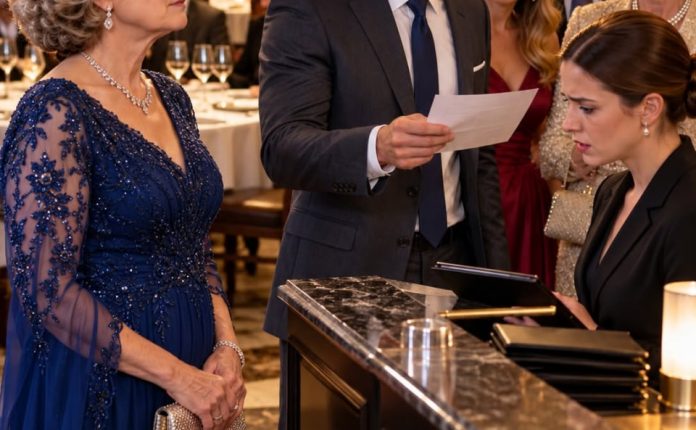
Three months after Mother's Day, I returned to Bellavita and asked for a table near the window.
This time, I wasn't alone.
Across from me sat Adam.
He was wearing a plain blue shirt, the sleeves rolled to his elbows.
His hair needed cutting.
He looked tired, but there was something less guarded about him.
"Would you like the ravioli?" he asked.
I smiled.
"How did you know?"
"You've ordered it since I was a kid."
I studied him.
"Apparently you do remember some things."
He smiled faintly.
"I remember more than you think."
The waiter brought water.
I looked around the dining room.
The restaurant was quieter than it had been on Mother's Day.
Outside, the late summer evening glowed against the buildings.
A couple sat near the bar discussing a map.
At another table, two elderly women shared a dessert.
Ordinary life continued.
I had learned to appreciate that.
The months since Mother's Day had not been easy.
But they had been useful.
In June, Graham and Celeste held their fortieth-anniversary dinner at a smaller restaurant.
Graham paid for it himself.
The gathering was pleasant, according to Adam, though less elaborate than originally planned.
There was no private entertainment.
No expensive reception package.
No attempt to charge someone who had not agreed.
I sent Celeste a handwritten card.
I wished her and Graham happiness and thanked them for the invitation I had declined.
She replied with a brief note.
It was courteous.
I did not expect friendship to develop overnight.
That was fine.
Not every relationship needed to become intimate in order to become respectful.
More importantly, the Bellavita matter had been resolved through documented arrangements.
The original reception request was withdrawn.
The false authorization remained invalid.
No money had been taken from my account.
The attempted notice redirection had never been completed.
Adam had supplied the relevant electronic files through his attorney.
The restaurant preserved its records, and its management reviewed the authorization procedures.
Helen and I had considered the available options for responding to the apparent forgery.
After reviewing the evidence, the lack of completed financial loss, the preservation of records, and Adam's cooperation, I decided not to pursue a private civil claim against him at that time.
That was my decision regarding my own interests.
It did not mean the false signature had become acceptable.
It did not erase what happened.
And it did not require the restaurant or anyone else to overlook future misconduct.
I made that clear to Adam.
He accepted it.
At least, he said he did.
What mattered more was what he did afterward.
He stopped contacting Bellavita about my account.
He stopped asking for access to my financial records.
He stopped describing me as confused or unable to manage my own affairs.
When he wanted to discuss money, he asked directly.
And when I declined something, he began learning to accept the answer.
Those changes were small.
But they were real.
During June, he told Vanessa the truth about his work.
It had been an uncomfortable conversation.
He called me afterward.
"We argued for three hours," he said.
I was sitting in the garden.
"That sounds exhausting."
"It was."
"Did you tell her everything?"
"Yes."
"How did she respond?"
"She was furious that I hadn't told her sooner."
I considered that.
"Understandable."
He sighed.
"I know."
Then he said something I hadn't expected.
"She also admitted that she liked the idea of my parents-in-law thinking we were doing better than we were."
I looked at the roses beside my chair.
"That's a difficult thing to admit."
"Yes."
"Perhaps it's a useful beginning."
He was quiet.
Then he said, "We're going to make some changes."
I did not ask for details.
Their marriage belonged to them.
They needed to decide how to live without using my finances as a convenient solution.
Later, Adam told me they had reduced several expenses.
They sold one of their cars.
They postponed a renovation.
He met with a financial adviser to review his business commitments.
None of these choices made him poor.
They simply forced him to live within the circumstances he actually had.
For years, I suspected he had been trying to maintain an image that required more money than he consistently earned.
Now he was beginning to accept that appearing successful was not the same as being secure.
Vanessa's relationship with me remained complicated.
She apologized one afternoon in July.
It happened during a brief visit when she and Adam brought pastries to my house.
We were standing alone in the kitchen.
She looked at the counter.
"Margaret, I owe you an apology."
I waited.
"I shouldn't have told Sofia you were forgetful."
"No," I said. "You shouldn't have."
She looked uncomfortable.
"I was trying to help Adam."
"By making me appear incapable?"
She lowered her head.
"Yes."
I appreciated that she didn't try to soften the admission.
I placed the kettle on the stove.
"Vanessa, I don't need you to agree with every decision I make."
"I know."
"But I do need you to speak truthfully about me."
She nodded.
"I understand."
I wasn't certain she did.
But I gave her room to demonstrate it.
Over the following weeks, she became more careful.
She asked before making plans involving me.
She stopped speaking for Adam when he was perfectly capable of answering.
She sometimes seemed awkward, as though ordinary courtesy were a language she had not practiced recently.
I didn't rush to fill the silence.
We had time.
At least, I hoped we did.
The greatest changes occurred between Adam and me.
After our conversation on the porch, he began calling regularly.
At first, the calls were stiff.
He asked about the weather.
I asked about work.
Neither of us knew how to speak naturally after everything that had happened.
Then one evening, he asked whether I still had Thomas's old fishing equipment.
"Of course."
"Could I come and look at it?"
I hesitated.
Then I said, "Yes."
He arrived on a Saturday.
We spent two hours in the garage.
Most of Thomas's fishing rods were still stored in their original cases.
Adam picked up a worn wooden tackle box.
"Dad used to bring this to the lake."
"Every summer."
He opened it.
Inside were hooks, old floats, and a small knife with a cracked handle.
He smiled.
"I remember him showing me how to tie a knot."
"Which knot?"
"I can't remember the name."
"The improved clinch knot."
He laughed.
"Of course you'd know."
"Your father practiced it at the kitchen table for years."
Adam held the tackle box.
For a moment, he looked close to tears.
"I wish I'd spent more time with him."
"So do I."
We stood quietly.
Then he asked, "Was he disappointed in me?"
I took a breath.
"Your father worried about some of your choices."
He looked down.
"But he loved you."
"I know."
"Those two things can be true at the same time."
He nodded.
I understood the sentence in a way I never had before.
I loved my son.
I was disappointed in what he had done.
Neither truth canceled the other.
That afternoon, I gave him one of Thomas's fishing rods.
Not because he asked for money.
Not because he expected an inheritance.
Because the rod belonged to a memory we shared.
He accepted it carefully.
"Are you sure?"
"Yes."
"Thank you, Mom."
I watched him put it in his car.
For the first time in a long while, I felt I had given him something freely rather than surrendered something under pressure.
That difference mattered.
At the same time, I made changes in my own life.
I resumed lunches with friends I had neglected during Thomas's illness.
I joined a local garden club.
I began attending a monthly discussion group at the library.
I also continued my work with Bellavita.
The restaurant business remained healthy, but its success required attention.
We approved several kitchen improvements.
We reviewed staffing plans.
We discussed a possible expansion that I ultimately decided should wait until the economic conditions were clearer.
I enjoyed those meetings.
Not because they made me powerful.
Because they reminded me that my judgment still had value.
I had spent years allowing Adam to speak about my financial interests as though they were dusty papers left behind by his father.
Now I stopped minimizing my involvement.
When someone asked what I did, I no longer said that I merely looked after a few old investments.
I explained that I oversaw family business interests, including our controlling shareholding in Bellavita.
I had earned the right to describe my work accurately.
Thomas had always encouraged me to do so.
I wished I had listened sooner.
One afternoon, Sofia asked whether I wanted to attend a staff appreciation dinner.
I accepted.
It was held after closing, with long tables arranged in the dining room.
Employees from the kitchen, dining staff, and management gathered for a meal prepared by several senior chefs.
I recognized many faces.
Some had worked at Bellavita for years.
Others were new.
Sofia introduced me to a young server who had recently completed her hospitality training.
"This is Mrs. Whitmore," she said. "One of the owners."
The young woman smiled.
"It's lovely to meet you."
"Likewise."
She looked around the dining room.
"I hope to manage a place like this someday."
I smiled.
"Then learn every part of the business. The kitchen, the customers, the numbers, and the people."
She nodded eagerly.
"And remember," I added, "good procedures protect everyone, including people who think they don't need protecting."
Sofia smiled at that.
Later, when the dinner ended, she walked me to the door.
"Mrs. Whitmore, I wanted to thank you."
"For what?"
"For supporting me after the incident."
I shook my head.
"You earned that support."
She hesitated.
"Some owners would have asked us to make an exception for their relatives."
"Then they would have been asking you to do something wrong."
She nodded.
I looked back at the restaurant.
"It's important that people know rules don't disappear when someone has an important surname."
Sofia smiled.
"I'll remember that."
I went home feeling pleased.
There had been a time when I thought leaving the business entirely to younger managers meant stepping away from responsibility.
Now I understood that good ownership involved choosing capable people and supporting them when they made difficult decisions.
Sofia had protected the company.
I had protected her right to do so.
That was how the system should work.
By August, Adam and I had found a tentative rhythm.
He called on Sundays.
Sometimes we spoke for ten minutes.
Sometimes for an hour.
He visited without needing anything.
He began asking questions about Thomas that had nothing to do with money.
I told him stories.
About the year his father tried to make homemade pasta and filled the kitchen with flour.
About the disastrous camping trip when rain soaked every blanket.
About the first Bellavita investment meeting, when Lorenzo served us dinner before showing us the financial records.
Adam laughed at that one.
"Dad agreed because of the food?"
"Not entirely. We examined the business carefully."
"But the food helped."
"Considerably."
For a moment, I heard the boy he had once been.
Then I heard the adult trying to find his way back to a more honest relationship.
Neither could erase the other.
One Tuesday, Adam asked whether we could have dinner at Bellavita.
I considered the request.
"Why there?"
He was quiet.
"Because I haven't been back since Mother's Day."
"Neither have you wanted to go?"
"No."
"Does the place make you uncomfortable?"
"Yes."
I waited.
Then he said, "I think I need to go back."
I understood.
Not because he needed a public display of forgiveness.
But because avoiding the restaurant had allowed the memory to remain suspended in that awful afternoon.
"All right," I said. "We can have dinner."
"Just us?"
"Just us."
And so, three months after Mother's Day, we sat across from each other near the window.
Daniel, the waiter who had served me that Sunday, approached with the menus.
He recognized us.
"Good evening, Mrs. Whitmore."
"Hello, Daniel."
He looked toward Adam.
"Good evening, sir."
"Hello."
There was no awkwardness in Daniel's voice.
No sign that he intended to turn our dinner into a spectacle.
He simply offered water and explained the specials.
I appreciated his discretion.
Adam ordered the veal.
I ordered mushroom ravioli.
We talked about ordinary things while we waited.
A new bookstore opening near my neighborhood.
His plans to take a few days off.
The roses in my garden.
Then Adam put down his glass.
"Mom, can I ask you something?"
"Of course."
"Did you know I was going to use the account before you heard me?"
I shook my head.
"No."
"Did Sofia tell you?"
"No."
He frowned.
"Then how did you know something was wrong?"
I looked toward the entrance.
"Because I heard you reading my membership number aloud."
He followed my gaze.
The reception desk stood beneath the warm lights.
A young couple was speaking with the hostess.
Everything looked ordinary.
Adam lowered his eyes.
"I still can't believe I did that."
"I believe it happened."
"I know."
He paused.
"I've thought about that day a lot."
"So have I."
He looked at me.
"I keep remembering what Vanessa said to Sofia."
"About my being forgetful?"
"Yes."
I waited.
"I should have stopped her."
"Yes," I said.
He nodded.
"I didn't."
"No."
He took a breath.
"I was willing to let people think you couldn't manage your money because it made what I wanted easier."
There was no defensive explanation.
No attempt to shift blame.
I felt tears gather unexpectedly.
"That was the part that hurt most," I said.
He looked at me.
"More than the signature?"
"Yes."
He seemed surprised.
I took a moment to explain.
"The signature frightened me. It was wrong, and it could have caused real financial trouble."
I paused.
"But hearing my own son describe me as incapable made me wonder whether you still saw me as a person whose judgment mattered."
He looked down.
"I did."
"Then why did you allow it?"
He swallowed.
"Because I wanted what I wanted."
The answer was simple.
Painfully simple.
And for the first time, it felt complete.
I looked at the pearl brooch on my lapel.
I had worn it deliberately.
Not as a statement to anyone else.
As a reminder of the life Thomas and I had built.
Adam noticed it.
"That's Dad's anniversary gift."
"Yes."
"You wore it on Mother's Day."
"I did."
He studied it.
"I remember seeing you near the door. You looked nice."
I smiled faintly.
"You didn't say so."
"No."
He looked embarrassed.
"I was too busy worrying about getting caught."
I laughed softly.
It wasn't a happy laugh.
But it was genuine.
"At least you're admitting that now."
He smiled sadly.
"I am."
Our food arrived.
For a while, we ate in silence.
The ravioli was just as good as I remembered.
Sage butter.
Mushrooms.
A little grated cheese.
Outside, traffic moved slowly along the street.
Then Adam asked another question.
"Do you think you'll ever trust me again?"
I put down my fork.
I had asked myself the same thing many times.
Trust was a difficult subject.
People often spoke about it as though it were a door that could be opened or closed with a single decision.
But trust was more complicated.
It was built through ordinary actions repeated over time.
It could be damaged quickly.
Repair took longer.
"I think trust can be rebuilt," I said.
He looked hopeful.
"But I don't think we can pretend it was never broken."
He nodded.
"That's fair."
"You'll have to keep being honest, even when the truth makes you uncomfortable."
"I know."
"And I need to stop protecting you from every consequence of your choices."
He smiled faintly.
"You've always been good at that."
"Too good, perhaps."
"No," he said. "You were trying to help."
"I was."
He looked at me.
"But sometimes you made it easy for me not to grow up."
I considered that.
He was probably right.
Not about the forgery.
That choice belonged to him.
But about our old pattern.
I had often rushed to solve his problems.
I had called it love.
Sometimes it was.
Sometimes it allowed him to avoid responsibilities he needed to face.
"I think we both have things to learn," I said.
He nodded.
Dinner continued.
We spoke about Thomas.
About Adam's childhood.
About the future.
Not the distant future of inheritance and estate plans.
The ordinary future.
Autumn weekends.
Family dinners.
Perhaps a trip to the lake.
At the end of the meal, Daniel brought the bill.
Adam reached for it.
"I've got this."
I looked at him.
"Are you sure?"
"Yes."
He smiled.
"And I'm paying with my own card."
I laughed.
Then I stopped.
Because the words carried more meaning than they might have in another family.
Adam placed his card inside the folder.
Daniel took it away.
There was no argument.
No elaborate gesture.
No attempt to use my membership.
Just a grown man paying for dinner with his mother.
When Daniel returned, Adam signed the receipt.
He pushed back his chair.
"Ready?"
"Almost."
I looked around the room.
Three months earlier, I had stood near the entrance and watched my son try to use my name.
I had feared what would happen if I refused him.
I had imagined losing him completely.
Instead, I had learned something important.
A relationship that survives only because one person remains silent is not the same as a relationship built on mutual respect.
I stood.
Adam offered his arm.
I took it.
We walked past the marble column where I had overheard him on Mother's Day.
He glanced toward the reception desk.
Sofia was speaking with a member of staff.
She looked up.
"Good evening, Mrs. Whitmore."
"Good evening, Sofia."
Her eyes moved briefly toward Adam.
He stopped.
"Ms. Martinez," he said, "I wanted to apologize for the way I spoke to you that day."
Sofia looked surprised.
Adam continued.
"You were doing your job. I made it difficult, and I was wrong."
She nodded.
"Thank you, Mr. Whitmore."
He looked uncomfortable.
But he didn't retreat into defensiveness.
He accepted the simple response.
Then we stepped outside.
The evening air was warm.
A breeze moved through the leaves of the olive trees beside the entrance.
Adam walked me to my car.
For a moment, we stood beside the driver's door.
"Mom?"
"Yes?"
"Can I come over Sunday?"
"What for?"
He smiled.
"Coffee. Maybe help you with the garden."
I raised an eyebrow.
"You know nothing about roses."
"I could learn."
I looked at him.
"Then come at ten."
He nodded.
"I'll be there."
He hugged me.
Not quickly.
Not because anyone was watching.
He held me with the careful uncertainty of someone who understood that affection was precious and could not simply be assumed.
I hugged him back.
Then he walked toward his car.
I watched until he reached it.
For a moment, I remembered the boy with the missing front tooth, the silver heart, and the breakfast tray full of spilled orange juice.
I remembered the man at the reception desk, reading my membership number and pretending he had permission to use it.
Both were my son.
I could not return to the first memory by denying the second.
But perhaps we could make better memories from here.
I drove home slowly.
At the house, I hung my navy suit in the wardrobe.
Then I removed Thomas's pearl brooch.
The small gray streak in one pearl caught the light.
I thought of my husband and the promise I had made to myself after reading his letter.
I would not spend the rest of my life becoming smaller so that other people could remain comfortable.
I placed the brooch in its box.
Then I went to the kitchen and wrote Sunday, 10 a.m. on the calendar.
Adam was coming to help with the garden.
I didn't know whether he would arrive on time.
I didn't know how many difficult conversations still waited for us.
I didn't know whether trust would ever feel as effortless as it once had.
But I knew something I had not understood on Mother's Day.
I did not have to surrender my independence to remain a mother.
I did not have to pay for affection.
And I did not have to choose between loving my son and insisting that he treat me honestly.
On the following Sunday, Adam arrived at 9:55 carrying gardening gloves and two coffees.
He stood on the porch, slightly out of breath.
"Am I early?"
"Five minutes."
He smiled.
"Trying something new."
I opened the door.
"Come in."
We spent the morning trimming roses.
He cut one branch too short.
I corrected him.
He laughed and tried again.
At noon, we sat on the back steps, drinking the last of our coffee.
The garden smelled of warm soil and newly cut leaves.
Adam looked toward the bird feeder Thomas had built.
"That thing needs fixing."
"I know."
"I could come back next week."
I looked at him.
"Would you like to?"
"Yes."
I nodded.
"Then we'll fix it together."
For the first time in months, I believed he was offering because he wanted to spend time with me.
Not because he needed a favor.
Not because he wanted access to an account.
Not because he expected something in return.
Simply because I was his mother, and he wanted to be there.
That was enough.
Not enough to erase everything.
But enough to begin again.
THE END
Disclaimer: This is a fictional story created for entertainment and reflection. Characters, conversations, events, and financial circumstances are products of storytelling and should not be interpreted as verified accounts of real individuals or events.
END PART 5
Disclaimer: This fictional story was created with AI assistance for entertainment. Names, characters, dialogue, and events are fictional. Any resemblance to actual people or events is coincidental.