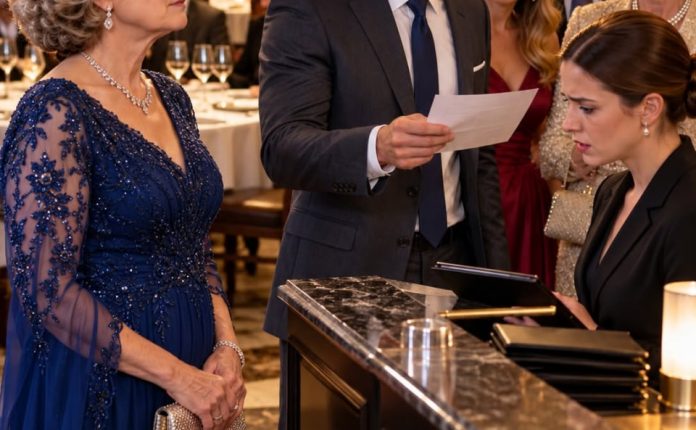
The first thing I heard was my son telling a stranger that he had permission to spend thirty-eight thousand dollars of my money.
The second was my daughter-in-law assuring that stranger I could no longer be trusted to understand my own finances.
"Margaret gets confused about these arrangements," Vanessa said. "Adam handles the paperwork now."
I stood just beyond the restaurant's marble entrance column, holding a receipt for eighty-six dollars.
For several seconds, I didn't move.
There are moments when a mother recognizes her child's voice but not the person speaking.
This was one of them.
My name is Margaret Whitmore. At sixty-eight, I have lived through a difficult childhood, a marriage that survived forty years, the death of a husband I adored, and the complicated experience of raising a son who grew steadily less interested in knowing me.
I had never expected to add financial betrayal to that list.
The afternoon had begun quietly.
I woke shortly after six, as I usually did, and reached across the bed before remembering that Thomas had been gone for almost four years.
Grief changes shape with time.
In the beginning, it had been a heavy, obvious thing. I could hardly enter the garage without crying because his gardening gloves still hung from a nail.
Later, it became smaller and more particular.
The empty space beside the coffee maker.
A television program he would have enjoyed.
The absence of anyone calling from another room to ask where the good scissors had gone.
Mother's Day brought its own difficulties.
For thirty-five years, Adam had occupied the center of that day.
As a little boy, he used to arrive at my bedroom carrying breakfast on a tray, usually with the orange juice spilled into the scrambled eggs.
When he was twelve, he bought me a tiny silver heart with money from mowing lawns.
At seventeen, embarrassed by such displays, he left a card beside the kitchen sink and pretended not to care whether I found it.
I still have every card.
The silver heart is in my jewelry box.
That morning, I took it out, held it briefly, and put it away again.
Three weeks earlier, I had suggested dinner together.
Adam was forty-three, married to Vanessa Price Whitmore, and working in commercial property development.
His schedule was always busy. I understood that.
What I didn't understand was why spending two hours with me had become such a difficult obligation.
I had called him on a Tuesday afternoon.
Vanessa answered.
"Hello, Margaret."
"Good afternoon, dear. Is Adam available?"
"He's in a meeting. What's this about?"
"I wanted to invite you both to dinner on Mother's Day."
There was a pause.
"We've already planned something with my parents."
"Of course. Would you prefer lunch?"
"Margaret, we're making a whole day of it."
"Then perhaps I could join you."
Her response came quickly.
"It's really a family occasion."
I looked through my kitchen window.
A pair of sparrows were arguing over the bird feeder Thomas had built.
"Vanessa," I asked, "am I not family?"
She laughed softly.
"Please don't be dramatic. Adam has responsibilities to his new family."
His new family.
As though marriage had erased the first thirty-five years of his life.
I could have argued.
Instead, I said, "Tell him I called."
"I will."
He never returned the call.
At first, I told myself he had forgotten.
Then I admitted something more painful.
Adam had been forgetting me deliberately for quite some time.
Not everything about our relationship had changed overnight.
There had been small moments.
The Christmas dinner when Vanessa seated me at the far end of the table beside a distant cousin.
The weekend when Adam borrowed Thomas's old tools and returned only half of them.
The birthday when he sent flowers selected by an assistant, with a card addressed simply to Margaret.
I had accepted these disappointments individually.
Together, they formed a picture I had been reluctant to examine.
On Mother's Day morning, my telephone remained silent.
At ten, I watered the plants in the sunroom.
At eleven, I made coffee and read the newspaper.
At noon, I considered ordering takeout and spending the evening with an old film.
Then I looked at the navy suit hanging inside my wardrobe.
Thomas had loved that suit.
He said it made me look as though I could negotiate a peace treaty before breakfast.
I put it on.
At my dressing table, I fastened the pearl brooch he had given me for our twenty-fifth anniversary.
It was shaped like a small cluster of leaves.
One pearl had a faint gray streak that Thomas had insisted made it special.
I touched the brooch, remembering the way he had pinned it on me himself.
"All right," I told the empty room. "I'm going out."
Bellavita stood on a downtown Boston street where old brick buildings had been carefully restored and expensive cars waited at the curb.
Its entrance had tall windows, polished brass handles, and two olive trees growing in enormous terracotta pots.
The restaurant had opened long before it became fashionable.
I remembered its first location, much smaller and considerably less elegant.
Back then, Bellavita had been struggling.
Its founder, Lorenzo Bellini, was a gifted chef but a nervous businessman.
Thomas and I had known Lorenzo for years. When his original restaurant nearly closed, Thomas suggested we invest.
I had been the cautious one.
"Restaurants fail every day," I told him.
"True," Thomas replied. "But Lorenzo makes the best food I've ever eaten, and people come back for it."
We investigated the finances.
We negotiated protections.
We invested, not as a favor, but as partners.
When the business expanded, we supplied additional capital.
Eventually, after Lorenzo retired from daily management, our family holding company became Bellavita's controlling shareholder.
Thomas never cared much for displaying wealth.
Neither did I.
Our names were rarely mentioned outside ownership meetings.
Bellavita's operating managers ran the restaurants. I reviewed budgets, approved major investments, and stayed out of everyday decisions unless necessary.
That arrangement suited everyone.
My son knew the broad outlines.
He had grown up hearing conversations about restaurants, investments, and business decisions around our kitchen table.
He knew Thomas and I had helped build Bellavita.
What he did not fully understand was how ownership worked after his father's death.
He seemed to have decided that because I was getting older, the family assets were becoming his.
No one had ever told him that.
I certainly had not.
At Bellavita, the hostess greeted me warmly.
"Good afternoon, Mrs. Whitmore."
"Hello, Clara. Is there room for one?"
Her expression softened.
"Of course. We have a lovely table by the window."
I thanked her.
A younger employee brought menus, and my waiter, Daniel, offered a glass of sparkling water.
I ordered mushroom ravioli with sage butter, a green salad, and coffee.
The dining room was busy.
At the table beside mine, three generations of women were laughing over photographs on a telephone.
Across the room, a small boy presented his grandmother with a rose that had lost most of its petals.
She treated it as though it were a priceless treasure.
Watching them hurt more than I expected.
Not because I resented their happiness.
Because I remembered having something similar.
I took my time with dinner.
The ravioli arrived hot, its edges delicate and the mushrooms fragrant with thyme.
I ate slowly and watched sunlight move across the white tablecloth.
Daniel asked whether everything was satisfactory.
"Very much so."
"Would you care for dessert?"
"Not today, thank you."
I requested the check.
It came to eighty-six dollars.
I paid with my own card.
That detail matters.
My Founder's Reserve membership included a private account used for legitimate ownership-related hospitality and approved personal benefits.
It was not an unlimited invitation to charge every family celebration to the restaurant.
Thomas and I had deliberately established rules separating business expenditures from personal expenses.
I followed those rules.
I expected my son to do the same.
As I stood, Daniel came to collect the signed receipt.
"I hope you've had a pleasant afternoon."
"I have," I replied.
And in a small way, I meant it.
I had survived the day without waiting beside a telephone.
That felt like progress.
Then I reached the entrance.
Adam was standing beside the reception desk.
For an instant, I was genuinely pleased to see him.
My first foolish thought was that he had come looking for me.
Then I noticed Vanessa.
She wore a pale cream dress and earrings that caught the light whenever she moved.
Beside her stood her father, Graham Price, whose silver hair and expensive watch were as carefully presented as his smile.
Celeste Price stood on his other side, holding a structured leather handbag.
Behind them were six relatives from Vanessa's family.
They were discussing drinks and a private dining room.
Adam noticed me.
His face changed.
"Mom?"
"Hello, sweetheart."
"What are you doing here?"
"I had dinner."
"Here?"
"Yes, Adam. People do occasionally eat in restaurants."
A faint smile crossed my face.
He didn't return it.
Vanessa looked behind me toward the table Daniel was clearing.
"Did you come alone?"
"I did."
"How depressing."
I felt the comment settle between us.
"It was a nice meal."
Celeste tilted her head.
"Some mothers have difficulty adjusting when their children become independent."
I looked at Adam.
He said nothing.
Graham glanced toward the dining room.
"Well, we're meeting with the events manager, so we'd better get on with it."
I stepped aside.
"Enjoy your evening."
I was nearly at the doors when Adam spoke again.
"The membership number is 000147."
I stopped.
He continued.
"Margaret Whitmore. You can put the whole reception against that account."
I turned slightly.
Sofia Martinez, Bellavita's general manager, stood behind the reception counter.
She was thirty-one, sharp-eyed, and unusually composed under pressure.
I had known her since she joined the business as an assistant manager.
She knew who I was.
More importantly, she knew what the Founder's Reserve account permitted.
"Mr. Whitmore," Sofia said, "I'm going to need the account holder's authorization."
Adam took a folded paper from his jacket.
"Already handled."
He placed it on the counter.
Vanessa moved closer.
"Margaret's been forgetting some of her financial arrangements lately. Adam helps her manage things."
Sofia did not react.
"Is Mrs. Whitmore aware of this booking?"
"Naturally," Adam answered.
Graham leaned forward.
"The reception totals thirty-eight thousand dollars. We chose the full package, including the private dining room, the wine service, and the entertainment."
Thirty-eight thousand dollars.
I looked at the people gathered around my son.
They had excluded me from Mother's Day dinner.
Now they were arranging an expensive celebration in my restaurant with my account.
I could hear Thomas's voice from years ago.
When people become evasive about money, ask for the documents before arguing about the amount.
He had taught me that during our earliest investments.
It was good advice then.
It was good advice now.
Sofia examined the paper.
"Who prepared this authorization?"
"My mother."
"Did she sign it in your presence?"
Adam hesitated.
"She gave it to me."
"When?"
"A few weeks ago."
"Do you remember the date?"
"Why does that matter?"
"Because the document appears to reference an earlier version of our authorization procedure."
Vanessa sighed.
"Is this really necessary?"
"Yes," Sofia said.
Something in her tone made Graham straighten.
Adam removed his telephone.
"If this is going to take all afternoon, we'll take our business elsewhere."
"You're welcome to make that decision," Sofia replied. "But this account cannot be charged without verification."
I knew I had to intervene.
Not because I wanted a confrontation.
Because my son had produced a document bearing my name.
And if he was willing to use it here, I needed to know where else he might have used it.
"Adam."
My voice wasn't loud.
It carried anyway.
He turned.
For a moment, he looked like a child caught breaking something valuable.
Then his expression hardened.
"Mom, I thought you'd gone."
"Apparently."
Vanessa stepped forward.
"Margaret, this isn't the time."
"Then I'm curious why my name is being discussed."
Adam glanced at Sofia.
"We're handling a family booking."
"With my membership?"
"It's a family account."
"No," I said. "It belongs to me."
Graham gave a polite, impatient smile.
"I'm sure this is a misunderstanding."
"Perhaps," I answered. "That's why I'd like to see the document."
Adam held out his hand toward Sofia.
"Give it back. I'll explain everything to her later."
Sofia placed one hand over the paper.
"Mrs. Whitmore has asked to review it."
"She's not involved in the arrangements."
I looked directly at him.
"Adam, the arrangements involve my account."
He opened his mouth.
I raised one finger.
"Please let me finish."
Something in my voice stopped him.
I turned toward Sofia.
"Would you preserve that document and any electronic copies?"
"Certainly."
"Please don't return the original to anyone until it has been reviewed."
"Understood."
Vanessa folded her arms.
"You're making this unnecessarily hostile."
"I'm asking for ordinary business records."
Then Sofia turned her computer screen slightly toward me.
"There's something else you should know."
I moved closer.
She pointed to a section of the account history.
"Earlier this week, someone requested that membership confirmations be redirected to a different email address."
I recognized the address.
It belonged to Adam.
I stared at the screen.
The restaurant had always sent my account notices directly to me.
I had never requested a change.
"Who submitted that instruction?" I asked.
"According to the record, Mr. Whitmore."
I turned toward him.
"Why were you redirecting my notices?"
He looked away.
"Because you don't always read them."
"That's not an answer."
"It was supposed to make things easier."
"For whom?"
Nobody replied.
I asked Sofia whether the change had been completed.
"No. It was flagged for verification and remained pending."
Relief came so quickly that I almost felt dizzy.
At least the system had worked.
At least there was one boundary Adam had not crossed.
But another thought followed.
If he had been trying to intercept my notices, this was not simply a mistaken dinner reservation.
He had expected the expenditure to be processed without my knowledge.
He had planned for me not to see it.
Sofia opened a secure file.
"Mrs. Whitmore, would you like to continue this conversation privately?"
"Yes," I said.
Adam immediately reached for the folded authorization.
Sofia moved it out of his reach.
"I'll be retaining this."
"That's my document," he protested.
"It concerns Mrs. Whitmore's account."
He looked at me.
"Mom, tell her to stop."
I studied his face.
The familiar jaw.
Thomas's eyes.
The little crease beside his mouth that appeared whenever he was anxious.
I knew every feature.
Yet I could not understand how he had arrived at this moment.
"Adam," I said, "did I authorize this reception?"
He drew a breath.
"You said you'd always help us."
"Did I authorize this particular charge?"
Vanessa interrupted.
"Your mother doesn't need to be interrogated in public."
I turned toward her.
"Then perhaps you can answer. Did you see me sign that paper?"
Her lips parted.
"No."
I looked at Graham.
"Did you?"
"No, but Adam assured us—"
"Thank you."
Finally, I returned to my son.
"Did you see me sign it?"
His eyes flickered toward Sofia.
"I handled the arrangements."
"That wasn't my question."
He lowered his voice.
"You're embarrassing me."
For years, I had been afraid of embarrassing him.
I had kept quiet when he dismissed my opinions.
I had overlooked visits that ended in requests for money.
I had apologized for asking ordinary questions about his life.
Now he was standing in a business I controlled, attempting to charge a reception to my account, and telling me I was causing the embarrassment.
I felt something inside me grow very still.
"Sofia," I said, "please place an immediate hold on any pending charges against membership 000147."
"Of course."
"Preserve the relevant records."
"Yes, ma'am."
"And inform the events department that no contract involving my membership is to be finalized without my direct written approval."
Adam stared at me.
"You can't just cancel our event."
"I haven't canceled anything yet."
"You know what I mean."
"I know exactly what you've requested."
Graham looked between us.
"Margaret, perhaps we should sit down and discuss this like adults."
"I agree."
I glanced toward Sofia.
"Is the small conference room available?"
"It is."
"Then let's go there."
Adam stepped closer.
"Mom, this is ridiculous."
I lowered my voice so only he could hear.
"Your father taught you better."
His face flushed.
"Don't bring Dad into this."
I looked at the forged-looking paper resting beneath Sofia's hand.
"Then don't use the things he left us as though they belong to you."
For the first time that afternoon, Adam had nothing to say.
We followed Sofia through a side corridor lined with photographs of Bellavita's earliest years.
Near the end hung one of Thomas and Lorenzo standing outside the original restaurant.
Thomas wore a terrible brown tie.
I remembered taking the picture.
Adam walked past without looking at it.
Inside the conference room, Sofia placed the document on the table.
A staff member brought water.
Nobody touched it.
I sat opposite my son.
Vanessa positioned herself beside him.
Her parents took the remaining chairs.
The six other relatives stayed in the lounge, unaware of how serious the conversation had become.
Sofia opened the folder.
"This is the authorization the events department received."
She slid a copy toward me.
I recognized the blue border.
The printed membership number.
The familiar address.
And beneath my name, a signature attempting to resemble mine.
I bent closer.
The last letter was wrong.
My signature ended with a small upward stroke, a habit developed after decades of signing business papers.
Whoever had copied it had dragged the pen downward.
It was a tiny difference.
But it was enough for me to know that I had not signed it.
I straightened.
"Adam, where did this come from?"
He rubbed his forehead.
"You gave me a stack of papers."
"No. You asked to photograph some of Thomas's estate documents."
"Same difference."
"It is not the same difference."
He leaned back.
"Fine. I prepared the form because you always make these things complicated."
I stared at him.
"Did you write my name?"
He did not answer.
Vanessa reached for his hand.
"Margaret, we can settle the charge privately. There's no reason to involve anyone else."
"I didn't agree to pay it."
"But you can afford it."
That sentence changed the room.
I looked at her.
"Affording something is not the same as agreeing to it."
She stared at the table.
Graham cleared his throat.
"Perhaps we've all made assumptions."
"Then now would be a good time to examine them."
Sofia glanced toward me.
"Mrs. Whitmore, I also need to mention that this membership was used as the proposed guarantee for an event contract."
I frowned.
"Guarantee?"
She nodded.
"The booking request states that the account holder accepts responsibility for any unpaid balance, cancellation charges, and additional expenses."
My attention returned to Adam.
He had not merely tried to use a restaurant benefit.
He had attempted to make me financially responsible for an event I had never approved.
"How much could that obligation become?" I asked.
Sofia checked the paperwork.
"The current package is thirty-eight thousand dollars. Additional services would increase the total."
I looked across the table.
"Adam, did you tell the events department I would guarantee this?"
He swallowed.
"That's how these bookings work."
"No," I said. "That is how they work when somebody actually agrees."
I turned the page.
The date on the authorization was three weeks earlier.
The same week Adam had visited my house.
He had brought flowers.
He had made coffee.
He had told me he wanted to help organize the records Thomas had left.
Now I understood why he had been so interested in my membership file.
I felt a familiar ache begin behind my ribs.
It was not the money.
Money could be recovered or lost.
This was the knowledge that a visit I had treasured might have been planned for another purpose.
I folded my hands.
"Sofia, I'd like a full review of every attempted transaction and account change connected to this membership."
Adam leaned forward.
"You're going too far."
"Perhaps."
I looked at the photograph of Thomas visible through the conference room's glass wall.
Then I turned back.
"But I would rather discover the truth now than spend another year pretending I don't see what's happening."
Sofia nodded.
"I'll contact our financial controller."
Adam stood abruptly.
"We're leaving."
"You're free to leave."
He stared at me.
"You're choosing a restaurant over your family."
I rose slowly.
"No, Adam. I'm refusing to let my family use a restaurant to take something that was never offered."
He looked at Vanessa.
She gathered her handbag without speaking.
Graham and Celeste followed.
At the doorway, my son paused.
"You'll regret making this public."
I answered softly.
"I haven't made anything public. I've asked questions in a private room."
He left.
I stayed beside the table until their footsteps disappeared.
Sofia waited quietly.
After a moment, she asked whether I wanted someone to drive me home.
"Not yet," I said.
I picked up the copy of the authorization.
"There's something I need to check first."
"What is it?"
I studied the bottom of the page.
The form carried a reference number.
I had seen that sequence before.
Not on the restaurant's current membership documents.
On an older packet of estate records Adam had photographed during his visit.
I looked at Sofia.
"Please ask the controller to retrieve the account change requests from the past thirty days."
"Certainly."
"And one more thing."
"Yes?"
"Check whether this form was attached to any other requests."
Sofia's expression sharpened.
"I'll do that."
I looked once more at the imitation of my signature.
My son had been careless enough to attempt this while I was standing nearby.
But he had also been careful enough to prepare documents, redirect notices, and make financial commitments in advance.
Those two facts did not fit neatly together.
I wanted to know why.
END PART 1