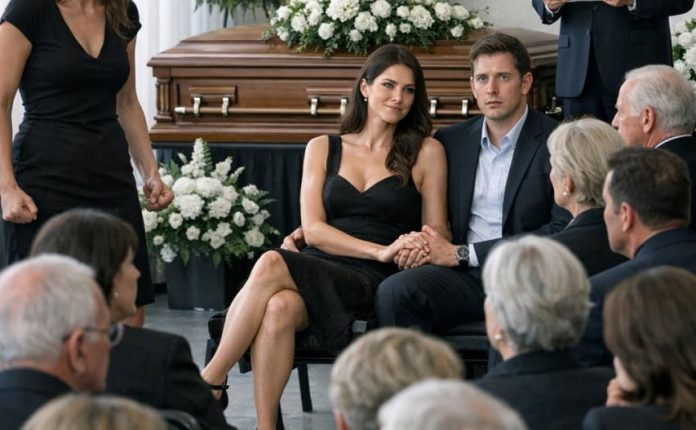
My Versace dress had vanished three weeks earlier, but I never imagined I would find it on my husband's mistress at my father's funeral.
She was sitting beside Grant in the front pew of St. Augustine's Cathedral, holding his hand, wearing the midnight blue silk my father had given me for my fortieth birthday.
For a moment, I couldn't move.
"Natalie," she said pleasantly when she noticed me. "I'm so sorry about your father."
Her name was Rebecca Thornton.
Most people called her Becca.
I had met her twice at Grant's company functions, where she introduced herself as a marketing associate and praised my husband's leadership with rather more enthusiasm than the occasion required.
Now she was wearing my dress.
Not something similar.
Mine.
I recognized the delicate crystal embroidery around the neckline, the unusual blue that shifted toward silver beneath bright light, and the nearly invisible repair beneath the left shoulder.
My father had insisted on having that repair done professionally after I damaged the fabric at his birthday dinner.
He said beautiful things deserved a second chance.
I wondered what he would have said about the woman wearing it now.
"Rebecca," I said, "why are you sitting with my husband?"
She glanced at Grant, then returned her attention to me.
"Because he wanted me here."
Grant stared straight ahead.
His jaw was tight, and his fingers remained tangled with hers.
"Grant."
He finally looked up.
"Not here, Natalie."
I studied his face.
We had been married sixteen years. I knew the difference between his embarrassment, annoyance, and fear.
This was fear.
"Why is she wearing my dress?"
Rebecca looked down at herself.
"Oh, this?"
She smoothed the fabric across her knees.
"Grant said it would be appropriate."
I felt something cold settle in my stomach.
"Appropriate for what?"
"For supporting him," she answered.
I stared at her.
Behind us, a few people stopped speaking.
My aunt Helen, who had been guiding mourners toward their seats, turned in our direction.
"Supporting him?" I repeated. "At my father's funeral?"
Rebecca gave a delicate shrug.
"Grief affects everyone differently."
It was such a ridiculous thing to say that I almost missed the significance of what she was doing.
She wasn't trying to hide.
She wanted to be seen.
She wanted everyone attending my father's funeral to understand that my husband had chosen her.
Even the dress was part of the announcement.
"Take it off," I said.
Grant stood abruptly.
"Natalie."
I didn't look at him.
"That's my dress."
Rebecca tilted her head.
"You're making people uncomfortable."
"My father is lying twenty feet away."
Her expression tightened.
For a fraction of a second, I thought she might apologize.
Instead, she lifted her chin.
"I'm practically family now."
My aunt Helen arrived beside me.
She was seventy-two, dressed in a black wool suit, with a pearl brooch that had belonged to my grandmother.
Helen had spent the morning organizing flowers, helping relatives find their seats, and quietly managing the thousand small details that become unbearable when someone dies.
She looked at Rebecca's hand.
Then at Grant.
Then at my dress.
"Young woman," she said, "you're in the wrong seat."
Rebecca blinked.
"Excuse me?"
"That place belongs to my niece."
"Grant invited me."
Helen's expression did not change.
"Grant was not in charge of the invitations."
Several people looked away, suddenly fascinated by the cathedral's stained glass.
Grant rubbed his forehead.
"Can we please not do this?"
I turned toward him.
"How long?"
He closed his eyes.
"Nat."
"How long have you been sleeping with her?"
Rebecca inhaled sharply.
Helen made no sound.
Grant glanced toward the casket.
"Your father deserves some respect."
I had never wanted to strike anyone more than I wanted to strike my husband in that moment.
Instead, I moved closer.
"Then show him some."
He stepped back.
Rebecca rose halfway from the pew, clutching her handbag.
For the first time, she appeared to realize that the spectators weren't admiring her courage.
They were horrified.
"Let's go," Grant whispered to her.
But Helen put her hand on my arm.
"Sweetheart, come with me."
I wanted to argue.
I wanted to demand the dress immediately, ask Grant for his phone, and force him to explain every night he had come home late.
But I looked toward the altar.
My father's casket rested beneath white roses and blue delphiniums.
He had chosen those flowers for my mother's funeral eleven years earlier.
I remembered him standing beside me then, one hand on my shoulder, his other hand shaking so badly that he couldn't fasten his cuff link.
"One thing at a time, Natalie," he had whispered that morning. "We don't have to survive the whole year today."
I could almost hear him saying it again.
So I let Helen lead me to the other side of the front pew.
Rebecca remained where she was for a moment.
Then Grant guided her toward the back.
I didn't watch them leave.
I kept my eyes on the flowers.
My father had been seventy-six when he died.
His name was Edward Bennett, and he had practiced law in our city for more than forty years.
People respected him because he was thorough, because he kept his word, and because he never pretended to know something he hadn't checked.
He was also stubborn.
When I was twelve, I brought home a report card with one disappointing grade and tried to hide it beneath a stack of library books.
He found it.
Instead of punishing me, he made tea and asked why I thought one bad grade was more dangerous than lying about it.
That conversation stayed with me longer than anything I learned in school.
He raised me to believe that mistakes could be repaired.
Dishonesty was harder.
When I married Grant Whitmore at twenty-nine, Dad welcomed him.
He never treated Grant as an outsider.
He took him fishing.
He introduced him to clients.
He invited him to Sunday dinners even after Grant developed the habit of arriving late with apologies about work.
My husband was intelligent, charming, and ambitious.
He worked for a commercial development firm called Westbridge Partners, eventually becoming a senior executive.
He liked expensive watches, well-cut suits, and restaurants where the waiters remembered his preferred wine.
At first, I found those tastes amusing.
My father called Grant a man who wanted to arrive before he had decided where he was going.
I laughed.
Grant did not.
For years, their relationship remained cordial.
Then something changed.
During the last six months of Dad's life, he began asking questions about Grant's business.
He asked whether the company was financially stable.
He wondered why Grant had recently opened a joint renovation account in our names.
He asked if I understood the investment paperwork Grant wanted me to sign.
I thought Dad was being overly cautious.
He had spent his career imagining worst-case scenarios.
Grant, meanwhile, insisted the commercial property investment was a routine opportunity.
"Your father's a brilliant attorney," Grant said one evening, "but he doesn't understand how development financing works."
I accepted that explanation.
I wanted to believe both men meant well.
I did not know that my father had already begun investigating.
Three weeks before the funeral, I discovered that my Versace dress was missing.
It had been a birthday present the previous autumn.
Dad purchased it after accompanying me to a charity reception where I admired the display in a boutique window.
I told him it was far too expensive.
He went back alone.
On my birthday, he presented the box with the pleased expression of a man who had successfully pulled off a complicated practical joke.
Inside was a card.
For the evenings when you need to remember that elegance can be armor.
He had always loved dramatic language.
I wore the dress only twice.
Once to his birthday dinner.
Once to an anniversary celebration with Grant.
Afterward, I returned it to its garment bag in the bedroom closet.
When I couldn't find it, I searched everywhere.
I checked the cedar chest.
I looked behind winter coats.
I telephoned the dry cleaner.
I even emptied a box of old handbags, although I knew perfectly well the dress couldn't have fit inside.
Grant watched me search one evening.
"Maybe you moved it," he suggested.
"I didn't."
"You've had a lot on your mind."
"That doesn't mean I forgot where I put a dress."
He shrugged.
"Then perhaps the cleaner misplaced it."
I remember feeling guilty about snapping at him.
Dad had been ill.
I was sleeping badly.
Grant seemed patient.
Now I understood that his patience had been the patience of someone waiting for a lie to become accepted.
The cathedral organ began playing.
Helen squeezed my hand.
I sat through the opening hymn with my father's prayer book resting on my lap.
The pages smelled faintly of paper and his familiar aftershave.
When Father Martinez began speaking, I heard his voice but struggled to follow the words.
He described Dad's dedication to his clients, his quiet charitable work, and his fondness for correcting newspaper grammar.
People smiled at that.
Dad had once written a three-page letter to the local editor about a misplaced apostrophe.
I smiled, too.
Then I looked down at the empty space beside me.
Grant should have been there.
Whatever had happened between us, he should have understood that today was about helping me bury my father.
Instead, he had brought Rebecca.
When the congregation stood, I glimpsed them toward the rear of the cathedral.
She was leaning close to whisper something.
He shook his head.
She looked irritated.
I turned away.
After the final prayer, mourners approached me in a slow procession.
Some offered condolences.
Others shared memories.
A retired judge told me that Dad had once stayed in court until nearly midnight to make sure an elderly widow received a fair settlement.
A former secretary remembered that he never forgot a birthday.
One man confessed that Dad had paid his law school tuition anonymously.
I had never known.
Each story made him feel both closer and farther away.
The man I had loved was becoming a collection of memories belonging to everyone.
Near the cathedral doors, Mr. Blackwood approached.
His first name was Arthur, although I had called him Mr. Blackwood since childhood.
He and Dad had practiced law together before Arthur established his own estate practice.
He was tall, silver-haired, and always seemed to carry the faint smell of leather briefcases and peppermint.
"Natalie," he said, taking my hands, "your father would have been proud of you today."
I nodded.
I couldn't speak.
His eyes moved briefly over my shoulder.
I turned.
Grant and Rebecca stood near the entrance.
Rebecca had removed her coat, displaying the dress fully.
Arthur's expression changed.
"Is that the dress Edward gave you?"
"Yes."
He looked carefully at my face.
"Did you lend it to her?"
"No."
His mouth tightened.
"Would you come to my office after the burial? There are matters we need to address."
"I thought the estate meeting was tomorrow."
"Your father requested that certain instructions be reviewed as soon as possible."
"Why?"
Arthur hesitated.
"Because he was worried about you."
I stared at him.
Dad had been worried about me?
I knew he had concerns about Grant.
But I had never imagined they were serious enough to affect his estate.
"Did he tell you something?"
Arthur looked toward the cathedral doors again.
"He told me several things."
Before I could ask more, Aunt Helen called me toward the hearse.
The burial passed in fragments.
A breeze carrying the smell of wet grass.
The metallic scrape of a folding chair.
The pale soil piled beside the grave.
My aunt's hand gripping mine during the final prayer.
When the casket was lowered, my chest tightened so violently that I couldn't draw a full breath.
I had been holding myself together all morning.
Now there was nothing left to hold.
I cried until Helen wrapped both arms around me.
Grant approached after the service.
I saw him coming across the cemetery path, his shoes collecting damp grass.
"Nat."
I stepped away from Helen.
"Where is Rebecca?"
"At the car."
"Of course she is."
He looked exhausted.
"This whole thing has gotten out of hand."
I stared at him.
"Gotten out of hand?"
"I wanted to talk to you privately."
"You brought your girlfriend to my father's funeral."
He looked around.
"Lower your voice."
"Why?"
"People are watching."
I laughed once.
It sounded terrible.
"That's what you're worried about?"
He rubbed the back of his neck.
"Rebecca thought attending would show that we're not hiding anymore."
I felt the ground shift beneath me.
"You're not hiding anymore?"
"That's not what I meant."
"Then tell me what you meant."
He looked toward the parking lot.
The silence stretched.
Finally, he said, "Things haven't been right between us for a while."
I had expected him to deny the affair.
I had expected anger, perhaps a clumsy explanation.
I was not prepared for him to behave as though I should have understood our marriage was ending.
"How long?" I asked.
He said nothing.
"Grant."
"Several months."
I stared at the man I had shared sixteen Christmas mornings with.
The man who brought me coffee when I worked late.
The man who knew I disliked mushrooms and always ordered them separately.
"How many months?"
"Eight."
Eight months.
I thought about birthdays.
Holidays.
The hospital visits Dad had endured.
Grant had visited him twice during those final weeks.
Both times, he had complained afterward about how uncomfortable hospitals made him.
"Did you bring her into our house?"
Grant looked away.
That answered the question.
"Did she take the dress?"
He hesitated.
"She liked it."
I waited.
"She saw it in your closet. I told her she could borrow it."
"Borrow it?"
He sighed.
"It was a mistake."
"She had it altered."
"She said it didn't fit properly."
I looked at him for a long time.
"Did you know she was going to wear it today?"
His silence was different this time.
He knew I could see the answer.
"Rebecca wanted to make a statement," he finally admitted.
"And you allowed it."
"I didn't think she'd actually do it."
I shook my head.
He stepped closer.
"Please, Natalie. We can discuss this when things calm down."
I moved away.
"There is no calm version of what you did."
His expression hardened.
"We still have practical matters to settle."
There it was.
Not an apology.
Not an acknowledgment of the pain he had caused.
Practical matters.
"Like what?"
"The house. Our investments. The accounts."
I remembered my father's question.
Has Grant asked you to sign anything recently?
A cold sensation moved through me.
"Why are you talking about our accounts at my father's grave?"
Grant looked startled.
"I just mean we need to be sensible."
"Did you bring Rebecca because you thought I would agree to something?"
"No."
But his answer came too quickly.
I looked past him toward the black sedan in the parking lot.
Rebecca was sitting in the passenger seat.
She had taken my place there as well.
"I need you to leave," I said.
"Nat."
"Now."
He stood still.
Then he straightened his jacket.
"Fine."
He walked away.
I watched him open the driver's door.
Rebecca leaned toward him before he had even sat down.
The car pulled out of the cemetery.
And something in me stopped waiting for Grant to turn around.
Helen drove me to Arthur Blackwood's office that afternoon.
His practice occupied the second floor of an old brick building overlooking the courthouse square.
Dad used to bring me there when I was little.
I would sit at the reception desk with colored pencils while he and Arthur argued over contract language.
The place looked much the same.
Dark wooden doors.
Green desk lamps.
Framed photographs of judges and attorneys.
The familiar smell of polished furniture.
But Dad was not there.
That absence struck me harder than I expected.
Arthur greeted us personally.
He led us into the conference room, where several folders were arranged across a long table.
My aunt sat beside me.
Grant arrived ten minutes later.
Rebecca accompanied him.
She was still wearing the dress.
Arthur rose.
"Mrs. Thornton, I'm afraid this is a private estate meeting."
Rebecca crossed her arms.
"I'm here with Grant."
"Are you an heir, beneficiary, or legal representative of an interested party?"
She glanced at Grant.
"We're together."
Arthur waited.
Rebecca's cheeks reddened.
Grant cleared his throat.
"She can wait outside."
"But Grant—"
"Please."
She stared at him.
Then she walked into the reception area, her heels striking the wooden floor.
Arthur closed the door.
He opened the first folder.
"Before we begin, Natalie, I need to explain something. Your father revised certain estate instructions shortly before his death."
Grant straightened.
"Revised them?"
"Yes."
"Why?"
Arthur ignored the question.
He looked directly at me.
"Your father signed a personal statement on March seventeenth, the day before his final hospitalization. It was prepared with the proper formalities as part of his estate planning file."
I remembered that date.
It was the day I telephoned Dad after discovering messages on Grant's tablet.
I had been standing in my kitchen, holding the phone with both hands.
Dad had listened to me cry.
I told him I believed Grant was having an affair.
I admitted that I had seen messages from Rebecca.
I told him about a hotel reservation that Grant claimed was connected to a business conference.
And I confessed that I was frightened.
Not only of losing my marriage.
Of discovering that the life I trusted had never been what I thought it was.
Dad asked whether Grant had mentioned financial paperwork.
I told him about the investment documents.
He made me promise not to sign anything.
Then he said he loved me.
It was the last real conversation we had.
Arthur adjusted his glasses.
"Your father wanted me to read the opening portion of his statement to you before discussing the estate."
Grant shifted in his chair.
Arthur began.
"To my daughter Natalie, who called me yesterday about her husband's affair, I want to say what I was unable to say clearly during our conversation."
My breath caught.
Grant turned pale.
Arthur continued.
"You were afraid that learning the truth about your marriage meant you had failed. You have not failed because someone else chose to deceive you. I am concerned, however, that the deception may extend beyond your marriage."
Grant leaned forward.
"What does that mean?"
Arthur raised one finger.
"I'm not finished."
My aunt Helen reached for my hand.
Arthur looked back at the page.
"I have instructed Arthur to examine the financial arrangements presented to you in recent months. Until he has completed that examination, I ask you not to sign anything Grant prepares or recommends."
I felt my pulse beating in my throat.
Arthur continued.
"My daughter has always tried to see the best in people. I admire that quality. But generosity should not require surrendering judgment."
Grant pushed back his chair.
"This is outrageous."
Arthur placed the statement on the table.
"Your father was entitled to express his concerns."
"He never liked me."
Helen turned toward him.
"Edward treated you like a son."
Grant gave an irritated laugh.
"Apparently not."
I looked at him.
For sixteen years, I had explained his sharp comments, his impatience, and his occasional cruelty as the unfortunate side effects of stress.
Now I heard every word without trying to make it kinder.
"Sit down, Grant," I said.
He stared at me.
"Excuse me?"
"You wanted to discuss practical matters. Here's your chance."
Slowly, he sat.
Arthur opened another folder.
"Your father also requested a review of a proposed investment involving Westbridge Partners and an entity called Harbor Point Development Holdings."
Grant's face lost what little color remained.
I recognized the name.
Harbor Point.
That was the project Grant had asked me to support.
He claimed it involved purchasing commercial property near the waterfront.
He said investors expected strong returns.
He wanted me to sign documents allowing us to participate.
I told him I wasn't comfortable risking our savings while Dad was sick.
Grant said the paperwork was routine.
And when I hesitated, he accused me of treating him like an incompetent stranger.
Arthur placed a sheet of paper before me.
"Do you recognize this?"
It was an investment authorization form.
My name appeared at the top.
Beneath it was a signature.
My signature.
Except I had never signed it.
I stared at the page.
"Where did you get this?"
"Your father received a copy through a professional contact who was reviewing the proposed transaction."
Grant made a sharp sound.
"That document doesn't prove anything."
Arthur watched him.
"I haven't said what it proves."
I touched the edge of the paper.
The signature looked like mine.
The shape of the N.
The long lower stroke on the W.
Even the small hesitation before the final letter.
Someone had practiced.
I looked up at Grant.
"Did you sign my name?"
He stared at the document.
"That's not what happened."
"Then what happened?"
He said nothing.
Arthur opened a second folder.
"Your father believed there were additional financial irregularities. He asked me to preserve the records and have them independently examined."
"How much money?" I whispered.
Arthur hesitated.
"The preliminary figures are substantial."
Grant stood.
"I'm leaving."
Arthur remained seated.
"You're free to leave."
Grant looked at me.
"Don't let them turn you against me."
I almost couldn't believe the words.
He had brought his mistress to my father's funeral.
He had allowed her to wear my stolen dress.
Now he was sitting across from me while my father's attorney displayed a document bearing a signature I had not written.
And somehow, Grant believed he was the victim.
"Go," I said quietly.
He stared.
"Natalie—"
"Go."
He left.
Through the glass wall separating the conference room from reception, I watched Rebecca rise when she saw him.
She reached for his arm.
He pulled away.
For the first time that day, they looked less like a triumphant couple and more like two people who had discovered their plans were no longer working.
Arthur waited until the elevator doors closed.
Then he slid another envelope toward me.
"This is what your father wanted you to examine first."
I opened it.
Inside was a printed photograph.
Grant and Rebecca stood outside a hotel.
The image was dated.
I recognized the date immediately.
It was the evening Grant told me he was visiting my father in the hospital.
END PART 1