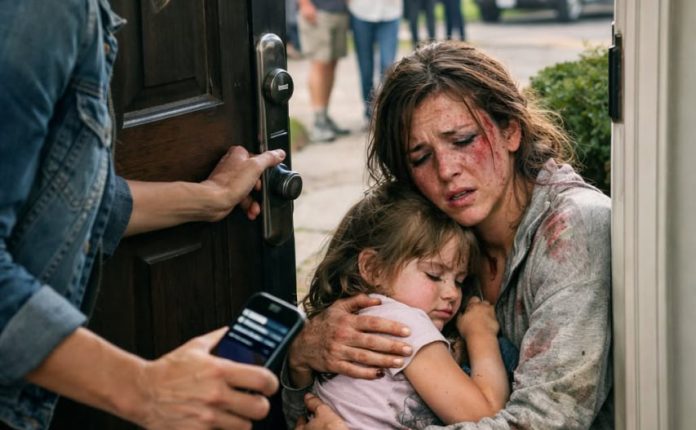
The dispatcher answered before Dean finished his next knock.
“911. What's your emergency?”
“My sister arrived at my apartment injured,” I said. “Her husband followed her here. He's outside my door, and we're afraid he'll try to take her daughter.”
I gave my address.
The dispatcher asked whether I had seen a weapon.
“No.”
Whether the door was locked.
“Yes.”
Whether the man was trying to enter.
“He tried the knob. He's still outside.”
Savannah sat bent forward, holding her ribs.
I explained that her breathing was painful and that she might have serious injuries.
The dispatcher said an ambulance and officers were on their way.
Dean heard enough.
“You called the cops?” he shouted.
I didn't answer.
“Savannah, you are making a terrible mistake.”
His voice had changed. The pleasant, long-suffering husband was gone.
“You don't get to take my daughter.”
Khloe lowered her head.
I wanted to shout back that a child wasn't something a parent could own.
Instead I asked the dispatcher to stay on the line.
Dean finally walked away.
We heard the elevator open, his footsteps disappearing, and eventually a car engine starting outside.
Savannah began shaking harder.
“He'll call Mom.”
“Then Mom can answer some questions too.”
“You don't understand.”
“Then tell me.”
She looked at Khloe.
“Not everything in front of her.”
That was fair.
I brought Khloe a glass of water and asked whether she'd like to sit in the kitchen where she could see us but wouldn't have to listen to every conversation.
“No,” she said. “People always talk about me like I'm not there.”
The words stung.
I pulled a chair beside her.
“Then we'll speak to you too.”
Khloe considered that.
“Okay.”
She handed me the locket.
The silver flower had a tiny scratch crossing its center.
“Mom put a little card inside,” she explained. “She said we needed somewhere Daddy wouldn't look.”
Savannah reached toward the necklace.
“I recorded them using the old camera I keep in the sewing box. It records sound onto a memory card. Dean checks my phone, so I couldn't keep it there.”
“Why didn't you call me?”
My sister looked exhausted.
“Because for the last year Mom kept telling me you thought I was using Khloe to get sympathy. She said you didn't want us here.”
I felt something twist beneath my ribs.
“Savannah, I never said that.”
She looked up.
“She told you I thought you were dangerous.”
“Yes.”
“Then maybe we should stop letting her speak for us.”
Savannah opened her mouth, but a knock interrupted her.
“Police.”
The dispatcher confirmed the officers' arrival.
I opened the door with the chain still attached.
Two officers stood outside, a woman and a man. Their uniforms were damp from the mist. The woman introduced herself as Officer Elena Ruiz.
I removed the chain.
Officer Ruiz took one look at Savannah and asked whether paramedics had been called.
“They're coming,” I said.
Her partner checked the hallway while she approached my sister.
“Ma'am, can you tell me what happened tonight?”
Savannah glanced at me.
I sat nearby but allowed her to answer.
“My husband hit me.”
The statement sounded almost too small for the damage visible on her face.
Officer Ruiz didn't rush her.
“Where did this happen?”
“At our house.”
“Is your husband here?”
“He left. I think.”
“Has he threatened you before?”
Savannah stared at the floor.
“Yes.”
There it was.
One word, spoken aloud in front of someone who wasn't part of our family.
Officer Ruiz wrote it down.
The paramedics arrived a few minutes later.
One examined Savannah's eye while the other checked her breathing and vital signs.
When he gently touched her left side, she cried out.
“We need to get you evaluated at the hospital.”
Savannah looked at Khloe.
“I can't leave her.”
I moved closer.
“I'll take her.”
“No.”
The force of her answer surprised me.
She reached for Khloe's hand.
“I want her with me.”
The paramedic nodded.
“We can coordinate that.”
Khloe's wheelchair could not fit safely into the ambulance alongside all the medical equipment, so Officer Ruiz arranged for me to follow with Khloe in my accessible van.
I had bought the van years earlier, partly because transporting Khloe in Dean's vehicle always required asking his permission.
Dean had complained about the purchase.
I remembered him saying it was unnecessary for a woman who rarely saw her niece.
Now I wondered whether that had been the point.
Before we left, Officer Ruiz asked about the threatening messages.
I showed her both.
Her expression tightened at my mother's text.
“May I photograph these?”
“Yes.”
She documented the messages and recorded the numbers.
Then she asked Khloe whether she had seen what happened.
Khloe looked at Savannah.
“Daddy pushed Mommy against the kitchen counter.”
Savannah closed her eyes.
“He was angry because she said we were leaving.”
Officer Ruiz knelt beside the wheelchair.
“Thank you for telling me. You don't need to explain everything tonight.”
Khloe touched the locket hanging open in my hand.
“Will somebody listen to what Grandma said?”
The officer looked at Savannah.
“Is there a recording?”
Savannah nodded.
“It's on a memory card.”
Officer Ruiz explained that she wanted to preserve it properly and asked that we avoid altering it or passing it around.
I put the card and locket into a clean envelope, noted where they had come from, and handed them over after Savannah agreed.
A small piece of evidence.
Something our mother had never imagined would reach anyone outside her carefully controlled family.
At the hospital, the fluorescent lights made Savannah look worse.
Her skin had turned gray beneath the bruises.
A nurse brought Khloe a warm blanket and asked whether she wanted apple juice.
Khloe said no.
Then, after a moment, “Do you have chocolate milk?”
The nurse smiled.
“I'll see.”
Savannah was taken for imaging.
I remained with Khloe in the waiting area.
At 3:46 a.m., my phone rang.
Mother.
I let it ring.
She called again.
Then a message arrived.
You have no idea what Savannah has done. Bring Khloe home before this becomes permanent.
I read the message while Khloe watched the television mounted above the waiting-room chairs.
An early-morning advertisement showed a cheerful family eating breakfast.
Everyone was laughing.
I wondered how many people watching that same advertisement were sitting somewhere frightened of the people who were supposed to love them.
Another message appeared.
Dean says Savannah attacked him. Don't make yourself an accomplice.
I showed it to Officer Ruiz when she returned.
She photographed that too.
“Has your mother been involved in earlier incidents?” she asked.
I hesitated.
There were years of incidents.
Harsh words. Financial pressure. Threats. Humiliation disguised as concern.
But I needed to distinguish what I knew from what I suspected.
“I've personally heard her threaten to withdraw support if Savannah disobeyed her,” I said. “I've never witnessed Dean strike Savannah.”
Officer Ruiz nodded.
“That's helpful. Keep those distinctions clear.”
A doctor came out shortly before five.
Savannah had two fractured ribs, extensive bruising, and a mild concussion. She would need observation, pain management, and follow-up care.
The injuries were serious, but she was stable.
I exhaled for what felt like the first time in hours.
Then the doctor added something that made my stomach tighten.
“Your sister says this wasn't the first incident.”
I looked through the glass toward her room.
Savannah lay on the bed with her eyes closed.
Khloe sat beside her, chocolate milk untouched in her lap.
The doctor spoke quietly.
“There are older injuries that deserve further assessment. She's also described a pattern of intimidation and control.”
I knew what he meant.
I also knew my sister had been living with it while I was telling myself she simply didn't want me around.
Across the corridor, the elevator doors opened.
Patricia stepped out wearing a cream coat, pearl earrings, and the expression she used when someone had embarrassed her in public.
Dean walked beside her.
Our mother spotted Khloe first.
“There you are, sweetheart.”
She opened her arms.
Khloe did not move.
Patricia's smile faded.
Then she looked at me.
“Madeline,” she said, using my full name as though I were still a disobedient teenager. “We need to discuss what you've done.”
END PART 2