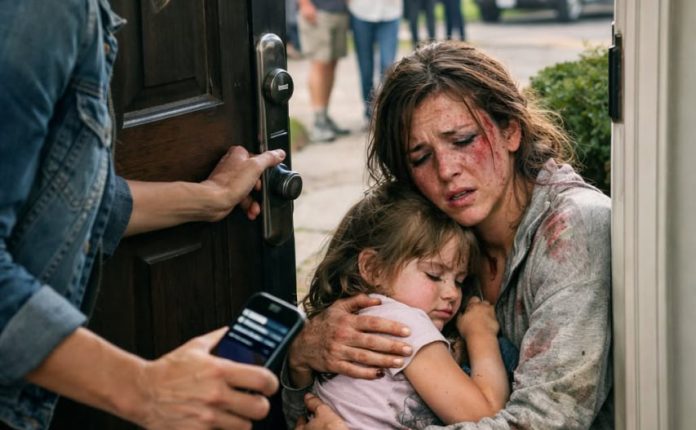
By late morning, I had learned that a hospital can become its own little world.
Outside, people were driving to work, buying coffee, walking dogs, and complaining about traffic.
Inside Savannah's room, we measured time by medication rounds, blood-pressure checks, and the footsteps of nurses.
Khloe was coloring a picture of a yellow house.
It had a ramp leading to the front door.
Three stick figures stood beside a flower bed.
I recognized Savannah by her blond hair.
Khloe had drawn herself wearing purple.
The third person had brown hair and an oversized green sweatshirt.
“Is that me?” I asked.
She nodded.
“You don't have to draw me if you don't want to.”
“I want to.”
I swallowed.
“That house looks nice.”
“It has no stairs.”
“A good feature.”
“And nobody yells.”
I couldn't answer immediately.
Savannah was watching us from the bed.
She had heard.
I could tell by the way she turned toward the window.
That afternoon, an attorney named Rebecca Hale met with my sister.
Rebecca worked with a local legal assistance organization and had experience with protective orders and family court matters.
She spoke calmly, without promising a quick or easy solution.
“First,” she said, “we need to separate three issues. Your immediate safety, Khloe's immediate safety, and whatever custody proceedings your husband may initiate.”
Savannah nodded.
Rebecca asked about Dean's threats, the financial records, and the documents Patricia had brought to the hospital.
“Can he really say I can't care for Khloe because she uses a wheelchair?” Savannah asked.
“He can make claims,” Rebecca replied. “But claims aren't findings. We need the actual evidence, and we need to respond to anything formally filed.”
Khloe was with a hospital child-life specialist for part of the appointment.
Savannah had requested that privacy.
I sat beside her as Rebecca went through the history.
It was painful listening to my sister explain her marriage.
Not because of one extraordinary incident.
Because of the ordinary details.
Dean deciding which groceries were necessary.
Dean turning off access to the shared credit card after arguments.
Dean telling the school office that Savannah was forgetful.
Dean offering to help with Khloe's physical therapy appointments, then later complaining that Savannah couldn't manage without him.
The same pattern appeared again and again.
He created obstacles.
Then he kept records of her struggling to get around them.
Rebecca took careful notes.
“Do you have any messages showing he restricted access to money?”
Savannah nodded.
“Some. I saved screenshots in an email account he doesn't know about.”
“Good. Don't delete anything.”
“What about Mom?”
“What about her?”
“She was helping him.”
Rebecca looked at her.
“What makes you believe that?”
Savannah glanced at me.
“The recording.”
Rebecca asked whether the police had the original card.
“Yes.”
“Then we'll work with them through the proper process. Tell me what you personally heard.”
Savannah closed her eyes.
She remembered Dean saying that Khloe's care was expensive.
She remembered Patricia saying that expenses needed to be managed.
She remembered the phrase temporary guardianship.
Then Dean had said something about Savannah's inheritance.
Rebecca stopped writing.
“What inheritance?”
Savannah looked confused.
“Grandma Eileen left me some money. Mom said it was put into a trust years ago.”
“Do you have the documents?”
“No.”
“Have you ever received statements?”
“Mom handled everything.”
Rebecca wrote another note.
I felt a familiar irritation rising.
Grandma Eileen had been careful with money.
She'd worked as a bookkeeper until her retirement, clipped coupons from newspapers, and saved every birthday card she'd ever received.
When she died, Patricia had taken charge of the paperwork.
She said it would be simpler.
Nobody argued.
Not Savannah, who was overwhelmed raising a young child.
Not me, who was stationed overseas.
I had asked once about Grandma's estate.
Patricia told me the lawyers had handled it.
I let the matter go.
Now I wondered what she'd omitted.
Rebecca cautioned us not to jump to conclusions.
“An inheritance may or may not be relevant,” she said. “We need records.”
She asked Savannah to give her written authorization to request available documents.
My sister signed.
Her hand shook so badly that I held the paper steady.
After the lawyer left, Savannah fell asleep.
I sat beside Khloe in the family waiting room.
She was trying to fit a blue puzzle piece into the wrong corner.
I didn't correct her.
After several attempts, she turned it around and smiled.
“Aunt Maddie?”
“Yeah?”
“Is Grandma going to jail?”
I set my coffee down.
“I don't know.”
“Would you be sad?”
I considered the question.
“I might be sad about what happened. That doesn't mean people shouldn't be responsible for their choices.”
Khloe nodded thoughtfully.
“Mom says you can miss someone and still not want them near you.”
“Your mom is right.”
She pressed the blue piece into place.
Then she said, “Grandma used to be nice to me.”
I remembered Patricia bringing Khloe expensive birthday presents.
Pretty dresses that were difficult to manage in her wheelchair.
A dollhouse that could only be reached from the floor.
Gifts chosen for how they looked in photographs.
“Sometimes people do nice things and hurtful things,” I said.
“Which one is the real person?”
I looked at her.
Both, I thought.
But that answer felt too complicated for a child who had spent the night listening to adults threaten her mother.
“It's important to notice how they treat you when you're not doing what they want.”
Khloe considered that.
“Grandma didn't like when I said no.”
“Then she needs to learn to respect it.”
Before dinner, Officer Ruiz called.
The neighbor's camera had captured more than the driveway.
There was a second angle looking across the side yard, with a partial view of the kitchen window.
It didn't record clear audio.
But it showed the argument.
Dean advancing toward Savannah.
Savannah stepping backward.
A sudden movement.
Savannah hitting the kitchen counter.
Patricia standing nearby.
And Khloe, visible in her wheelchair, trying to move toward her mother.
The footage did not show every detail, and I knew a court would examine it carefully.
Still, it contradicted Dean's account of a mutual struggle.
More importantly, Patricia had been standing close enough to see.
When Savannah learned this, she stared at the wall for a long time.
“Mom watched?”
I sat beside her.
“She was there.”
“She watched him hurt me?”
I didn't pretend the video showed more than it did.
“She was standing in the kitchen when it happened.”
Savannah turned away.
For several minutes, she said nothing.
Then she whispered, “When I was little, I used to believe that if something really bad happened, she'd finally choose me.”
I reached for her hand.
“She should have helped you.”
Savannah began to cry.
Not loudly.
Just a steady, exhausted grief.
I sat with her until she fell asleep again.
At 9:17 that night, Rebecca called.
She had located a probate record from Grandma Eileen's estate.
There was indeed a trust.
But it wasn't simply a small inheritance set aside for Savannah.
The documents named Khloe as an intended beneficiary too.
And according to the most recent publicly available filing, Patricia was still acting as trustee.
Rebecca paused.
“There are financial questions we need answered.”
I looked toward Savannah's hospital bed.
Her daughter was sleeping beside her.
“Questions about what?”
“About money that may have been meant for Khloe's care.”
END PART 4