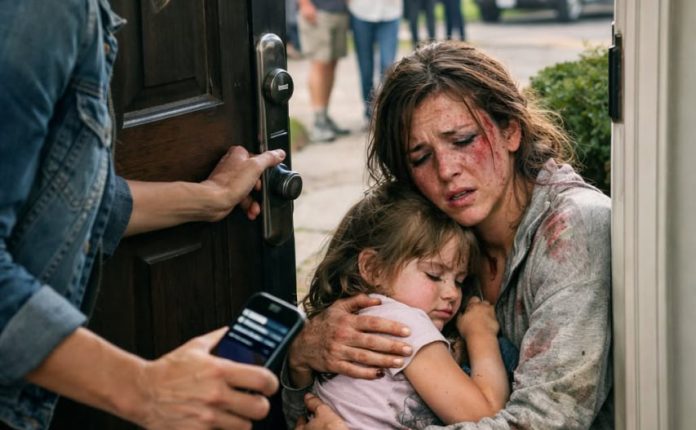
Savannah was discharged four days after she arrived at my apartment.
The doctor gave her instructions about her ribs, concussion symptoms, pain medication, and follow-up appointments.
Rebecca helped coordinate a safety plan.
Savannah agreed to stay with me temporarily.
She also began pursuing a protective order.
I cleared out my spare bedroom.
The room had been my office, which mostly meant it contained an old printer, three boxes of paperwork, and exercise equipment I pretended to use.
Khloe supervised from the doorway.
“You need a bigger desk,” she observed.
“I need less junk.”
“You have a lot of junk.”
“Thank you.”
She pointed toward a shelf.
“Are those medals?”
“Some of them.”
“Can I see?”
I brought down a small wooden case.
Khloe examined the medals carefully, asking what each represented.
When she reached a photograph of me in uniform beside three other women, she looked up.
“Were you scared?”
“Sometimes.”
“Did anybody know?”
“Usually.”
She considered that.
“Mom tries to hide when she's scared.”
“She's had reasons.”
“Can you tell her she doesn't have to do that here?”
I sat on the edge of the bed.
“Would you like to tell her together?”
Khloe smiled.
“Yes.”
We converted the room into a bedroom with enough space for her chair to turn comfortably.
I ordered a portable ramp for the small step between the living room and kitchen and arranged for a proper accessibility assessment rather than relying on guesses.
The apartment was not perfect.
The bathroom needed changes.
The bedroom door was narrower than ideal.
But it was a beginning.
Savannah insisted on helping within the limits of her recovery.
She folded towels.
She chose curtains.
She made lists of everything Khloe would need at school.
Then she apologized for taking up space.
I told her she didn't need to.
She apologized for apologizing.
I nearly laughed, but stopped when I saw her expression.
Some habits weren't funny when you understood where they came from.
Rebecca continued working on the legal issues.
Dean had filed a petition seeking temporary custody, alleging that Savannah had become unable to provide consistent care.
His filing referred to missed appointments, financial instability, and what he described as an emotionally volatile household.
He also asserted that Savannah had caused the confrontation leading to her injuries.
Savannah read the petition at my kitchen table.
Her face reddened.
“He's using every bad day I've ever had.”
Rebecca nodded.
“Then we answer with records and accurate context.”
Together they gathered school attendance reports, appointment confirmations, messages, and testimony from professionals familiar with Khloe's care.
A physical therapist who had worked with Khloe for years described Savannah as consistently engaged.
A teacher provided records showing that Savannah communicated regularly about accommodations and classroom needs.
The school's accessibility coordinator confirmed that Savannah had advocated for Khloe to participate fully in field trips rather than be excluded.
None of those people could decide custody.
But their records provided a fuller picture than Dean's selective examples.
Meanwhile, the trust investigation became more complicated.
Rebecca referred Savannah to an attorney experienced in trust disputes, Daniel Price.
Daniel reviewed the estate documents and the limited financial information available.
He requested a formal accounting.
Patricia resisted.
Her attorney argued that all expenditures had been for legitimate care and family support.
Daniel explained that labels on payments did not settle the question.
“We need to see who received the money, what services were actually provided, and whether the expenses were authorized.”
Savannah listened.
Then she asked, “If the money's gone, can it come back?”
Daniel didn't promise.
“Depending on what happened, there may be remedies. But first we establish the facts.”
The first meaningful breakthrough came from a routine bank record.
One of the trust's statements showed recurring payments to Mercer Family Services.
Some were modest.
Others exceeded several thousand dollars.
A particularly large payment had been described as a care coordination retainer.
Savannah stared at the entry.
“That was the month Dean told me we couldn't afford a new seat cushion for Khloe.”
The cushion had worn unevenly.
Khloe had complained about discomfort.
Savannah spent weeks trying to get approval for a replacement.
Dean told her insurance was difficult and the household needed to be patient.
Yet the trust had paid his company a substantial amount that same month.
Daniel asked Savannah whether she had ever signed a contract for care coordination.
“No.”
Had Khloe received services from Mercer Family Services?
“Not that I know of.”
Had Dean mentioned being paid for those services?
“Never.”
Daniel noted her answers.
He didn't call it fraud.
Not yet.
The company could have records we hadn't seen.
But the discrepancy demanded an explanation.
Two weeks after Savannah moved in, my mother appeared at the apartment building.
She didn't come to my door.
Instead, she waited near the entrance when Khloe's school transportation arrived.
I learned about it from a call Savannah received from the school transportation coordinator.
Patricia had approached Khloe and told her Grandma was waiting for her to come home.
The driver kept Khloe on the vehicle, followed the safety instructions on file, and called Savannah.
Khloe was frightened but unharmed.
Savannah stood in the kitchen holding her phone.
“She went to her school.”
I felt anger rise.
“Call Rebecca.”
Savannah already was.
The incident was documented and raised with the appropriate authorities.
Patricia later claimed she'd simply wanted to see her granddaughter.
But she had been told not to approach Khloe without agreed arrangements.
Savannah's decision was clear.
No unsupervised contact.
Not until the safety issues were addressed.
That evening, Khloe sat beside me while I repaired the loose wheel on her school backpack.
“Grandma said Mom is keeping me away because she's angry.”
“What do you think?”
“I think Grandma scares Mom.”
I stopped turning the screwdriver.
“Does Grandma scare you?”
Khloe nodded.
“Sometimes she's nice. Then she says something mean if I don't agree.”
I sat back.
“That's important. You can tell the adults helping your family.”
Khloe watched me tighten the final screw.
“Will I have to choose between Mommy and Daddy?”
I wanted to tell her no.
I wanted to promise the kind of simple ending children deserve.
Instead I said, “Grown-ups and the court are supposed to work out safe arrangements. You're allowed to love people and still say when something frightens you.”
She looked relieved.
“I don't want everybody to hate Daddy.”
“You don't have to decide how everybody feels.”
The next afternoon, Daniel called with another development.
A review of available filings indicated that Mercer Family Services had received payments shortly after Patricia borrowed against a property she owned.
The business also appeared to have paid expenses connected with Dean's personal vehicles.
Those details required further verification, but the pattern concerned him.
He planned to seek additional records through the court process.
Then he asked Savannah something unexpected.
“Has your mother ever asked you to sign a document concerning the trust?”
Savannah thought for several seconds.
“Yes.”
“When?”
“About a year ago. She said it was a receipt.”
“Do you have a copy?”
“No.”
“What did it say?”
“I don't remember. She covered most of the page and pointed to where I should sign.”
Daniel went quiet.
“Can you describe it?”
Savannah told him it was a thick document with a blue tab near the bottom.
Patricia had brought it to Sunday dinner.
Dean stood beside her.
Both insisted it was routine.
When Savannah hesitated, Patricia said she was making everyone uncomfortable.
Eventually Savannah signed.
Daniel said he would request the document.
After the call, my sister sat still for a long time.
“I signed something without reading it.”
“You trusted your mother.”
“I knew I shouldn't.”
“Savannah.”
She looked at me.
“Trusting someone isn't permission for them to deceive you.”
Her eyes filled.
Then she whispered, “I want to know what I signed.”
So did I.
END PART 6