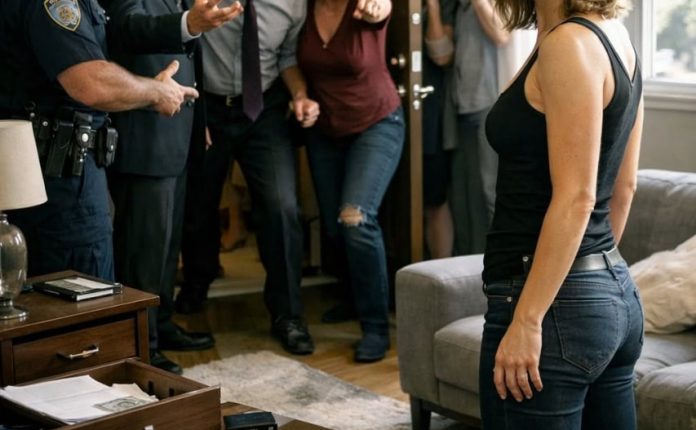
“Where is that woman? I swear I'll drag her home by her hair!”
My mother's voice exploded through the phone at precisely 6:43 on a freezing December evening.
I was sitting barefoot on the edge of a bed, looking at the two suitcases beside the door. The radiator knocked against the wall, and somewhere beyond the window, people were setting off fireworks three nights before New Year's Eve.
“Caleb is in the hospital!” she shouted. “We broke into the country house, and there was nothing there! Then thieves showed up! Somebody set a trap, Naomi!”
I closed my eyes.
Not because I was surprised.
Because I had spent thirty-four years listening to my mother turn other people's decisions into my responsibility, and I could already hear her preparing to do it again.
“Mom, slow down. Is Caleb conscious?”
“Don't you dare tell me to slow down.”
“Is he conscious?”
“Yes! But that's not the point!”
It was the point to me.
Caleb was my younger brother. He was thirty-one, three years younger than I was, and despite everything that had happened between us, I still remembered the little boy who once followed me around our backyard carrying a plastic dinosaur.
I didn't want him hurt.
I also knew that his injury didn't automatically make me guilty.
“What happened?” I asked.
“We broke into that house because you changed the locks without telling anybody!”
“I told you three weeks ago.”
“Don't interrupt me!”
I looked across the room at the small overnight bag I had packed that morning.
My apartment lease ended on December thirty-first. Most of my belongings were already in storage, and I was spending the final nights before my move in a furnished short-term rental across town.
My parents didn't know where I was staying.
That was intentional.
“Your father left work as soon as I called him,” Mom continued. “We came straight to your apartment to get this mess sorted out. And when we opened your door…”
Her voice faltered.
For a moment, the only sound was someone talking angrily behind her.
Then she said, quieter, “Naomi, what have you done?”
I didn't answer immediately.
I knew what she had discovered.
My apartment was empty.
There were no photographs, no familiar blankets, no furniture she could claim to have helped me purchase.
And on the kitchen counter sat a white envelope.
I had left it there that afternoon.
“Where are you?” she demanded.
“Somewhere safe.”
“Safe from what?”
I looked at the second copy of the envelope beside my suitcase.
“That's a question you should probably think about.”
My mother made an offended noise.
“I'm your mother.”
“I know.”
“You don't get to speak to me this way.”
“Then let's speak calmly. Why did you break into a house that belongs to me?”
A silence followed.
It was remarkable how often my family became speechless when I asked a simple question.
The country house had been in our family for decades, but it hadn't belonged to my parents.
It had belonged to my father's older sister, Ruth.
Aunt Ruth had no children. She never married, and she lived nearly her entire adult life in a modest white farmhouse outside the city.
There were two apple trees behind the kitchen, a narrow gravel driveway, and a blue wooden porch swing my grandfather had built before I was born.
The house smelled of cinnamon, furniture polish, and the lavender soap Aunt Ruth kept beside every sink.
As a child, I loved it more than anywhere else.
My parents' home was always loud.
Someone was arguing about money. Someone had disappointed my father. Someone had failed to do what my mother expected.
At Aunt Ruth's house, things were different.
She never asked me to explain why I was quiet.
If I wanted to read for three hours on the porch, she brought me lemonade and left me alone.
If I wanted to talk, she listened.
When I was nineteen and considering college, she sat with me at her kitchen table while I filled out scholarship applications.
My father had already decided I should attend a local program and help with family expenses.
Ruth told me something I never forgot.
“Being grateful for your family doesn't mean surrendering your future to them.”
At nineteen, I thought that sounded brave.
At thirty-four, I understood how difficult it was to practice.
Aunt Ruth died the previous spring after a short illness.
She had been seventy-eight.
I visited her almost every weekend during her final months, bringing groceries, washing sheets, and reading aloud when she grew too tired to hold a book.
My father came twice.
My mother visited once.
Caleb appeared at the funeral wearing a dark suit and talking about how expensive property taxes had become.
Six weeks later, we learned Ruth had left me the house.
The property was mine.
Not jointly owned.
Not temporarily entrusted to me.
Mine.
I could still remember my father's face when the attorney explained the will.
He looked at the papers as though someone had made a clerical error.
“Ruth must have misunderstood what she was doing,” he said.
The attorney, a patient woman named Marianne Ellis, adjusted her glasses.
“Your sister was quite clear about her intentions.”
Dad leaned back in his chair.
“She should have discussed it with the family.”
Marianne didn't argue.
She simply repeated that Ruth had the legal right to decide who inherited her property.
My mother cried in the parking lot afterward.
Not because she missed Ruth.
Because she thought I had somehow manipulated a dying woman.
“You were always her favorite,” she accused.
I had no answer.
I didn't know how to explain that perhaps Ruth had simply appreciated being visited.
For several months after the inheritance, I tried to keep peace.
I let my parents continue using the house on weekends.
I allowed Caleb to keep his fishing equipment in the shed.
When Dad asked whether he could host his annual family barbecue there, I agreed.
I thought generosity would prevent resentment.
Instead, it became permission in their minds.
By late summer, Mom had started referring to the farmhouse as “our country place.”
She arranged visits without consulting me.
She invited distant relatives to stay overnight.
Once, I arrived on a Saturday morning to find twelve people in the yard and three cars blocking the driveway.
Nobody had told me they were coming.
When I asked why, Mom looked genuinely puzzled.
“What difference does it make? We're family.”
I tried to explain that I needed to know who was entering the property.
She rolled her eyes.
“Now that your name is on a piece of paper, you've become very important.”
Dad was worse.
He began discussing repairs as though he were the owner.
At Thanksgiving, he announced that the kitchen needed remodeling.
He described replacing the original cabinets, removing a pantry wall, and building a deck behind the house.
I told him I wasn't ready to make those decisions.
He smiled in the condescending way he used when he believed a conversation was already settled.
“You don't understand property values, sweetheart.”
I had worked in commercial property administration for eleven years.
Understanding leases, maintenance expenses, and property records was literally part of my job.
But my father had never been particularly interested in what I knew.
Only in what he could decide for me.
The first serious warning arrived three weeks before Christmas.
My neighbor near the farmhouse, a retired teacher named Helen Price, called me one afternoon.
“Naomi, I hope I'm not bothering you.”
“Of course not. Is everything all right?”
“There's a truck in your driveway.”
I assumed Caleb had gone to collect his fishing equipment.
Then Helen mentioned two strangers measuring the yard.
One of them had been taking photographs of the kitchen through the open back door.
“Your brother seems to be showing them around,” she said.
I thanked her and called Caleb.
He answered on the fourth ring.
“What?”
“Are you at Aunt Ruth's house?”
“Yeah.”
“Who are the men with you?”
“Contractors.”
I stood up from my desk.
“Contractors for what?”
“The deck. Dad said we should get estimates before spring.”
“I told Dad I'm not remodeling the house.”
Caleb sighed.
“Can you stop being difficult for once?”
“Caleb, you don't have permission to hire anyone.”
“I'm not hiring them. I'm getting prices.”
“Please ask them to leave.”
He laughed.
“You're acting like we're strangers.”
“No. I'm asking you to respect something I own.”
His tone changed.
“Funny how one little inheritance makes people forget who raised them.”
I ended the call.
That night, Dad called to lecture me about embarrassing my brother in front of the contractors.
Mom followed with a message saying I was becoming selfish.
I didn't respond.
Two days later, I discovered the rental advertisement.
It was posted on a regional vacation rental website.
The photographs showed the farmhouse living room, kitchen, bedrooms, and garden.
I recognized the blue quilt on the downstairs bed.
I recognized Aunt Ruth's old clock above the fireplace.
And I recognized the contact number.
Caleb's.
The listing offered the entire property for holiday rentals, including New Year's weekend.
It described the house as privately managed by a local family.
I stared at the screen until the words blurred.
Then I called my brother.
He didn't answer.
I sent him a screenshot.
Five minutes later, he called.
“Why are you stalking my business?”
“Why are you advertising my house?”
“Because it's sitting empty.”
“That doesn't give you the right to rent it.”
“I was going to split the money with you.”
“You didn't ask me.”
“Because you'd say no.”
He sounded annoyed rather than ashamed.
I asked him to remove the listing immediately.
He said he would think about it.
That was the moment I understood something important.
My family wasn't confused about ownership.
They understood perfectly well that I could refuse.
They simply believed my refusal shouldn't matter.
The following morning, I contacted the rental platform and reported that the advertisement had been created without the property owner's authorization.
I also spoke to Marianne Ellis.
She advised me to document everything and withdraw permission for unsupervised access.
I changed the locks on the farmhouse.
Then I installed a monitored security system.
The company placed warning signs near both entrances and sensors on the doors.
I informed my parents and Caleb by email and text.
No one was permitted to enter the house without my written approval.
I offered Caleb a specific afternoon to collect his belongings from the shed.
He rejected it.
His final message read:
You'll regret this.
I saved it.
I had begun saving everything.
At first, I felt embarrassed doing that.
Who keeps evidence against their own family?
But after enough conversations in which my words were denied, rearranged, or attributed to someone else, documentation became the only way to protect what actually happened.
My parents ignored the notice.
Dad accused me of humiliating him.
Mom said Aunt Ruth would be ashamed.
Caleb stopped answering my calls.
Then, two days before the break-in, a stranger contacted me.
Her name was Margaret Delaney.
She was sixty-seven and lived three hours away.
She had booked the farmhouse for her family's New Year's gathering.
Her daughter, son-in-law, and three grandchildren planned to arrive on Friday.
There was only one problem.
I knew nothing about her reservation.
“Your brother gave me your number,” she said uncertainly.
“He said you handle maintenance.”
I sat very still.
“Mrs. Delaney, could you tell me how much you've paid?”
“Two thousand four hundred dollars.”
I wrote down the figure.
She explained that the payment included a rental deposit and an additional security amount.
Caleb had instructed her to transfer the funds directly.
She had received a confirmation message and photographs of the property.
He had promised to provide the entry instructions before arrival.
I asked her to send everything.
Within an hour, my email contained screenshots, bank records, and the original advertisement.
I felt sick.
Mrs. Delaney wasn't some investor looking for an opportunity.
She was a grandmother who had saved for a holiday with her family.
Her messages were full of ordinary questions.
Would there be enough blankets?
Was the driveway safe in snowy weather?
Could her youngest grandson bring his small dog?
Caleb had answered every question as though he owned the place.
I called her back.
“I need to tell you something difficult,” I said.
She listened.
I explained that I was the legal owner and had never authorized the rental.
I apologized for the inconvenience, although I had done nothing to cause it.
For several seconds, Margaret said nothing.
Then she asked, “Does that mean my grandchildren won't have anywhere to stay?”
That question hurt more than anything Caleb had said.
I promised to cooperate with her bank and provide written confirmation of the unauthorized listing.
She thanked me.
Then she said something that stayed with me.
“Your brother sounded so trustworthy.”
I didn't know what to say.
That night, I prepared a complete record for Marianne.
Copies of the deed.
The messages to Caleb.
The rental advertisement.
The payment receipt.
The alarm installation documents.
And a final page describing the connection between the unauthorized rental and my family's continuing attempts to enter the property.
I also included a detail that troubled me.
Caleb's rental correspondence contained my father's name.
According to Margaret, Caleb had described Dad as the person responsible for approving family property arrangements.
She had received a message supposedly confirming his approval.
I couldn't tell whether Dad had actually authorized anything or whether Caleb was using his name.
Either possibility was serious.
I sent Marianne the documents.
Then I packed my apartment.
I had already accepted a position in another city and arranged temporary accommodations there.
My move had been planned for months.
The dispute over the farmhouse hadn't caused it, but it made me more determined to leave quietly.
That afternoon, after the movers collected the final boxes, I cleaned the apartment.
I removed the family photographs.
I checked every cupboard.
I left the white envelope on the kitchen counter.
It contained copies of the documents and a cover letter addressed to any officer responding to unauthorized entry.
I had also notified my building manager, Mr. Bennett, that my parents no longer had permission to access the apartment.
He agreed to document any attempted entry.
Before I left, I stood in the doorway and looked back.
For seven years, that apartment had been my refuge.
It was where I had celebrated promotions, recovered from disappointments, and learned how to live without constantly asking my parents whether my decisions were acceptable.
Leaving felt strange.
But not wrong.
Then, at 6:43, my mother called.
And everything my family had ignored finally collided.
“Your brother is in the hospital,” she repeated.
I asked again what had happened.
This time, Dad took the phone.
His voice was clipped and angry.
“Caleb forced the back door. Your alarm went off. He panicked when he heard a vehicle outside and fell down the steps.”
“Was the vehicle from the security company?”
“Yes. A deputy came too.”
I pressed my fingers against my forehead.
“Is Caleb receiving treatment?”
“Yes. Broken ankle. The doctors say he'll recover.”
Relief washed through me.
I had feared something much worse.
“I'm glad he's going to be all right.”
Dad ignored that.
“You need to explain why you deliberately set this situation up.”
“I didn't set anything up. I secured my property.”
“You knew we'd need access.”
“I explicitly told you not to enter.”
My mother grabbed the phone again.
“You don't understand what this has done to your father!”
I glanced at the envelope beside my bag.
“What about what Caleb did to Mrs. Delaney?”
Silence.
“Who?” Mom asked.
I knew then.
She didn't know about the deposit.
Or she was pretending not to.
I explained what I had discovered.
Mom immediately insisted Caleb must have had a good reason.
Dad interrupted.
“What deposit?”
“Two thousand four hundred dollars.”
“What are you talking about?”
“Caleb advertised the farmhouse, collected payment, and promised it to a family for New Year's.”
Dad began breathing heavily.
Then came the sound of paper.
The envelope had been opened.
“Why is my name on this?” he asked.
I didn't answer immediately.
Because I had been asking myself the same question since Margaret's documents arrived.
“Dad,” I said, “did you tell Caleb he could rent out Aunt Ruth's house?”
He didn't reply.
From somewhere nearby, Mr. Bennett spoke.
“Sir, please remain in the hallway while I contact the appropriate office.”
Mom began shouting again.
Dad said something I couldn't hear.
Then he came back to the phone.
“Naomi, we need to discuss this privately.”
I looked at the winter sky beyond the window.
For years, private family discussions had meant one thing.
They spoke.
I surrendered.
This time, there were records.
There were witnesses.
And there was a woman who had paid money for a holiday house my brother didn't own.
“Dad,” I said, “we can talk when you're ready to tell me exactly what happened.”
He lowered his voice.
“You don't understand how serious this could become.”
I held the phone against my ear.
“I think I'm beginning to.”
END PART 1