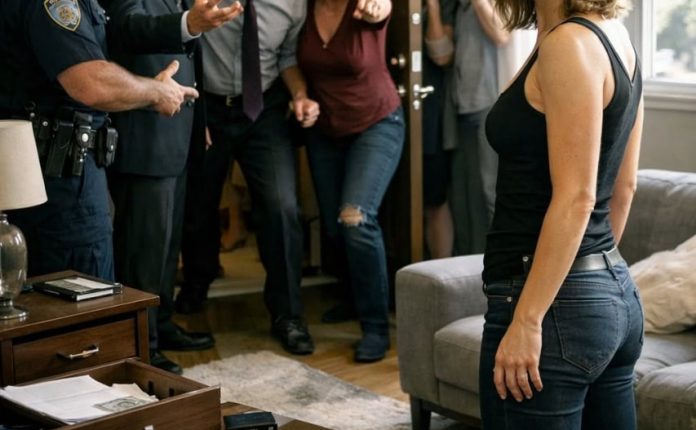
My father's name appeared twice in the documents Margaret Delaney had sent me.
The first time was in an ordinary message.
Caleb had written that his father helped oversee maintenance and scheduling for the farmhouse.
The second time was considerably more troubling.
Margaret had asked whether the rental was approved by the property's legal owner.
Caleb responded with a message saying the arrangement had been cleared through his father, who represented the family.
That wasn't a direct claim that Dad owned the property.
It was something more carefully worded.
It created the impression of authority without explaining where that authority came from.
I had been thinking about that distinction for forty-eight hours.
Now Dad was standing in the hallway outside my empty apartment, asking me why his name appeared in the rental documents.
“Did you know Caleb was accepting bookings?” I asked.
He hesitated.
“I knew he was exploring ways to make the property useful.”
“That's not what I asked.”
“Naomi, don't start interrogating me.”
“Did you know he accepted money?”
“No.”
His answer came quickly.
Too quickly, perhaps.
But I couldn't assume he was lying simply because I no longer trusted him.
“What did you agree to?” I asked.
He exhaled.
“I told him he could look into seasonal rentals. Nothing was supposed to happen without a discussion.”
“With me?”
“Obviously.”
“Because I'm the owner.”
He didn't respond.
I waited.
Finally, he said, “Yes, Naomi. Because you're the owner.”
It was the first time I had heard him acknowledge that without adding a qualification.
Before I could answer, Mom began talking loudly in the background.
She wanted to know why Mr. Bennett was recording their names.
Dad covered the microphone.
I heard him tell her to stop speaking.
That frightened me more than her shouting.
My father usually controlled a room by increasing his volume.
When he became quiet, it meant he was calculating.
“Where are you staying?” he asked.
“I've already told you I'm safe.”
“We could come over and settle this.”
“No.”
“I'm your father.”
“I understand who you are.”
“Then act like it.”
I looked down at the written instructions Marianne had given me.
Do not argue about ownership with anyone who refuses to acknowledge the deed.
Do not meet alone if a confrontation has become hostile.
Preserve the original messages.
Those were practical recommendations.
Nothing dramatic.
Yet following them felt like stepping across a line I had spent my whole life avoiding.
“I won't meet tonight,” I said.
Dad began protesting.
I ended the call.
For several minutes, I sat completely still.
Then I called Marianne.
She answered from her kitchen. I could hear dishes moving in the background.
“Naomi? Is everything all right?”
“My family forced the door at the farmhouse.”
The dishes stopped.
“Is anyone injured?”
“Caleb broke his ankle.”
“I'm sorry to hear that.”
“The alarm company called a deputy. My parents have also entered my old apartment.”
“Are you there?”
“No.”
“Good. Are you somewhere secure?”
“Yes.”
I explained the conversation.
Marianne listened without interruption.
When I mentioned Dad's admission that he had encouraged Caleb to investigate rentals, she asked me to repeat his words.
I did.
“Write that down now,” she said.
I found a notebook in my bag.
“Do you think he's responsible?”
“I think we need to separate what he authorized from what Caleb actually did. Encouraging someone to research rental possibilities isn't the same as authorizing them to collect money.”
I appreciated her precision.
My family had spent years accusing me of terrible motives whenever I disagreed with them.
I didn't want to become someone who returned that treatment.
“Mrs. Delaney needs her money back,” I said.
“Yes. And it matters that she has proof of payment.”
“What about the door?”
“Take photographs before it's repaired. Get the incident information from the responding agency. Your insurer may need it.”
Marianne paused.
“And Naomi?”
“Yes?”
“Do not let anyone persuade you to say the entry was authorized if it wasn't.”
I wrote that down too.
After the call, I sat near the window and watched the distant fireworks.
I thought about Aunt Ruth.
She had once told me that kindness was easiest when nobody was asking you to sacrifice anything.
The difficult kind was knowing when to help without making yourself available to be used.
At the time, I thought she was talking about my father.
Now I wondered whether she had been talking about our entire family.
The next morning, I called Helen Price.
She answered with immediate concern.
“Naomi, I heard what happened.”
“How?”
“The deputy stopped by to ask whether I'd seen anyone around the property.”
“Did you?”
Helen paused.
Then she said, “Your brother's car arrived shortly after three.”
I found my notebook.
“Was he alone?”
“No. Your mother was with him.”
That surprised me.
Mom had told me she learned about the break-in only after Caleb was hurt.
“Are you certain?”
“Of course. She was wearing that bright red coat she always wears at Christmas.”
I remembered the coat.
Mom had purchased it during a shopping trip she later complained I had failed to appreciate.
Helen continued.
“I saw your mother standing by the back door. Your brother was carrying something from his car.”
“What was it?”
“A tool bag, I think.”
My stomach tightened.
“Did you see my father?”
“No. His car arrived much later, after the ambulance had gone.”
I thanked her.
Then I called the office handling the incident.
The deputy who responded, Daniel Mercer, wasn't available immediately, but he returned my call before noon.
He was direct and professional.
He confirmed that the security company had contacted dispatch after the monitored door alarm activated.
Caleb had forced the rear entrance.
According to the initial information, he had slipped on an icy step while moving away from the doorway.
No evidence suggested that thieves had attacked him.
The responding deputy had found Caleb conscious and complaining of ankle pain.
Medical assistance was requested.
Mom had been present.
The vehicle outside had belonged to the security service.
I thanked him.
Then I asked whether Caleb had explained why he entered the house.
Mercer hesitated.
“He indicated that he believed he had family permission.”
“From whom?”
“That's still being clarified.”
I understood.
The deputy couldn't tell me things that hadn't been established.
But his answer confirmed something important.
Caleb was relying on the same argument my father had been using for months.
Family permission.
As though the people related to me could grant rights over my property without consulting me.
Mercer asked whether I had sent written notice revoking access.
I said yes.
He requested copies.
I sent them.
Then I forwarded everything to Marianne.
By afternoon, Mom had called seventeen times.
I didn't answer.
She left three messages.
The first was furious.
The second was tearful.
The third sounded rehearsed.
“Naomi, sweetheart, your brother has been through something terrible. Whatever disagreements we've had, this isn't the time to punish him. Your father and I are asking you to remember that we're a family.”
I listened twice.
Then I saved the recording.
There was no apology.
No acknowledgment that they had broken into the house.
Only another invitation to take responsibility for someone else's behavior.
That evening, Caleb called from the hospital.
His voice sounded strained.
“Are you happy now?”
I stood by the kitchen sink.
“I'm glad you're able to call.”
“Don't do that.”
“Do what?”
“Act like you care.”
“I do care. How's your ankle?”
“Broken. They put a plate in.”
“I'm sorry.”
“You should be.”
I pressed my lips together.
He continued.
“Do you know how humiliating it was having a deputy question me while I was lying on the ground?”
“I imagine it was awful.”
“Because of you.”
“No, Caleb. Because you forced a locked door.”
He swore.
I waited until he finished.
Then I asked the question that mattered.
“Why were you there?”
“To get my stuff.”
“Your fishing equipment was in the shed.”
“I needed to check the house.”
“For what?”
He didn't answer.
“Caleb, Mrs. Delaney paid you twenty-four hundred dollars.”
Silence.
Then he said, “She's getting it back.”
“When?”
“Soon.”
“Where's the money?”
“I used some of it.”
I closed my eyes.
“For what?”
“Expenses.”
“What expenses?”
“Do you have to make everything sound like a courtroom?”
I sat down.
“No. I want to understand how you plan to repay a woman who trusted you.”
He sighed.
“Dad said I could look into renting the place.”
“Did Dad tell you to accept payment?”
Caleb hesitated.
“He knew the plan.”
“What plan?”
“The place was going to help pay for improvements.”
“Improvements I never agreed to.”
He became angry again.
“You don't understand how much work that house needs.”
“I do understand. I've been paying for it.”
He ignored that.
I asked whether he had other bookings.
He said no.
Then he added, “Not confirmed ones.”
I wrote down his words.
“How many people have contacted you?”
“Naomi, stop.”
“Have you taken money from anybody else?”
“No.”
His tone sharpened.
“You're making me sound like a criminal.”
“I haven't called you anything.”
“Then why did you send the police those messages?”
“Because someone entered my house without permission.”
He laughed bitterly.
“Congratulations. You've finally got exactly what you wanted.”
“What do you think I wanted?”
“To be better than everybody.”
I looked at the notebook beside me.
The truth was so ordinary it almost seemed ridiculous.
I wanted to decide who used my property.
I wanted people to ask before entering.
I wanted them not to accept money using my address.
None of those things required me to be better than anyone.
“I wanted you to respect my answer,” I said.
Caleb hung up.
I stared at the dark screen.
When we were children, he had been charming and funny.
He could make our mother laugh even when she was furious.
He was also good at avoiding consequences.
At twelve, he broke a neighbor's window and let me be blamed because I had been playing outside nearby.
At seventeen, he borrowed my bicycle and damaged the frame, then told Dad it had been defective.
At twenty-four, he missed several car payments and convinced Mom that helping him was more important than replacing my broken refrigerator.
Each incident seemed small by itself.
Together, they formed a pattern everyone recognized but nobody discussed.
I had spent years trying to compensate for Caleb's lack of responsibility.
My parents called that being a good sister.
Now he had taken money from a stranger.
And the consequences were no longer confined to our kitchen table.
The following morning, Marianne called.
She had reviewed the documents.
“There's something we should discuss before you leave town,” she said.
I sat down.
“What is it?”
“The payment receipt Mrs. Delaney sent you has Caleb's banking details. But the rental confirmation identifies your father as the family representative.”
“I saw that.”
“Did your father send her anything personally?”
“I don't know.”
“Find out.”
I asked whether that would change the situation.
“It could help establish who said what. We shouldn't assume your father participated in the payment arrangement simply because Caleb used his name.”
I agreed.
Then Marianne mentioned something else.
“Caleb appears to have sent Mrs. Delaney a copy of an old utility bill.”
My stomach tightened.
“What utility bill?”
“One in your aunt's name.”
I leaned forward.
“Why?”
“Presumably to demonstrate a connection to the property.”
I remembered sorting through Ruth's papers after her death.
I had stored old utility bills in a labeled folder in the upstairs bedroom.
That room had been locked.
The rental advertisement included photographs of it.
Caleb had entered the room sometime before I changed the locks.
He had taken pictures.
And perhaps documents.
I called Helen again.
“Do you remember anyone carrying boxes out of the house this fall?”
She considered.
“Your brother had some folders one afternoon. I assumed he was helping you organize things.”
My hands went cold.
After Aunt Ruth died, I had been careful about preserving her records.
There were tax receipts, insurance documents, old letters, and photographs.
Some were sentimental.
Others were important to establishing the property's history.
I had never given Caleb permission to remove them.
When I told Marianne, she became more serious.
“We need to check exactly what's missing.”
I asked whether I should drive to the farmhouse.
“Not alone,” she said. “And not before the damaged entrance is secured.”
That afternoon, I arranged for a locksmith and temporary door repair.
Helen agreed to meet the contractor.
I also asked a professional property inspector to document the interior condition.
It cost money I hadn't planned to spend.
But I needed reliable information.
By evening, photographs began arriving.
The back doorframe was cracked.
The lock mechanism hung loosely from the wood.
Mud marked the kitchen floor.
A drawer near the pantry stood open.
Upstairs, Aunt Ruth's bedroom door had scratches around the latch.
I stared at one photograph.
The narrow cupboard where Ruth kept her household records was open.
The green folder that had once contained several years of property correspondence was missing.
I had placed it there myself.
I remembered because Aunt Ruth had insisted on keeping everything organized.
I sent the photograph to Marianne.
Then I called Dad.
He answered immediately.
“Finally.”
“Do you have Aunt Ruth's green folder?”
“What folder?”
“The one from the upstairs bedroom.”
“I don't know what you're talking about.”
“Caleb had access to it. Some documents are missing.”
Dad sighed.
“Naomi, you're turning this into something ridiculous.”
“Do you have them?”
“No.”
“Did Caleb give you anything from the house?”
Another pause.
Then he said, “He brought me some paperwork a while ago.”
“What paperwork?”
“Copies of bills. Maintenance information.”
“Why?”
“Because we were discussing rental expenses.”
I rubbed my forehead.
“Dad, did you know Caleb was using Ruth's records to convince people he could rent out the property?”
“No.”
The answer was less certain this time.
I asked him to send me everything Caleb had given him.
He refused.
“I'm not handing over private family documents because you've decided to make accusations.”
“They're documents from a house I own.”
“They were your aunt's!”
“Yes. And she left the house and its records to me.”
His voice hardened.
“Do you have any idea how much I've done for this family?”
I looked at the damaged doorway in the photograph.
“I'm asking about the paperwork.”
For once, he seemed unable to change the subject successfully.
Finally, he said, “We'll talk when you've calmed down.”
He disconnected.
I sat there for a long time.
Then I called Marianne.
I told her about the green folder.
She asked me to send her the photographs.
Before we ended the conversation, she said something that made the situation feel different.
“Naomi, there may be more here than an unauthorized holiday listing. We need to determine whether anyone used those records to make commitments on your behalf.”
I looked toward the window.
The city lights reflected against the glass.
For weeks, I had believed my family was fighting over access to a farmhouse.
Now I was beginning to wonder whether they had been making decisions involving my property long before I knew there was anything to question.
END PART 2