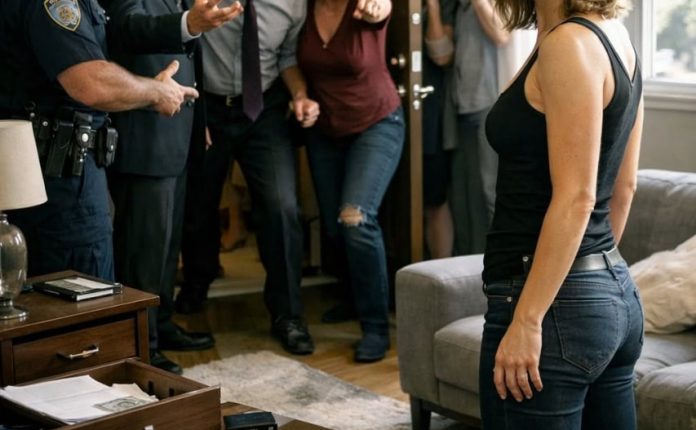
Caleb came home from the hospital four days after the break-in.
Mom called to tell me.
Her voice was softer than it had been during our earlier conversations.
“The doctors say he'll need several weeks before he can put much weight on that ankle.”
“I'm glad he's home.”
“He's having a difficult time.”
“I imagine so.”
She waited.
Then she said, “He wants to know whether you're going to report him.”
I was standing in a grocery store beside a refrigerated display.
I moved my cart away from the other customers.
“The property incident has already been documented.”
“That's not what I asked.”
“I know.”
Mom sighed.
“You could make this disappear.”
I looked at a row of milk cartons.
“No, Mom. I can't.”
“Of course you can. You own the house.”
“Caleb accepted money from someone else. I can't erase that.”
“He made a mistake.”
“He needs to repay her.”
“He will.”
“When?”
My mother became quiet.
I recognized that silence.
She had no answer.
“Mom, has he told you where the deposit went?”
She lowered her voice.
“He needed money.”
“For what?”
“His expenses.”
“Which expenses?”
“Naomi, you're making this harder than it needs to be.”
I closed my eyes briefly.
For a moment, I almost agreed to help.
It would have been so easy to transfer the money to Margaret myself.
I had enough savings.
Not an unlimited amount, but enough.
Then I imagined Caleb returning home, relieved, with Mom telling everyone that I had finally done the right thing.
He would learn nothing.
Dad would tell himself the family had resolved the issue.
And Margaret might never understand who had actually been responsible.
I wasn't willing to participate in that.
“Tell Caleb I hope he recovers quickly,” I said. “But he needs to speak directly with Margaret about repayment.”
Mom ended the call without saying goodbye.
That evening, I received an unexpected message from Dad.
He had located additional papers from Aunt Ruth's folder.
He wanted to give them to me.
We arranged another meeting at Marianne's office.
This time, Mom did not attend.
Dad arrived carrying a plain cardboard envelope.
He looked older than he had a week earlier.
His hair was neatly combed, but there were dark circles beneath his eyes.
We sat across from each other.
For a while, neither of us spoke.
Then Dad pushed the envelope toward me.
“These were in my filing cabinet.”
Inside were several repair receipts, copies of utility bills, and handwritten notes.
There was also the missing maintenance ledger.
I recognized Ruth's handwriting immediately.
She had recorded every major expense.
Roof repairs.
Electrical work.
A replacement water heater.
Property taxes.
And several payments she had made to help Dad during a period when his business was struggling.
I turned the pages slowly.
Ruth had lent him money.
Not once.
Several times.
Dad stared at his hands.
“She helped me when things were bad.”
“I can see that.”
“I paid some of it back.”
The ledger supported that.
There were repayment entries, though the account appeared to remain unfinished.
“Why didn't you tell me?” I asked.
He gave a tired laugh.
“Because it's embarrassing.”
I looked up.
“Needing help isn't embarrassing.”
He rubbed his forehead.
“No. But needing it from your older sister when you're supposed to have everything under control…”
His voice trailed off.
For the first time, I saw something beneath his anger.
Shame.
Not an excuse.
But an explanation.
Ruth had helped Dad financially.
Then she had left the farmhouse to me.
Perhaps he had experienced the inheritance as another judgment about his ability to manage money.
Perhaps every time I insisted the house was mine, he heard a reminder that his sister had trusted me with something she hadn't trusted him to control.
I couldn't know all of that.
But I could finally see how much pride had shaped his behavior.
“Did you ever try to use the house as collateral?” I asked.
“No.”
He answered firmly.
“Ruth warned me about that years ago. I never did.”
“Then why was she worried?”
He looked down.
“I asked her once whether she'd consider guaranteeing a business loan. She refused. She had every right.”
I waited.
“She wrote that note afterward.”
“Were you angry?”
“Yes.”
He swallowed.
“For a long time.”
I closed the ledger.
“Dad, Aunt Ruth wasn't punishing you by leaving the house to me.”
He looked at me sharply.
“You don't know what she intended.”
“No. But I know she didn't want the house used to solve anyone else's financial problems.”
Dad glanced at the ledger.
For several seconds, he didn't speak.
Then he nodded.
“I can see that now.”
Our conversation turned to Caleb.
Dad confirmed that he had encouraged his son to research rental income.
He admitted he had been frustrated by my refusal to remodel the house.
He had convinced himself that Caleb could produce a proposal so financially attractive that I would eventually agree.
When I asked why he hadn't simply respected my answer, Dad looked at the window.
“I thought you were being stubborn.”
“I was making a decision.”
“I know.”
I waited.
Then he said, “I treated those as the same thing.”
That sentence stayed with me.
It was the closest Dad had come to recognizing how he had treated me for years.
Marianne asked him whether he had spoken to Caleb about the money.
Dad nodded.
“He admitted he took the deposit.”
“What did he use it for?” I asked.
“Part of it went toward overdue bills. The rest went into a payment on his truck.”
I looked away.
There had been no contractor invoice.
No emergency repair.
No money set aside for the farmhouse.
Caleb had accepted a stranger's holiday payment and spent it on his personal expenses.
Dad continued.
“He thought he'd replace it before the guests arrived.”
“With what?”
Dad shook his head.
“He didn't have a real plan.”
That was Caleb.
He always assumed something would turn up.
A paycheck.
A favor.
A parent.
Or me.
I asked whether he had admitted writing the approval message in Dad's name.
“He did.”
Dad's jaw tightened.
“He said he didn't think it mattered because I'd already supported the idea.”
“Does he understand why it matters?”
“I don't know.”
Marianne explained that the clearest immediate priority was for Caleb to stop making false representations and repay Margaret.
Dad agreed.
Then he surprised me.
“I've told him he needs to use his own money.”
I looked at him.
“Are you sure?”
He nodded.
“Linda wants us to help. But I've helped him avoid enough consequences.”
It was a small statement.
Yet hearing my father say it felt unfamiliar.
For years, Mom and Dad had always been united when they wanted something from me.
Now Dad seemed to be questioning a habit he had helped create.
Before we left, he asked whether I intended to keep the farmhouse.
“I haven't decided.”
He nodded.
“I won't make any more plans for it.”
I looked at him carefully.
“Thank you.”
He reached for his coat.
Then he stopped.
“Naomi, I'm sorry I took the folder.”
I didn't answer immediately.
He added, “I should have returned it when you asked.”
It wasn't an apology for everything.
It didn't undo the months of pressure.
But it was specific.
And specific apologies mattered.
Two days later, Caleb asked to speak with me.
He couldn't drive because of his ankle, so I agreed to a video call.
He appeared on my screen sitting on my parents' couch.
His injured leg rested on two pillows.
He looked uncomfortable.
Not merely physically.
He seemed to be searching for a version of the conversation in which I would make things easy for him.
“Hey,” he said.
“Hi.”
He glanced away.
“Dad told me you talked.”
“Yes.”
“He said you have all the documents.”
“I do.”
Caleb rubbed his face.
Then he said, “I didn't think it would turn into this.”
I waited.
“I thought I could rent the house for a couple weekends, make some money, pay a few bills, and give you a cut.”
“You didn't tell me.”
“I knew you'd say no.”
“Then why did you do it?”
He looked down.
“Because I needed money.”
There it was.
Not the renovation excuse.
Not the claim that he was helping me.
Money.
He had needed it, and he believed access to my property would provide it.
“Why didn't you ask me for help?” I asked.
He gave a short, bitter laugh.
“Because you would've lectured me.”
“Maybe I would've asked how you planned to repay it.”
“Exactly.”
I studied his face.
He seemed genuinely unable to understand why that was reasonable.
“Caleb, borrowing money requires permission. Renting someone's house requires permission. You can't decide those things are yours because asking makes you uncomfortable.”
He shifted his injured leg.
“I get it.”
“Do you?”
His eyes narrowed.
“What do you want me to say?”
“The truth.”
He sighed.
Then he admitted that he had created the advertisement without my authorization.
He had taken photographs while visiting the property.
He had removed copies of Aunt Ruth's documents to make the listing seem legitimate.
He had used Dad's name in a message without Dad's knowledge.
And he had accepted Margaret's deposit while knowing he had no confirmed right to provide the rental.
I listened.
It was painful.
Not because I hadn't suspected most of it.
Because hearing him acknowledge each decision removed the comforting possibility that some part of it had been an innocent misunderstanding.
He hadn't been confused.
He had been desperate and dishonest.
“What happened at the house?” I asked.
Caleb looked away.
“Mom went with me.”
“Why?”
“She thought we could get inside and talk to you afterward.”
“Talk to me afterward?”
“She said once we were in, you'd have to deal with us.”
I felt my stomach tighten.
“What were you going to do inside?”
“Get the old keys. Check the rooms.”
“The locks had been changed.”
“I know.”
He swallowed.
“I tried the back door. It wouldn't open. So I used a pry bar.”
“Did Mom know?”
“Yes.”
I looked down at my hands.
The picture was becoming clear.
My mother hadn't arrived at the farmhouse to rescue Caleb.
She had accompanied him while he forced entry.
Then, when the alarm sounded and he fell, she had called me screaming about thieves and traps.
I asked what happened next.
Caleb stared at the screen.
“I heard the alarm. I thought someone was coming. I went down the steps too fast.”
“And slipped?”
“Yes.”
“Was anybody chasing you?”
“No.”
“Did anybody touch you?”
“No.”
He closed his eyes.
“I slipped. That's it.”
I sat back.
There had been no thieves.
No trap.
No attack.
Just a forced door, an alarm, an icy step, and a terrible consequence.
I was sorry he was injured.
But I couldn't take responsibility for choices I hadn't made.
Caleb rubbed his forehead.
“I know I messed up.”
I waited.
He seemed irritated that I didn't immediately comfort him.
Then he said, “I can repay Margaret.”
“How?”
“Dad's helping me make a payment plan.”
“Using your money?”
“Yes.”
“Have you contacted her?”
“Not yet.”
“Then you need to.”
He nodded reluctantly.
I told him Margaret deserved a direct apology and a clear repayment arrangement.
He agreed.
Then he asked the question I had expected.
“Are you going to make the police charge me?”
I took a breath.
“That's not entirely my decision. I've given the responding agency accurate information. I'm not going to invent a different story to protect you.”
Caleb stared at me.
“You'd really let this happen?”
“It already happened.”
He looked away.
For several seconds, neither of us spoke.
Then he said, “Mom told me you'd never forgive me.”
I felt something tighten in my throat.
“Mom doesn't get to decide that.”
He looked back.
“Will you?”
“I don't know yet.”
He seemed stunned.
I think he had expected either instant forgiveness or dramatic rejection.
He hadn't expected uncertainty.
But that was the truth.
I didn't know whether I could trust him again.
I didn't know whether he would repay Margaret.
I didn't know whether he would stop treating other people's boundaries as obstacles.
I only knew that pretending everything was fine would not help either of us.
After the call, I sat quietly for several minutes.
Then I received a message from Margaret.
Caleb had finally contacted her.
He had apologized.
He had acknowledged accepting the money without proper authorization.
And he had offered to begin repayment within the week.
Margaret wasn't ready to forgive him.
She had every right not to.
But at least the situation was moving toward a practical resolution.
That evening, Mom arrived outside the building where I was staying.
I hadn't given her the address.
She had obtained it from Dad, who knew the general area because he'd offered to help with my move before our dispute escalated.
The front desk called my room.
“A woman says she's your mother. Would you like us to send her up?”
“No, thank you.”
I almost left it there.
Then I looked at the little overnight bag beside the chair.
I thought about all the conversations I had avoided because I knew Mom would shout.
For once, I wanted to speak without being trapped in the same familiar roles.
I went downstairs.
She was standing near the entrance, holding her red coat closed with one hand.
When she saw me, relief crossed her face.
Then anger replaced it.
“You've turned everyone against each other.”
I stopped several feet away.
“No, Mom.”
“Your father is refusing to help Caleb. Your brother is miserable. And you're behaving as though none of this matters.”
“It matters very much.”
“Then come home.”
I looked at her.
“Why?”
“Because we're your family.”
I waited.
She seemed bewildered by the question.
“That's not a reason to ignore what happened,” I said.
She folded her arms.
“Your brother made a mistake.”
“He made several decisions. And you helped him break into my house.”
Her mouth opened.
Then closed.
I continued.
“Caleb told me you were there when he forced the door.”
Mom looked toward the entrance.
“He needed his belongings.”
“They were in the shed.”
“He wanted to see the house.”
“I told you both not to enter.”
She became angry.
“You've always been so controlling.”
I felt a familiar urge to defend myself.
To explain ownership.
To list the messages.
To prove that I wasn't unreasonable.
Then I stopped.
She knew all those things already.
“Mom, I'm not arguing about whether I had the right to lock my own door.”
Her expression changed.
“You'd really choose that house over your family?”
I shook my head.
“I'm choosing not to let my family decide what belongs to me.”
For a moment, she looked genuinely wounded.
I felt sorry for her.
Then I remembered her voice on the phone.
The threats.
The accusations.
The insistence that I accept blame for Caleb's injury.
“Did you know about Margaret's deposit?” I asked.
“No.”
“Would you have stopped Caleb if you had?”
She looked away.
I waited.
Finally, she whispered, “I would've asked him why he needed to do it.”
“That isn't what I asked.”
She rubbed her forehead.
“I don't know, Naomi.”
It was the first honest answer she'd given me.
Not a good answer.
Not a reassuring one.
But honest.
We stood in silence.
Then Mom said, “I never thought we'd become strangers.”
I looked at her face.
The woman who had raised me.
Who had taught me to bake.
Who had stayed awake when I was sick.
Who had also frightened me, belittled me, and demanded that I apologize whenever I protected myself.
All those things were true.
“We don't have to be strangers,” I said.
“But things can't continue the way they were.”
She didn't answer.
I told her I would speak with her again when she was ready to discuss what happened without blaming me.
Then I went upstairs.
For the first time in my life, I ended a conversation with my mother without feeling required to make her feel better.
It hurt.
But it also felt necessary.
END PART 4