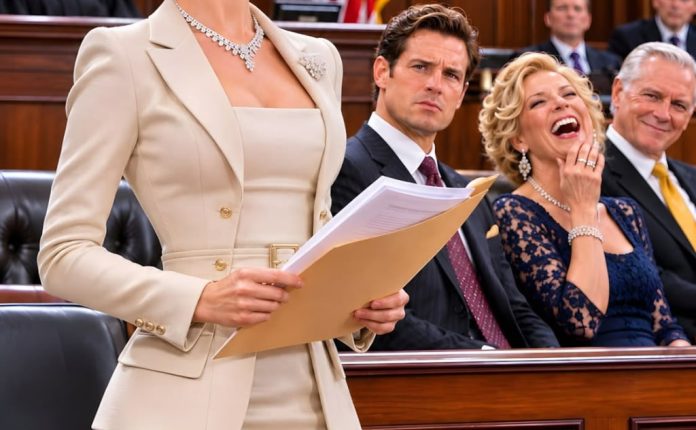
My mother-in-law started laughing before I reached my seat.
It was not a loud laugh. Ruth Ellison understood the importance of appearing respectable in public. She preferred the sort of cruelty that could be disguised as a private joke, delivered just loudly enough to reach its intended target.
“Well, look who decided to come,” she said to her husband. “And without an attorney. How unfortunate.”
Frank Ellison looked up from his telephone.
“Andrew said she wouldn't have the resources to fight him.”
Ruth adjusted the diamond bracelet on her wrist.
“Apparently, he was right.”
I was standing less than six feet away.
Neither of them lowered their voices.
I set my leather briefcase on the floor beside an empty chair and took my seat.
Across the courtroom, my husband sat with three attorneys. Stephen Calder, the senior lawyer, occupied the chair nearest the aisle. His colleagues had arranged several thick binders across their table.
Andrew wore a charcoal suit I had chosen for him two Christmases earlier. His blue silk tie had been a gift from his father. Even from where I sat, I could see the expensive watch on his wrist.
He looked pleased with himself.
That expression had become familiar during the last months of our marriage.
When Andrew wanted to hurt someone, he rarely shouted. He smiled, spoke softly, and made certain everyone understood that he possessed the authority to decide what happened next.
Seven years earlier, I had mistaken that confidence for strength.
Judge Elaine Porter entered shortly after nine.
Everyone stood.
The courtroom settled as she arranged the documents before her.
When she reached our case, she examined the attorneys' table and then turned to me.
“Mrs. Ellison, are you represented?”
“No, Your Honor.”
“You understand that you have the right to retain an attorney?”
“Yes.”
“And you are choosing to represent yourself today?”
“For this hearing, Your Honor.”
She considered my answer.
“Very well. I will hold you to the applicable procedural rules. I will also make sure you have an appropriate opportunity to be heard.”
“Thank you.”
Stephen Calder rose.
“Your Honor, my client hopes to finalize an uncontested settlement. We are concerned Mrs. Ellison may be attempting to reopen issues already resolved.”
I looked at him.
Already resolved.
Those two words described almost everything wrong with my marriage.
Andrew had decided which neighborhood we would live in, which investments were worthwhile, which relatives deserved assistance, and which friendships were useful.
Whenever I disagreed, he announced that the matter had already been settled.
Eventually, I stopped arguing over small things.
It had been easier to choose my own quiet moments than to spend every evening defending them.
But there was a difference between refusing an argument and accepting a falsehood.
Our marriage had taught me that distinction more thoroughly than I ever expected.
Three weeks before the hearing, Andrew had entered the kitchen while I was making breakfast.
It was a rainy Tuesday morning in northern Virginia.
The dishwasher was running. Coffee had just finished brewing. On the counter lay a small stack of appointment reminders I had collected for Ruth.
Andrew placed a large envelope beside my plate.
“I need you to sign those.”
I opened it.
The first page identified the documents as a proposed marital settlement agreement.
I looked up.
“What's this?”
“Don't make it dramatic, Mara.”
I read the heading again.
“Andrew.”
He pulled out his phone.
“We both know this marriage isn't working.”
I had suspected for months that he wanted a divorce. He had moved into the guest bedroom and stopped discussing anything beyond schedules and social obligations.
Still, hearing it stated so casually felt different.
“Were you planning to tell me before giving me paperwork?”
“I just did.”
He poured coffee into a travel mug.
I turned another page.
The proposed agreement gave him the house, the primary investment accounts, and control of his business interests.
It identified several assets as his separate property.
A provision stated that I was not seeking spousal support.
Another suggested that my household responsibilities were ordinary marital services that had not materially contributed to the growth of his wealth.
I reread that sentence.
For seven years, I had maintained the household around Andrew's relentless schedule.
I organized business dinners, coordinated repairs on our home, handled deliveries, arranged travel, managed family appointments, and dealt with the practical emergencies Andrew considered beneath his attention.
His parents relied on me almost as much as he did.
When Frank had knee surgery, I drove him to physical therapy three times a week.
When Ruth developed complications following an outpatient procedure, I stayed overnight at their house because she refused to hire temporary assistance.
I never kept a running account of those hours.
Marriage, I believed, was not supposed to operate like a commercial contract.
But I had also contributed money.
Substantial money.
I looked at Andrew.
“What happened to the funds I transferred when we purchased the house?”
He glanced at the agreement.
“The house is mine.”
“That wasn't my question.”
“Mara, you lived there.”
“I contributed to the down payment.”
“You helped with household expenses.”
“The money went directly to closing.”
He sighed as though I were exhausting him.
“Stephen has taken care of the details.”
“Stephen?”
“My attorney.”
I looked at the agreement again.
“You hired an attorney before telling me we were divorcing?”
“Yes.”
“And you expect me to sign without reviewing any of this?”
“You've had a comfortable life. I suggest you remember that.”
Then he took his mug and walked toward the garage.
I called after him.
“Seven years, Andrew.”
He stopped.
“Seven years of helping you and your parents. You don't get to pretend none of it happened.”
He turned.
“Taking care of a house doesn't make you a business partner.”
His face was expressionless.
“And don't bother hiring some cheap lawyer to fight this. You'll only embarrass yourself.”
The garage door opened a moment later.
I stood in the kitchen, holding a document that attempted to erase my contribution to my own marriage.
For several minutes, I did nothing.
Then I took the agreement to the dining room table and began reading it properly.
At first, I examined the financial provisions.
Then I turned to the final pages.
Something was wrong.
The document included a signature attributed to me.
Below it appeared a notarial acknowledgment.
I stared at the date.
The acknowledgment represented that I had personally appeared before a notary on September 17.
I had not.
I had spent that day in Richmond helping a former colleague prepare materials for a veterans' legal assistance seminar.
I remembered the date because I had driven through heavy rain on the return trip.
I had receipts from the parking garage.
My former colleague had sent me photographs afterward.
There had also been a registration record.
I examined the signature again.
It resembled mine at a distance.
The first letter was nearly right, but the middle strokes looked stiff. Whoever had written it seemed to have copied a signature without understanding how my hand moved across the page.
I placed the agreement on the table.
Then I read the certification a second time.
I had never seen a notary in connection with the divorce.
I had never signed the agreement.
And I had certainly never authorized anyone else to sign it.
I went upstairs and opened the cabinet containing our financial records.
Andrew believed that I had become indifferent to his business affairs during our marriage.
He never considered that I might have continued organizing documents because I preferred to understand our financial position.
I found records from the purchase of our house.
There was the closing statement, the mortgage documentation, and a bank record showing my transfer of $185,000 toward the purchase.
I had inherited a portion of that money from my grandmother and saved the rest before marriage.
Andrew knew where it came from.
He had thanked me repeatedly when we bought the property.
At the time, he described the house as our shared future.
Now the proposed settlement claimed I had contributed nothing toward its acquisition.
I kept reading.
Over the next few days, I discovered additional discrepancies.
An investment account Andrew described as entirely his had received transfers from our joint funds.
Several expenses recorded as business expenditures appeared to have been paid through accounts that also received marital income.
I did not immediately assume fraud.
Financial records could be complicated.
Business owners often mixed legitimate transactions in ways that required careful accounting.
I wanted evidence, not speculation.
But the documents gave me a reason to investigate further.
I contacted the circuit court clerk and requested copies of the materials filed in our case.
The clerk explained which documents were available and how I could obtain certified copies.
When I examined the filing, I found the same disputed signature.
The acknowledgment bore the name of a notary, Daniel Mercer.
I searched the relevant public notary records and found contact information associated with his commission.
Then I called.
“Mr. Mercer, my name is Mara Ellison. I have a document that identifies you as the notary who acknowledged my signature.”
He sounded cautious.
“What kind of document?”
“A marital settlement agreement.”
“Could you give me the date?”
“September seventeenth.”
There was a pause.
“Can you tell me the parties involved?”
I gave him our names.
He asked me to send a copy through an appropriate secure method so he could examine it.
Two days later, he called back.
His voice was noticeably different.
“Mrs. Ellison, I need to be careful about what I say. The acknowledgment contains my name and commission information, but I cannot verify that I performed this notarization.”
“Do you have a journal entry?”
“Not for you.”
I remained silent.
He continued.
“I maintain records of the notarizations I perform. I do not have a corresponding entry for that date involving you.”
“Would you be willing to provide a statement about what your records show?”
“I can state what I found. Anything beyond that would require further examination.”
“That's all I'm asking.”
He agreed to provide a limited signed statement.
I thanked him.
After ending the call, I sat at my desk for a long time.
The situation had moved beyond a husband trying to secure an unfair divorce settlement.
A document submitted to a court carried my name and a disputed acknowledgment.
Someone had represented that I consented to terms I had never accepted.
I did not yet know who had created the questionable paperwork.
I knew only that Andrew had presented it through his attorneys.
And that made the documents important.
I also knew enough about legal proceedings to understand that evidence needed proper handling.
Before marrying Andrew, I had served as Captain Mara Pierce, a United States Army attorney.
My professional life had included reviewing military justice matters, advising commanders, preparing witnesses, and examining records in proceedings where accuracy was not optional.
I had seen cases altered by a single inconsistent date.
I had seen confident witnesses struggle when contemporaneous documents contradicted their accounts.
And I had learned never to confuse a polished presentation with a reliable factual record.
I had left active duty years earlier.
My marriage had not required me to surrender that training.
But I was no longer a practicing Army lawyer, and I did not pretend otherwise.
I reviewed the applicable court rules carefully, considered the limits of representing myself, and recognized that the issues might eventually require independent counsel.
For the upcoming hearing, however, I was prepared to challenge the disputed agreement and request an appropriate process for examining it.
Andrew did not know about those preparations.
He was too busy congratulating himself.
A week before court, Ruth invited me to lunch at the country club.
I almost declined.
Then I decided to go.
She was waiting beside a window overlooking the golf course.
“Mara, darling,” she said, without rising. “I hope we can be civilized about all this.”
“I intend to be.”
“Wonderful.”
She took a sip of sparkling water.
“Andrew has been very generous, considering the circumstances.”
“What circumstances?”
She looked surprised.
“Well, you haven't worked during the marriage.”
“I've worked.”
“You know what I mean. You haven't earned a conventional salary.”
I studied her face.
There had been years when I believed Ruth's dismissive remarks came from simple thoughtlessness.
By then, I understood that she knew exactly what she was doing.
She preferred to reduce people before they had an opportunity to disagree.
“I managed quite a few responsibilities,” I said.
“Of course. Family things.”
She leaned closer.
“Frank and I think it would be best if you signed the documents and moved on. A legal dispute could be humiliating.”
“For whom?”
Her smile tightened.
“Mara, let's not pretend you're equipped for this.”
I put down my glass.
“What makes you think that?”
“Andrew has excellent attorneys.”
“Yes, he does.”
“And you simply don't have his resources.”
I considered telling her about my military legal career.
I had never hidden it.
Andrew knew I had served in the Army and worked in the legal field. He simply disliked discussing my former career because it conflicted with the role he expected me to occupy.
Ruth knew almost nothing about it.
She had never asked.
There seemed little value in explaining myself over lunch.
Instead, I said, “I hope Andrew has given his attorneys accurate information.”
Ruth laughed.
“My dear, those men know exactly what they're doing.”
I looked out at the golf course.
“I hope so.”
Now, inside Judge Porter's courtroom, Ruth wore the same expression of certainty.
Calder stood before the bench.
“Your Honor, the petitioner submits that the marital settlement agreement resolves all substantial issues. My client has agreed to permit Mrs. Ellison to retain certain personal belongings and a modest cash payment.”
I looked at Andrew.
He gave me a faint smile.
Calder continued.
“The agreement reflects the parties' understanding of their respective contributions.”
Judge Porter glanced at the paperwork.
“Is there a dispute concerning execution?”
I stood.
“Yes, Your Honor.”
Calder turned.
“I beg your pardon?”
“I dispute the authenticity of the signature attributed to me.”
The courtroom became very quiet.
Andrew sat straighter.
I continued.
“I have never signed this agreement. I have never appeared before the notary identified in the acknowledgment. And I have records directly relevant to those representations.”
Calder's expression changed.
“Mrs. Ellison, are you suggesting misconduct?”
“I am identifying a factual dispute. I am not asking the court to reach a conclusion before the evidence is examined.”
Judge Porter nodded.
“That's an appropriate distinction.”
I opened my folder.
“May I provide the court and opposing counsel with copies of the documents supporting my position?”
“Proceed.”
I handed the prepared copies to the clerk, following the judge's instructions.
Calder took his copy.
His eyes moved to the notarial acknowledgment.
Then to Daniel Mercer's statement.
He read it again.
Andrew leaned toward him.
“What is it?”
Calder did not answer.
He stood abruptly.
“Your Honor, I need to confer with my client concerning the origin of certain documents.”
Judge Porter watched him for a moment.
“Mr. Calder, did your office verify the execution of this agreement before presenting it as accepted by both parties?”
Calder's mouth opened.
Then closed.
“I need to review our records before answering fully.”
“Then I suggest you do so carefully.”
I remained standing.
“Your Honor, there is one additional issue.”
The judge turned to me.
“What is it, Mrs. Ellison?”
I looked at the disputed financial disclosures.
“The agreement isn't the only document that appears inconsistent with the underlying records.”
Andrew's smile vanished completely.
And for the first time that morning, Stephen Calder looked at his own client as though he were reconsidering the entire case.
END PART 1