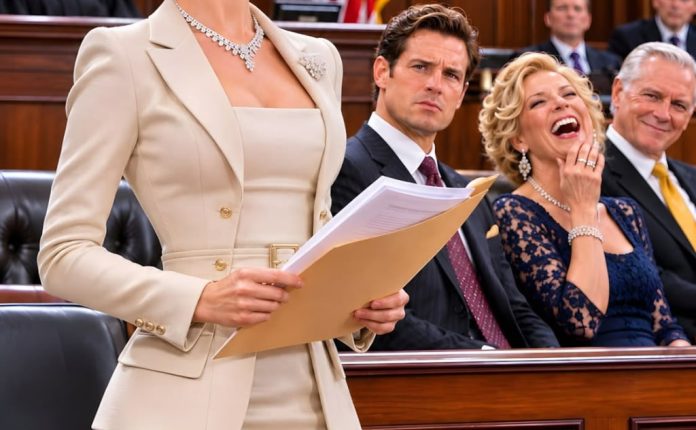
By the time we returned to Judge Porter's courtroom, the divorce no longer resembled the simple matter Andrew had promised his parents.
The parties had exchanged thousands of pages of records.
Witnesses had been identified.
Financial disclosures had been supplemented.
A forensic accountant had examined transactions Andrew originally described as irrelevant.
And the disputed agreement had become the subject of formal testimony.
I arrived with Rebecca Shaw shortly before nine.
This time, I did not sit alone.
Rebecca carried two binders.
I carried the same leather briefcase I had brought to the first hearing.
The handle had begun to wear.
I liked it that way.
It reminded me of the difference between appearance and usefulness.
Ruth and Frank were already seated.
Ruth looked at me without smiling.
Her bracelet caught the light as she adjusted her handbag.
Frank gave me a brief nod.
I returned it.
Andrew sat with Stephen Calder and Natalie Brooks.
His face was drawn.
The confident smile he had worn at the first hearing was gone.
Judge Porter entered.
After addressing preliminary matters, she explained that the court would hear evidence concerning the contested settlement and disputed financial issues.
She emphasized that allegations were not findings.
Each party would have an opportunity to present evidence and challenge the other side's interpretation.
That was exactly what I wanted.
I had not spent months gathering records so that a judge would accept my conclusions merely because I stated them forcefully.
I wanted the evidence examined.
Daniel Mercer testified first.
He described his notarial practices, his recordkeeping procedures, and the steps he took when asked to authenticate a document.
Rebecca showed him the acknowledgment attached to the settlement.
“Mr. Mercer, do you recognize the name and commission information appearing here?”
“Yes.”
“Can you verify that you personally performed this notarization?”
“No.”
“Did your records contain an entry showing that Mara Ellison appeared before you on the stated date?”
“No.”
“Have you examined the seal image?”
“Yes.”
“What can you tell the court?”
He explained that the image did not establish that he had personally applied his seal.
He also identified differences between the image and examples of acknowledgments he had issued during the relevant period.
Calder questioned him carefully.
“Mr. Mercer, are you saying you can conclusively identify who placed this image on the document?”
“No.”
“Can you establish who created the disputed signature?”
“No.”
“Can you prove that my client personally altered the document?”
“No.”
I appreciated the precision of the exchange.
Mercer did not overstate what he knew.
His evidence supported the conclusion that the notarization could not be verified through his records.
It did not, by itself, identify the person responsible.
Next came Patricia Lowe.
She appeared nervous.
Her attorney sat nearby.
Rebecca asked her about her responsibilities at Ellison Strategic Holdings.
Patricia explained that she managed schedules, transmitted documents, coordinated meetings, and handled administrative correspondence.
She was not an attorney or notary.
“Did you personally witness Mara Ellison sign the marital settlement agreement?”
“No.”
“Did you arrange an appointment at which she signed it?”
“No.”
“Did you receive a signed original directly from Mrs. Ellison?”
“No.”
Rebecca presented the email correspondence.
Patricia identified messages she had sent and received.
One showed that she had informed Andrew the signature pages were incomplete.
Another contained his response instructing that the completed packet be delivered to counsel.
Rebecca asked her to explain what happened next.
Patricia took a breath.
“I received an electronic file that appeared to contain completed signature pages.”
“From whom?”
“Mr. Ellison.”
“Did you know whether Mrs. Ellison had signed?”
“No.”
“Did you ask?”
“Yes.”
“What response did you receive?”
Patricia looked toward Andrew.
He stared straight ahead.
She answered.
“He told me not to delay the paperwork.”
Rebecca continued.
“Did you personally create the signature appearing on the agreement?”
“No.”
“Did you insert the notarial acknowledgment?”
“No.”
“Did you know who did?”
“No.”
Calder cross-examined her.
He established that Patricia had not watched Andrew create or alter the signature.
She could not identify the person who originally assembled every part of the disputed PDF.
She also acknowledged that several people had access to administrative systems used for document preparation.
Her testimony did not establish every step in the document's creation.
But it confirmed that she had warned Andrew about the incomplete signature pages and that an apparently completed version later arrived from him.
I watched Ruth.
She had stopped whispering.
Her hands rested motionless in her lap.
When Patricia stepped down, Frank leaned toward her.
Ruth shook her head slowly.
For the first time, she seemed unwilling to speak.
Then Rebecca called Daniel Price.
His testimony concerned the financial records.
Daniel explained his professional qualifications and the scope of the analysis he performed.
He identified the records he relied upon and distinguished verified transactions from those requiring further explanation.
The judge listened closely.
Daniel began with the house.
He traced my $185,000 transfer from an account I had maintained before marriage to the closing transaction.
He explained how the funds were applied.
He also identified the contemporaneous correspondence acknowledging my contribution.
Calder questioned whether the transfer could have been a gift.
Daniel agreed that the accounting records alone did not determine the legal character of the contribution.
That issue required consideration of applicable law and other evidence.
But the contribution itself was documented.
Next came the business accounts.
Daniel explained that Ellison Strategic Holdings existed before our marriage.
Its original ownership was not disputed.
What required analysis was the treatment of financial activity during the marriage and the accuracy of disclosures concerning certain accounts and transfers.
He identified the $240,000 movement into Ashford Capital Ventures.
Then he presented records showing Andrew's connection to that entity.
He explained why the transfer should have been disclosed for evaluation rather than excluded from the financial picture.
Calder asked whether the transfer proved wrongdoing.
Daniel answered without hesitation.
“No. A transfer does not establish improper conduct by itself.”
“Then why is it relevant?”
“Because its existence, ownership, and source of funds bear on the completeness and accuracy of the financial information presented.”
Judge Porter made a note.
The distinction mattered.
We were not asking the court to punish Andrew simply for moving money.
We were asking it to examine whether the assets and transactions had been accurately disclosed.
Daniel continued with additional reimbursements and transfers.
Some had innocent explanations supported by documentation.
Others lacked supporting records or were inconsistent with Andrew's initial descriptions.
Over the following hours, the financial picture became clearer.
Not simpler.
Clearer.
Andrew had wanted the court to accept broad statements that everything important belonged to him.
The evidence required a more careful examination.
When Daniel finished, the judge recessed for lunch.
I stepped into the hallway with Rebecca.
Neither of us spoke immediately.
Then she asked, “How are you holding up?”
“Better than I expected.”
“Any concerns?”
I considered the testimony.
“Patricia seems frightened.”
“She does.”
“I hope she doesn't lose her livelihood because of this.”
Rebecca looked at me.
“Her employment circumstances may be complicated, but she has her own attorney. Our responsibility is to handle her evidence fairly.”
“I know.”
We walked toward the elevators.
Ruth was waiting near the corridor window.
“Mara.”
Rebecca stopped beside me.
Ruth looked at her.
“Could I speak to Mara?”
Rebecca turned toward me.
“Your choice.”
I nodded.
Ruth clasped her hands.
For once, she appeared uncertain how to begin.
“I didn't know about the agreement.”
I studied her.
“Which part?”
“The signature. The notary.”
“You told me it was genuine.”
“I believed Andrew.”
I waited.
She looked down at her bracelet.
“He said you were refusing to be reasonable.”
“I refused to sign something that misrepresented our finances.”
“He told us you were trying to take the company.”
“I wasn't.”
Ruth lifted her eyes.
“I don't understand why he would let things get this far.”
I could have offered a dozen answers.
He was accustomed to being obeyed.
He considered disagreement a personal insult.
He believed money could resolve problems before anyone examined them.
But those were judgments about his behavior, not evidence of his state of mind.
So I said, “You'll have to ask Andrew.”
Ruth glanced toward the courtroom.
“He won't talk to us.”
I almost told her how familiar that felt.
Instead, I waited.
She spoke again.
“I know I've been unkind to you.”
The admission surprised me.
It was not an apology.
Not yet.
But it was the first time I could remember Ruth naming her behavior without immediately finding someone else to blame.
“Yes,” I said. “You have.”
Her eyes filled.
“I thought you were trying to hurt him.”
“I was trying to protect myself.”
She nodded once.
Then she walked away.
When the hearing resumed, Andrew testified.
His attorney began with questions about the history of his business and our marriage.
Andrew described himself as the primary income earner.
That much was true.
He described me as responsible for household management.
Also true.
Then he characterized my financial contribution as minor.
Rebecca addressed that during cross-examination.
“Mr. Ellison, you received $185,000 from Mara toward the purchase of your residence?”
“Yes.”
“Was that a minor amount to you?”
“It was a contribution.”
“Earlier, you described her contributions as insignificant.”
“I meant compared to the overall business.”
“Was the house purchased for the business?”
“No.”
“Then let's discuss the house.”
She placed the closing record before him.
Andrew answered reluctantly.
The funds had been transferred.
They had been used in the purchase.
He had acknowledged them at the time.
Rebecca then turned to the disputed agreement.
“Did you know Mrs. Ellison had not signed the settlement agreement when you instructed Patricia Lowe to deliver a completed packet?”
Calder objected to the form of the question.
Judge Porter directed Rebecca to separate the issues.
She did.
“Did Patricia tell you the signature pages were incomplete?”
“Yes.”
“Did you subsequently send her a document appearing to contain Mrs. Ellison's signature?”
“Yes.”
“Where did you obtain that version?”
Andrew looked down.
“I don't remember.”
“Did Mrs. Ellison give it to you?”
“No.”
“Did you observe her execute it?”
“No.”
“Did you communicate with Daniel Mercer about the acknowledgment?”
“No.”
“Can you identify anyone who witnessed Mrs. Ellison sign?”
“No.”
Rebecca paused.
Then she asked the question I had been waiting to hear.
“Despite knowing you had not seen your wife sign and despite receiving notice that the pages were incomplete, you provided your attorneys with a document represented as executed by both parties. Is that correct?”
Andrew looked at Calder.
Calder remained still.
Andrew swallowed.
“Yes.”
No one shouted.
There was no dramatic announcement.
Judge Porter simply made another note.
But I felt the weight of his answer.
For months, Andrew had insisted that the divorce agreement was a straightforward matter.
Now he had acknowledged the facts that made its authenticity seriously doubtful.
Rebecca continued.
“Did you tell your attorneys that you could not verify your wife's signature?”
“I don't remember.”
“Did you tell your wife the agreement had already been filed with a signature attributed to her?”
“No.”
“Instead, you delivered another copy and told her to sign?”
“I told her to review it.”
“Did you say, ‘Sign these, Mara’?”
Andrew looked toward me.
Then he answered.
“Something like that.”
I lowered my eyes.
The memory of our kitchen returned with painful clarity.
The coffee.
The rain.
The envelope beside my plate.
How casually he had demanded my consent while treating my questions as an inconvenience.
Rebecca moved to financial disclosures.
She examined Andrew's statements concerning Ashford Capital Ventures and other accounts.
He admitted that some information had been omitted from his original disclosures.
He characterized those omissions as mistakes.
Rebecca asked whether the omissions had been corrected before the initial uncontested hearing.
“No.”
The cross-examination continued.
By late afternoon, the judge had heard extensive evidence about the disputed agreement and financial records.
The court did not make every determination immediately.
Judge Porter explained that the evidence and applicable law required careful consideration.
She also made clear that the disputed agreement could not serve as the uncontested basis for the divorce.
Further proceedings would address the remaining financial issues.
She directed that relevant records and testimony be preserved.
She also noted that questions arising from the disputed acknowledgment could be referred to appropriate authorities for independent review.
That was not a criminal conviction.
It was not a finding that every allegation had been proved.
It was a recognition that the irregularities required serious examination beyond Andrew's preferred explanation.
Court adjourned.
Andrew rose slowly.
Ruth approached him.
I could not hear everything she said.
But I saw her face.
She was no longer the woman who had laughed when I entered court alone.
Andrew shook his head at something she asked.
Frank stepped between them.
Calder placed a hand on Andrew's shoulder and guided him toward the exit.
Rebecca touched my arm.
“Come on. We have work to do.”
I nodded.
The case was not over.
The financial distribution still needed resolution.
But something important had changed.
Andrew could no longer control the entire story merely by declaring his version final.
Outside, I stood on the courthouse steps.
The afternoon sun was beginning to drop behind the buildings.
For years, I had imagined that freedom would arrive as one dramatic moment.
A court order.
A declaration.
A final judgment.
Instead, I was discovering that freedom came through smaller decisions.
Reading the document.
Questioning the signature.
Preserving records.
Asking for help.
Refusing to accept a false account of my own life.
Rebecca stepped beside me.
“There's a settlement proposal coming,” she said.
“How do you know?”
“Calder asked whether we'd be willing to discuss one.”
I watched traffic move through the intersection.
“And?”
“I told him we would review any serious proposal supported by complete financial information.”
I considered that.
After months of conflict, Andrew might finally be prepared to negotiate.
But a negotiation was not the same thing as accountability.
I opened my briefcase and took out a notebook.
“Then we make sure the numbers are right.”
Rebecca smiled.
“Exactly.”
END PART 4