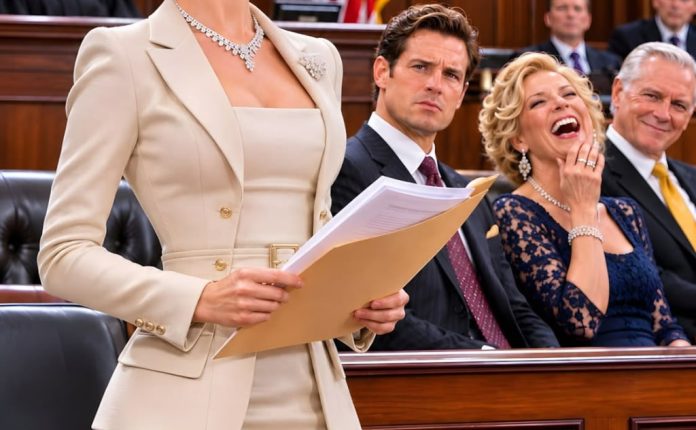
Stephen Calder requested a recess.
Judge Porter looked at the clock.
“We have not been in session long enough for a recess to become a substitute for answering a basic question, Mr. Calder.”
“Your Honor, I understand. However, Mrs. Ellison has raised a serious concern regarding materials supplied by my client.”
“Then you should begin by identifying what your office knows.”
Calder looked down at the disputed settlement agreement.
“To the best of my current knowledge, our office received the purportedly executed agreement from Mr. Ellison. I cannot confirm whether anyone on our staff independently verified the notarial acknowledgment.”
Andrew leaned forward.
“Stephen, I thought we were supposed to be discussing the settlement.”
Calder turned toward him.
“Andrew, please allow me to address the court.”
It was the first time I had heard anyone from his legal team speak to him with anything other than polished deference.
Judge Porter studied Andrew.
“Mr. Ellison, did you provide this agreement to your attorneys?”
Andrew hesitated.
“Yes, but I didn't prepare every page personally.”
“Who did?”
“My office handled some of the paperwork.”
The judge made a note.
“Which office?”
“My company's administrative office.”
“Who specifically?”
Andrew looked toward Calder.
His attorney did not rescue him.
“I would have to check,” Andrew said.
That answer mattered.
For three weeks, Andrew had treated the agreement as final and unquestionable. He had repeatedly demanded that I sign it.
Now, under a simple question about its origin, he could not identify who had prepared the supposedly completed document.
Judge Porter turned to me.
“Mrs. Ellison, please explain the evidence you wish the court to consider at this stage.”
I opened the first section of my folder.
“The agreement contains a signature attributed to me. The accompanying acknowledgment identifies Daniel Mercer as the notary and states that I appeared before him on September seventeenth.”
I handed the clerk my supporting materials.
“I did not appear before Mr. Mercer. I have records showing that I was in Richmond that day, and I have a signed statement from Mr. Mercer concerning his own records.”
Judge Porter examined the statement.
She read it without interruption.
The only sound was the ventilation system.
“Mr. Mercer states that he cannot locate a corresponding journal entry and cannot verify this notarization,” she said.
“Yes, Your Honor.”
“Does he claim the signature or seal was forged?”
“No. He limits his statement to what he personally knows. I am not asking the court to make a finding beyond the available evidence.”
“Very well.”
Calder looked up.
“Your Honor, I would respectfully request an opportunity to obtain additional information from the notary.”
“I would expect you to.”
Judge Porter placed the statement beside the agreement.
“The court will not treat the disputed settlement as an uncontested agreement at this time.”
Behind me, I heard Ruth make a sharp sound.
It was almost a gasp.
Frank whispered something to her.
The judge continued.
“Any assertion concerning the authenticity of the signatures or acknowledgments will require appropriate proof. The court will determine what further proceedings are necessary.”
Calder nodded.
“Understood.”
Then Judge Porter addressed me again.
“You also mentioned financial discrepancies.”
“Yes, Your Honor.”
I opened the next section.
“My concern is that the proposed settlement describes certain assets as Mr. Ellison's separate property, although the underlying records show substantial contributions from marital funds and funds I owned before the marriage.”
Andrew shook his head.
“This is unbelievable.”
Judge Porter looked directly at him.
“Mr. Ellison, I will not repeatedly remind you of courtroom procedure.”
He leaned back.
I continued.
“When we purchased our home, I transferred $185,000 toward the closing. I have the bank statement, the closing record, and correspondence in which Mr. Ellison acknowledged the contribution.”
Calder looked at Andrew.
Andrew stared at the table.
“In addition,” I said, “the financial disclosure appears incomplete concerning accounts associated with the business and several transfers made during the breakdown of our marriage.”
Calder stood again.
“Your Honor, we have not had an opportunity to examine these records.”
“I understand,” Judge Porter said. “Mrs. Ellison is identifying disputes, not asking me to decide final distribution today.”
She turned back to me.
“Are you prepared to exchange the relevant records through the proper process?”
“Yes.”
“Do you understand that the other party may challenge their authenticity or interpretation?”
“Yes.”
“Good.”
The judge glanced at the attorneys.
“This appears to be a contested matter, not the routine approval of an uncontested settlement.”
Calder lowered his eyes.
That single statement changed the atmosphere.
Only minutes earlier, Andrew's side had expected a brief hearing followed by an order accepting their terms.
Now they faced unresolved questions about an agreement, financial disclosures, and the source of documents filed with the court.
I did not feel victorious.
I felt alert.
Experience had taught me that exposing a contradiction was only the beginning.
The difficult work came afterward, when everyone had time to construct explanations.
Judge Porter allowed a short recess for counsel to review the materials.
I remained seated as Andrew's legal team gathered at the far side of the courtroom.
Calder spoke quietly but intensely.
Andrew repeatedly shook his head.
One of the younger attorneys, a woman named Natalie Brooks, opened a laptop and began comparing documents.
I recognized her expression.
She had discovered something she had not expected.
Ruth approached me.
“Mara.”
I looked up.
She stood over me with her handbag clutched against her coat.
“Do you have any idea what you're doing to Andrew?”
I closed my notebook.
“I've challenged a document I never signed.”
“You are accusing him of being dishonest in front of a judge.”
“I'm asking how my name appeared on a legal agreement without my permission.”
She frowned.
“You could have discussed this privately.”
“I tried discussing the agreement with Andrew.”
“You've always been stubborn.”
I studied her face.
“Ruth, if someone filed a document saying you surrendered your property, and you knew you hadn't signed it, what would you do?”
She did not answer.
Frank approached.
“This could become expensive, Mara.”
“Yes.”
“Andrew is prepared to be reasonable if you stop making accusations.”
“Did he ask you to tell me that?”
Frank adjusted his jacket.
“We're trying to keep the family from being dragged through something unnecessary.”
I looked from one of them to the other.
“You haven't asked whether the document is genuine.”
Ruth's cheeks colored.
“Of course it is.”
“How do you know?”
“Because Andrew wouldn't do something like that.”
I waited.
She had no further explanation.
Across the room, Calder called Andrew back to the table.
Ruth turned away.
I watched her return to her seat beside Frank.
For years, I had helped Ruth through illnesses, family disagreements, and countless appointments.
I had listened when she complained about feeling ignored by her sons.
I had taken meals to her when she was recovering.
Yet when confronted with evidence that someone might have misused my signature, her first concern was Andrew's embarrassment.
That realization hurt more than her laughter.
When court resumed, Calder requested a scheduling order allowing the parties to exchange evidence and conduct discovery.
He also told the judge that his office would investigate the disputed execution of the agreement.
Judge Porter approved an orderly schedule.
She made clear that neither side was entitled to have allegations accepted without proof.
The agreement would not be approved as an uncontested settlement.
The financial issues would proceed through the appropriate contested-divorce process.
She advised both parties concerning the importance of preserving relevant records.
Then she looked at me.
“Mrs. Ellison, I want to be certain you understand the procedural complexity of what comes next. You may wish to consider obtaining counsel.”
“I understand, Your Honor.”
“Your decision to appear without an attorney today does not prevent you from retaining one later.”
“Thank you.”
The hearing concluded shortly before noon.
I gathered my papers slowly.
Andrew approached before I reached the doors.
His face was flushed.
“What was that supposed to accomplish?”
I closed my briefcase.
“A chance to examine the real evidence.”
“You made me look like a criminal.”
“I said I never signed the agreement.”
“Same difference, apparently.”
“No, Andrew. They're very different.”
He stepped closer.
“You think because you used to work in military law, you can outsmart three experienced attorneys?”
I looked at him.
It was the first time he had acknowledged my former profession in months.
“I don't need to outsmart anyone. I need the record to be accurate.”
“You're going to regret this.”
Calder appeared beside us.
“Andrew, not another word.”
My husband turned.
“She's making accusations about me.”
“And the proper place to respond is through the legal process,” Calder said firmly.
Andrew stared at him.
Calder lowered his voice.
“We need to leave.”
I walked past them.
Outside, the air was cold and clear.
I reached my car before realizing that my hands were shaking.
I sat behind the steering wheel and waited.
For years, I had kept my emotions contained while Andrew and his family decided what kind of wife I ought to be.
In court, I had managed to remain composed.
Alone, the weight of everything pressed against me.
My marriage was ending.
The house I had helped purchase was disputed.
My name appeared on a document I had never signed.
And the man I had once trusted was furious that I had challenged him.
I let myself cry.
Not for long.
Then I took a tissue from the glove compartment, wiped my face, and called my former colleague, Laura Bennett.
Laura had served with me years earlier and now practiced civilian law.
She had been the person I visited in Richmond on September seventeenth.
She answered on the second ring.
“How did it go?”
“The judge won't approve the agreement as uncontested.”
“Good.”
“Calder says his office is investigating.”
“Also good.”
I looked through the windshield.
“Andrew is furious.”
Laura was quiet for a moment.
“Mara, I want you to listen to me. You've established that there are serious factual disputes. Now you need independent representation.”
“I know.”
“You did what you needed to do at the initial hearing. Don't let pride turn this into a contest about whether you can handle the entire case alone.”
I almost smiled.
“You sound like my supervising attorney.”
“I learned from an excellent one.”
I looked at the folder beside me.
“I'll call the lawyer you recommended.”
“Please do.”
Before hanging up, Laura asked one more question.
“Have you figured out where that disputed agreement originated?”
“Not yet.”
“Then don't assume the answer. Follow the records.”
I promised I would.
That afternoon, I contacted attorney Rebecca Shaw.
Rebecca had been recommended by Laura because of her experience handling contested divorces involving business interests and complicated financial records.
We scheduled a consultation.
When she reviewed my documents, she did not begin with praise.
She asked questions.
Where had I obtained the bank records?
Which materials were already part of the court file?
Had I preserved the original agreement Andrew gave me?
Who had access to the home office?
Could I identify the source of each disputed transfer?
I answered as carefully as possible.
Then she reached the notarial acknowledgment.
“This needs a proper authentication process,” she said.
“I agree.”
“And we need to be cautious about claiming intent before we know who prepared it.”
“Yes.”
She looked up.
“You understand that your military legal background gives you useful skills, but these proceedings have their own rules.”
“Completely.”
Rebecca considered me for a moment.
“Then we should work well together.”
I retained her.
It was the first financial decision I made during the divorce without considering whether Andrew would approve.
Over the following weeks, formal requests for records revealed something unexpected.
The disputed agreement had apparently been transmitted to Calder's office as a completed document from an administrative email account associated with Andrew's company.
The accompanying message represented that both parties had already executed it.
The name on the account belonged to Andrew's executive assistant, Patricia Lowe.
I knew Patricia.
She had worked for Andrew for almost five years.
She was efficient, reserved, and meticulous about scheduling.
We had exchanged hundreds of messages about business dinners and travel arrangements.
I also knew that she rarely sent legal paperwork without explicit instructions.
Rebecca requested the relevant correspondence and metadata through the discovery process.
Calder's office produced the email showing receipt of the agreement.
But it did not establish who had created the signatures or whether Patricia had personally sent the attachment.
Andrew insisted that administrative staff had managed the paperwork.
Patricia, through counsel, indicated that she had not notarized anything and had never witnessed me sign the agreement.
Then Rebecca found a discrepancy in the transmission timeline.
The supposedly executed agreement had been emailed to Calder's office on September 18.
But its electronic creation history, as preserved in the produced records, suggested that the particular PDF file had been assembled several days later.
Rebecca checked the dates twice.
“So either these records are being interpreted incorrectly,” she said, “or the sequence we've been given isn't complete.”
I examined the documents.
“Can we obtain the original file and relevant email records?”
“We can request them. We may need further orders if there are objections.”
I looked at Andrew's correspondence.
There was another detail.
The administrative email had been sent from the company's account, but the accompanying message used phrasing Andrew frequently used when instructing employees.
“Please finalize without further discussion.”
He had written those words to me many times.
That did not prove authorship.
But it gave us a direction for further inquiry.
Rebecca prepared additional discovery requests.
Two days later, Calder contacted her.
His office had learned that Daniel Mercer disputed performing the acknowledgment.
He was also seeking clarification concerning the source of the seal image appearing on the document.
More importantly, Calder indicated that his client had offered differing explanations about who completed the agreement.
Andrew first claimed Patricia handled it.
Then he suggested a third-party document service.
Neither explanation had yet been supported.
Rebecca listened carefully.
When the call ended, she turned to me.
“Your husband has a problem.”
I looked at the file.
“What kind?”
“He needs a consistent, verifiable account of how that document was created.”
I thought of Andrew standing in our kitchen, ordering me to sign papers that already appeared to contain my signature.
“There's something else,” I said.
Rebecca looked up.
“When Andrew gave me the agreement, he told me to sign it by Friday.”
“Yes?”
“If he believed I had already signed, why would he say that?”
She remained silent.
Then she reached for her notebook.
“Tell me his exact words, as closely as you can remember.”
I did.
She wrote them down.
Finally, she looked at me.
“That contradiction may become important.”
The following morning, Rebecca received an unexpected message from Natalie Brooks, one of Calder's associate attorneys.
The message was professional and carefully worded.
Calder's firm had identified additional documents that might require supplemental production.
Rebecca called Natalie immediately.
Their conversation lasted nearly half an hour.
When she finished, she told me what had changed.
An earlier draft of the agreement had been located.
It carried a different version of my signature.
And attached to it was an internal message that appeared to show Andrew personally instructing his assistant to prepare the final version.
END PART 2