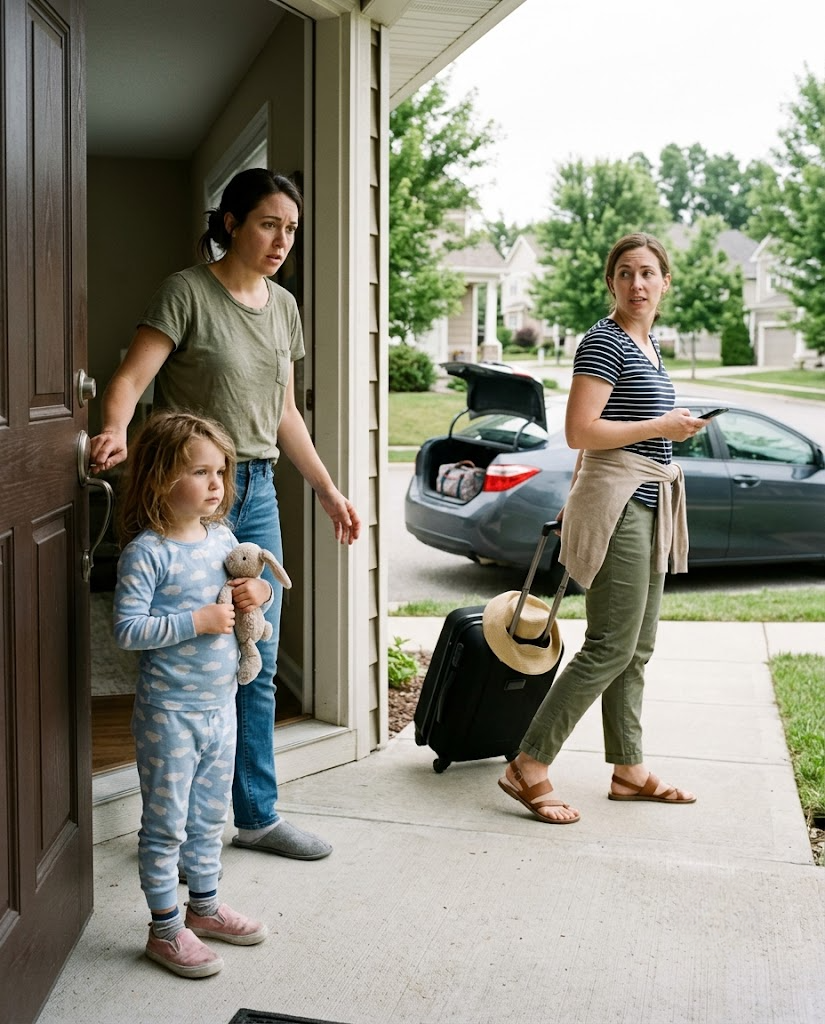
Kelsey arrived at my porch early Thursday morning with the same bright smile she used whenever she wanted everyone to believe everything was under control.
“Just a few hours,” she said. “Maybe a follow-up appointment. I’ll be back by lunch.”
She handed me her four-year-old daughter Sophie’s worn little bag. Inside was one pull-up, a half-finished juice, and a snack with a bite missing. Sophie stood beside her mother in wrinkled pajamas, holding her stuffed bunny tightly. Her hair had been brushed only across the top, like someone had rushed through the motions without really stopping to care.
I noticed. I always noticed.
But for years, I had done what family members often do when they love someone who keeps making the same mistakes. I covered the gaps. I answered the calls. I told myself Kelsey was overwhelmed and that things would eventually get better.
So when she walked toward her car, I opened the door wider.
“Be good for Auntie,” she told Sophie before leaving.
By noon, Kelsey had not called.
Sophie sat at my kitchen table eating grilled cheese with tomato soup, carefully dipping each piece without spilling. She colored flowers, a sun, and a small house with three people standing outside.
Then she looked up.
“Is Mommy coming soon?”
“She said she would,” I answered.
Sophie nodded, picked up another crayon, and said something that changed the entire day.
“Mommy’s at the big pool.”
I kept my voice calm.
“What big pool, sweetheart?”
“The one after the plane. She has her new swimming clothes. She said it’s only for grown-ups.”
The room suddenly felt much quieter.
I stepped into the hallway and checked my phone. It took only minutes to find what Kelsey had tried to hide from me. A cousin had shared one of her resort posts.
There was Kelsey beneath palm trees beside an oceanfront pool, wearing sunglasses and holding a bright drink. The caption talked about finally choosing herself.
The post had been uploaded before she even reached my driveway.
Her suitcase was already packed when she handed me her child.
That was when I stopped making excuses.
For years, I had saved pieces of evidence without admitting why. Messages from daycare asking why nobody had arrived. Screenshots of Kelsey promising she would return in twenty minutes and disappearing for hours. Receipts for shoes, medicine, groceries, and preschool costs she said she would repay. Photos of bags packed without enough food, proper clothing, or instructions.
I kept those things because Kelsey had a way of making me doubt my own memory.
That afternoon, I finally trusted it.
When she answered my call, I could hear music and splashing behind her.
“Where are you?” I asked.
“Running around. Why?”
“Sophie told me about the plane.”
The noise disappeared.
Then Kelsey’s voice changed.
“Just be a good aunt. I need this.”
I looked through the doorway. Sophie was holding up her drawing.
“That’s our house,” she said.
But now there were only two people beside it.
I looked back at my phone.
“No,” I told Kelsey. “This time, there needs to be a record.”
Her response came quickly.
“You call anyone, and you will never see Sophie again.”
I did not argue. I ended the call and began documenting everything. I saved the resort posts, photographed Sophie’s nearly empty bag, wrote down the exact time Kelsey arrived, and downloaded the doorbell footage from that morning.
Then I contacted a family-support professional.
She did not ask me to protect Kelsey’s image. She asked simple questions.
Did Sophie have food? Did she have medication? Did she have a safe place to sleep? Had this happened before?
I looked at my niece asleep on the couch, one hand wrapped around her bunny’s ear.
“Yes,” I said. “Many times.”
Our parents reacted the way Kelsey expected.
My mother asked why I could not handle it privately. My father said Kelsey was overwhelmed and reminded me that family comes first.
I looked at them and answered quietly.
“Sophie is family.”
Neither of them had a response.
When Kelsey finally returned, she walked in already prepared to be the victim.
Her first words were not about whether Sophie had eaten. They were not about the fear a child feels when she wakes up wondering when her mother will return.
“How could you do this to me?”
That sentence told me everything I needed to know.
“Sophie is safe,” I said. “That is what matters.”
Then the family-support worker asked a question Kelsey never expected.
“Where is Sophie’s father?”
For years, Kelsey had told us Daniel did not care. She said he missed birthdays, ignored visits, and refused to help. I believed her because every message from him seemed to vanish before anyone else saw it.
But when I found an old email address and contacted Daniel, his first question was not about blaming Kelsey.
“Is she safe?”
Two days later, Daniel walked into the meeting carrying a thick gray folder.
Inside were child-support receipts, returned birthday cards, unanswered requests to visit Sophie, emails offering to help with preschool, and certified letters Kelsey had refused to collect. He also had records showing that she had changed Sophie’s daycare without telling him and blocked his number after he asked for a formal parenting schedule.
Kelsey stared at the folder.
“Those don’t prove anything,” she said.
Daniel stayed calm.
“They prove I kept knocking.”
The room went silent.
For the first time, my parents looked at Kelsey without immediately defending her.
Then Kelsey tried a different strategy. She accused Daniel of harassment. She accused me of jealousy. She claimed Sophie had never been abandoned because I had supposedly agreed to watch her for the entire trip.
Then she pulled a notarized document from her handbag.
My name was printed beneath a statement saying I had voluntarily agreed to care for Sophie for six days.
The signature looked almost like mine.
Almost.
Kelsey placed the paper on the table and leaned back.
For the first time all day, she smiled.
“There,” she said. “Now everyone can stop pretending I abandoned anyone.”
The caseworker studied the paper, then looked at me.
I did not yell. I did not cry.
I placed my phone on the table and opened the doorbell recording from Thursday morning.
The screen showed Kelsey standing on my porch with Sophie’s nearly empty bag. The timestamp was clear.
The recording began.
Her own voice filled the room.
“A few hours. Maybe a follow-up appointment. I’ll be back by lunch.”
Nobody spoke as the video continued. It showed her handing me the bag, turning toward her car, and leaving while I believed exactly what she had promised.
When the recording ended, the caseworker placed Kelsey’s document beside my phone.
Six days written on a paper. A few hours captured on video.
Kelsey opened her mouth, but Daniel placed his folder back on the table. The evidence she wanted everyone to ignore was now sitting beside the document she hoped would save her.
Then the caseworker pointed to the signature.
“You said she signed this before you left,” she said.
Kelsey nodded too quickly.
The caseworker looked at the timestamp again.
Then she asked the question that changed the entire room.
“Where, exactly, did this six-day agreement come from?”
And for the first time, Kelsey had no prepared answer.