The small house key rested in Officer Reid Holloway’s hand as seven-year-old Micah Sutton stood at the corner, waiting for him to understand that the next few minutes would reveal why he had asked for help in the first place. Micah had not asked for someone to rescue him from the walk home. He had asked for someone to see the truth before another explanation covered it up.
The moment was unusual because Micah was not acting like a child who wanted attention. He was not trying to tell a dramatic story or make an accusation that needed immediate approval. He was asking for something much simpler and much heavier. He wanted an adult witness.
For nearly five years, Officer Holloway had worked around the school district on the west side of Fort Collins, Colorado. He knew the ordinary rhythm of weekday afternoons. The final bell would send students spilling outside with backpacks bouncing against their shoulders. Parents would pull into the pickup line. Car doors would open and close. Teachers would remain outside until the last children were safely headed home.
Most days were predictable. Most conversations were simple.
Children asked about his radio. They asked about his patrol vehicle. They asked the kinds of questions children ask when they see someone in uniform who seems approachable. Sometimes they just waved before running toward a waiting parent.
Micah was different that Tuesday.
He approached carefully, standing close enough that Holloway immediately noticed something was wrong. His gray sneakers were worn at the toes. His backpack looked heavy on his small shoulders. His haircut was uneven around the edges. Those details were ordinary, but his expression was not.
The seven-year-old looked like he had been carrying a sentence in his mind and was afraid that saying it the wrong way would make people ignore him again.
He looked toward the school entrance. Then he looked back at Holloway. Then he checked the entrance once more.
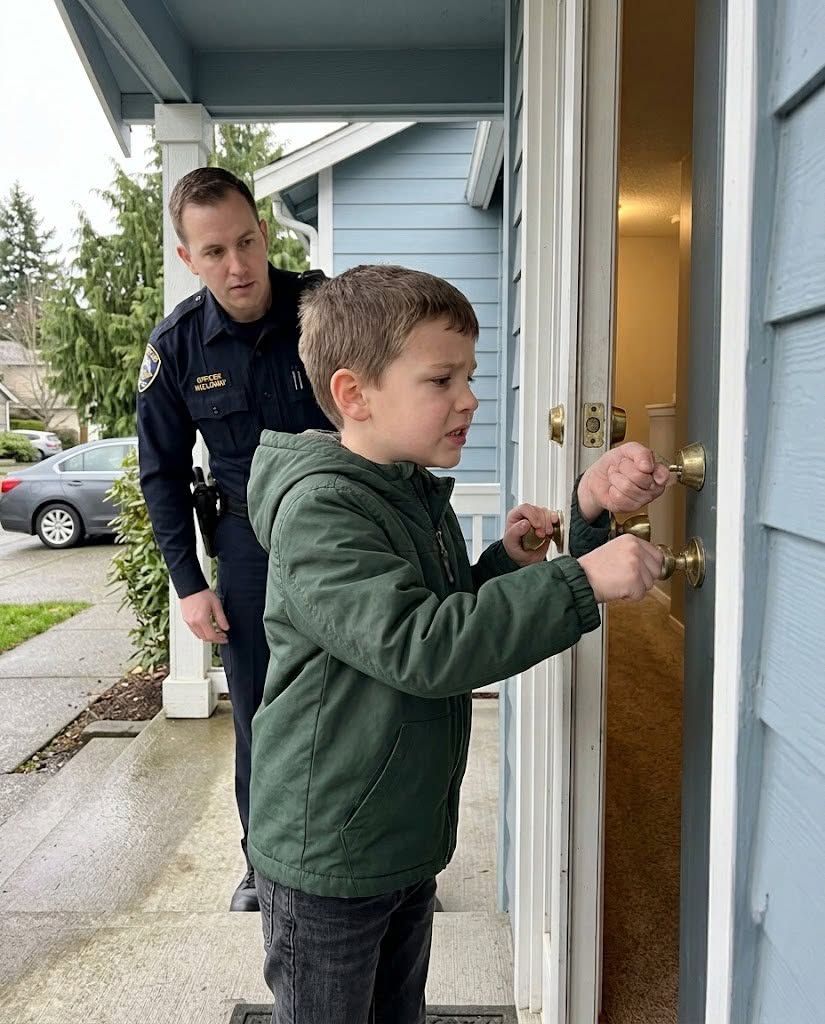
Finally, he asked if Holloway was Officer Holloway. When the officer confirmed his name, the boy introduced himself as Micah Sutton. The conversation could have ended there. It could have been a normal introduction between a student and an officer near the end of a school day. But Micah had something else to ask. He wanted Holloway to walk home with him. At first, the officer considered the obvious possibilities. Maybe someone was late picking him up. Maybe there was a misunderstanding. Maybe Micah simply needed help getting home safely. But Micah explained that he always walked home. His fingers tightened around his backpack straps. That small movement changed the meaning of the request. Micah was not asking because he was lost. He was not asking because he wanted company. He was asking because he believed something at home needed to be seen by someone who could not be talked out of what he witnessed. He lowered his voice and explained that he needed to show Holloway something at his house. The careful way Micah spoke was what stayed with the officer. There was no panic. There was no exaggerated claim. There was only the quiet determination of a child who had already tried explaining and had watched adults find reasons not to believe him. Holloway agreed. Micah adjusted his backpack and started walking. He did not smile. He did not suddenly relax. He simply moved forward while checking every few moments to make sure the officer was still following. The walk away from the school was quiet. Micah moved quickly for a child his age, but he did not run. His steps showed purpose. His shoulders carried the weight of both the backpack and whatever he had been trying to communicate. Holloway chose not to fill the silence with questions. Micah had come to him. Micah had chosen the moment. The officer wanted the boy to explain what he needed to explain without feeling pushed toward a certain answer. After the first block, Holloway asked one careful question. Did Micah feel safe going home right now? The answer came immediately. Yes. But the way Micah held onto his backpack straps told the officer that the situation was more complicated than that single word suggested. Holloway watched him closely but decided not to pressure him. The boy had already made a clear request. He wanted a witness before he wanted a conversation. They continued walking. The neighborhood became quieter. The sounds of school traffic faded behind them. The ordinary afternoon continued around them, with cars moving past and people going about their routines, unaware that a child had decided the only way to be understood was to bring an adult directly to what he had been trying to describe. Micah eventually stopped at a corner. He reached into his pocket. He pulled out a small house key. Then he placed it in Officer Holloway’s open hand. That small object carried more weight than its size suggested. A key was normally something private. It represented a place where someone belonged. It represented a door that opened because the person holding it was trusted. But for Micah, the key seemed to represent something else. It was the final step before someone else could see what he had been unable to make them understand. Holloway looked at the key, then back at Micah. The boy did not explain everything at that moment. He did not suddenly reveal every detail. He did not give a speech about what adults had missed. He simply waited. That was what made the situation so striking. Micah was not trying to control the reaction. He was not telling Holloway what conclusion to reach. He was giving him the chance to see. The officer followed him the rest of the way with a growing awareness that the child had been preparing for this moment long before they met on the sidewalk. Micah had likely learned something difficult about being believed. He had learned that words alone could be dismissed. Explanations could be questioned. Concerns could be minimized. But seeing something firsthand was different. Once another person saw it themselves, there was no longer a simple explanation that could erase it. The door ahead represented that turning point. Until then, everything existed through Micah’s words. Adults had heard pieces. Adults had formed opinions. Adults had accepted explanations. But the door was where those explanations would have to meet reality. As they approached the house, Holloway paid attention to Micah’s behavior. The boy was not acting like someone who wanted to create trouble. He was acting like someone who wanted the truth handled carefully. There is a difference between a child seeking attention and a child seeking confirmation that someone finally understands. Micah seemed to be searching for the second. The officer followed him to the entrance and watched as the boy prepared to unlock the door. For a seven-year-old, the movement should have been routine. A child coming home after school. A key turning in a lock. An ordinary afternoon ending. But Micah’s hands shook. That small detail changed the atmosphere. The key was not just opening a door. It was opening the place where every previous explanation would either hold up or fall apart. Holloway stayed close but allowed Micah to lead. The boy had asked him to come because he trusted what his own eyes would tell him. The officer understood that stepping ahead too quickly could take away the very thing Micah needed most: control over finally being heard. The child turned the key. The lock moved. The door opened. And within moments, the things adults had previously accepted began to look different. The details that had once been explained away now had to be examined. The small things Micah had noticed mattered. The concerns he had tried to communicate were no longer just words from a child. They were things another person could see. Officer Holloway’s role in that moment was not simply to arrive. It was to observe. It was to listen. It was to understand why Micah had chosen him. Sometimes children do not need someone to immediately solve every problem. Sometimes they need someone who will stop dismissing what they are saying long enough to look. Micah had spent enough time trying to convince people. Now someone else was finally there to witness. The afternoon that began like any other school pickup ended with a seven-year-old proving something important: being believed can begin with one person willing to walk beside you and see what you have been trying to show them all along.