The first thing I remember about that Sunday was the smell.
Rust from the fence.
Sour chlorine from the pool.
Wet leaves baking under a bright summer sun.
Somewhere beyond the neighboring yards, a lawn mower coughed, stopped, and started again, making the whole street sound painfully normal.
My name is Michael Carter, and for months I told myself I was being careful.
After the divorce, our ten-year-old daughter, Emily, divided her time between my house and the suburban home Sarah and I had once bought together.
Mondays were mine for school drop-off.
Fridays were usually Sarah’s for dinner.
Sundays were supposed to be easy.
Emily would climb into my SUV with her backpack, a library book, and half a story about recess that she would finish before we reached the second stoplight.
That routine had always made me feel as though the divorce had not taken everything from her.
Then the routine began to change.
Emily started asking to sit in my driveway for a few extra minutes before I took her back to Sarah’s.
She would stare through the windshield at the mailbox, the cracked sidewalk, or the neighbor’s sprinkler, anywhere except at me.
Her thumb moved over the seat belt until the skin around her nail turned red.
Whenever Jason’s name came up, she went silent.
Not sulking. Not distracted. Still.
There is a kind of silence children use when they are hiding a surprise. There is another kind they use when they are measuring danger.
I should have known the difference sooner.
I asked Sarah about it twice.
The first time, she laughed and said Emily was adjusting to new rules.
The second time, she accused me of trying to poison our daughter against her marriage.
“Jason is strict,” she said. “He is not cruel.”
Then she told me I was jealous.
She said divorced fathers always wanted to look like heroes after losing the house.
That sentence stayed with me because it was designed to.
Sarah knew exactly where to aim.
I had spent months trying to prove that I could be reasonable, cooperative, and calm.
I did not want every disagreement to become a custody fight.
I did not want Emily sitting in a family court hallway while two adults argued over who loved her correctly.
So I swallowed my anger.
I documented what I could.
I kept screenshots of missed calls. I wrote down dates. I saved school notices.
But I kept returning Emily to that house because I believed restraint was what a good father was supposed to show.
Peace can become a costume for cowardice.
You call it maturity until you realize your child has been paying for your restraint.
At 8:12 a.m. on Friday, the school office marked Emily absent.
I saw the automated notice during a work break and called Sarah immediately.
No answer.
I texted twice.
No reply.
At 6:47 p.m., Emily’s phone went straight to voicemail.
I requested a welfare check that evening.
The dispatcher gave me an incident number, and I wrote it on the back of a gas receipt because my fingers were shaking too badly to use my phone properly.
I called again before midnight.
The answer was the same.
The address had been checked. No one had opened the door. No immediate emergency had been confirmed.
Saturday came and went.
No picture. No call. No message saying they had gone somewhere. No irritated response from Sarah telling me to stop overreacting.
By Sunday afternoon, three full days had passed since I had heard Emily’s voice.
I drove to the house we had bought when she was born.
The cracked front step was still there. The flower beds were dead. The curtains were closed even though the sun was hard and white against the windows.
A heavy chain stretched across the gate.
I rang the bell until my thumb hurt.
Nothing moved.
Then Mrs. Harris hurried across from next door in house slippers.
She had a rosary wrapped around one hand so tightly that her knuckles looked bloodless.
“Michael,” she whispered. “Thank God you’re here.”
I had known Mrs. Harris for years.
She had brought soup when Emily had the flu. She had once kept a spare key for Sarah when we went out of town.
She was not dramatic. She was not nosy.
That mattered.
She told me she had heard screaming for weeks.
Arguments. Crying. Something heavy hitting a wall.
She had called twice, but Sarah had refused to let anyone inside.
“People can smile through a screen door,” she said. “That does not mean the house is safe.”
Then she told me about the black contractor bags.
She had seen Jason carrying them into the backyard after dark.
“He threw them into the pool,” she said.
My mouth went dry.
“What was in them?”
“I don’t know.”
The air seemed to leave the yard.
Mrs. Harris opened her side gate.
I climbed the fence between the properties and tore my palm on a rusted edge.
The cut was shallow, but blood ran across my wrist and disappeared beneath my watchband.
I barely noticed.
All I could hear was my own breathing and the faint slap of water behind the house.
The backyard looked abandoned.
Toys had been stacked against the wall as though no one wanted to touch them. Two patio chairs were overturned.
The pool had gone green, its surface thick and still.
Dark shapes rested beneath the water.
Then I saw the blue tarp behind the shed.
It was torn at one corner and held down with a brick and a plastic bucket.
The wind lifted the edge just enough to show metal bars.
I pulled it back.
A large dog cage sat underneath.
Emily was inside.
She wore a pale blue hoodie. Her knees were pulled to her chest. Her hair was tangled around her face.
Her lower lip was split.
Her eyes were too dry.
That detail frightened me more than tears would have.
Children are supposed to cry when they see a parent after being afraid. They are supposed to reach. They are supposed to fall apart.
Emily only stared at me as though she had to decide whether I was real.
“Daddy?”
The word nearly took my legs out from under me.
I dropped to my knees and grabbed the padlock.
The metal was hot. My fingers slipped.
I found a pair of old pliers near a flowerpot and clamped them around the lock.
The cage rattled against the concrete.
Emily flinched at the sound.
“I’m sorry,” I said. “I’m sorry. I’m getting you out.”
For one heartbeat, I pictured Jason walking through the back door.
I pictured leaving the lock and going after him.
Something black and hot moved through me.
Then Emily pressed both hands over her ears.
I stayed with the lock.
That choice mattered.
My daughter did not need another furious man in that yard.
She needed her father to open the cage.
The padlock snapped at 3:26 p.m.
Emily came out so quickly that she struck my chest with both fists.
Then she wrapped herself around my neck.
She felt frighteningly light. All elbows. All shaking breath.
I lifted her and kept one hand behind her head.
“You’re safe,” I told her.
I said it again because I needed her to hear it. I said it a third time because I needed to believe it.
Then her body went rigid.
She was not looking at the house.
She was looking at the pool.
The green water sat perfectly still.
The black bags rested beneath the surface in uneven lumps.
A strip of silver duct tape drifted near the shallow end.
Emily gripped my shirt and pulled hard.
“Daddy,” she whispered. “Please don’t look at the pool.”
My blood went cold.
Behind us, an upstairs curtain moved.
Then it moved again.
I shifted Emily higher against my chest and backed toward the fence.
Mrs. Harris stood on the other side with her phone pressed to her ear.
Her free hand reached toward us through the links.
The back door opened.
Jason stepped onto the patio in jeans and a gray T-shirt.
His face was blank for half a second.
Then he saw the open cage.
His gaze moved to the broken padlock. Then to Emily. Then to the pool.
The color left his face.
“Michael,” he said carefully. “Put her down.”
I kept moving.
He took one step forward.
Emily made a sound so small it barely seemed human.
Mrs. Harris’s knees buckled.
She caught herself against the fence while the dispatcher’s voice crackled from her phone.
That was the one thing Jason had not expected.
Someone else was listening.
“Do not come closer,” I said.
He stopped.
His right hand moved behind him toward the door.
His eyes kept cutting toward the pool.
Emily lifted her head.
“He made Mom hold the key,” she whispered.
Jason’s expression changed.
Footsteps sounded inside the house.
Sarah reached the doorway at a run.
She saw Emily in my arms. She saw the open cage. She saw Jason standing between us and the pool.
Then Emily looked at her mother.
“Mom,” she asked, “why did you lock it?”
Sarah struck the doorframe with one hand as though the question had physically hit her.
She opened her mouth.
Nothing came out.
The first patrol car arrived less than four minutes later.
Mrs. Harris had stayed on the line and given the dispatcher every detail she could see.
The officer entered through the side gate while a second officer came around the front.
Jason raised both hands only after he was ordered twice.
Sarah remained in the doorway.
She looked at Emily but did not move toward her.
I remember that more clearly than anything she said.
One officer took Emily and me toward the driveway.
The other secured the backyard.
The blue tarp stayed where it was. The broken padlock lay on the concrete. The cage door hung open.
At 3:41 p.m., an officer photographed the cage, the blanket, the tarp, and the marks around the lock.
At 3:48 p.m., paramedics examined Emily in the back of an ambulance.
They checked her pulse, her breathing, her lip, and the bruising along her wrists.
They asked questions slowly.
They did not force her to answer.
She kept one fist closed around the collar of my shirt.
I rode with her to the hospital.
The bright corridor lights made her squint.
A nurse gave her water in a paper cup.
Another nurse placed a hospital wristband around her arm and wrote down every visible injury on the intake form.
Emily watched the pen move.
“Is that for court?” she asked.
The nurse paused.
“It is so people know what happened to you,” she said.
Emily nodded as though that made more sense than comfort.
Back at the house, officers brought the contractor bags out of the pool one at a time.
I did not see them opened.
I learned later that the bags contained items from Emily’s room and school life that had been thrown away or hidden: her backpack, damaged school papers, a cracked phone, food wrappers, and the blanket from the cage.
Nothing in those bags made the scene less horrifying.
They made it organized.
That was worse.
Not one cruel moment. Not one punishment that went too far. A process. A key. A cage. A child being erased one object at a time.
Sarah came to the hospital that evening with an officer nearby.
She asked to see Emily.
Emily heard her voice from the hallway and curled toward the wall.
That was the answer.
The hospital social worker documented the reaction.
The police report included the school absence notice, the welfare-check incident number, Mrs. Harris’s calls, the photographs, the broken lock, and the items recovered from the pool.
By midnight, I had signed temporary safety paperwork.
The next morning, I sat in a family court hallway with dried blood still under my watchband and Emily’s pale blue hoodie folded inside a plastic property bag.
Sarah sat across from me.
Jason was not beside her.
For years, I had thought the worst thing divorce could do was turn two parents into opponents.
I was wrong.
The worst thing is when one parent becomes so afraid of conflict, shame, or losing a new relationship that a child is left alone inside it.
Sarah cried when the temporary custody order was read.
I did not feel victorious.
There is no victory in learning that your daughter was right to be afraid.
There is only the work that comes after.
Emily came home with me.
For the first week, she slept with the hallway light on.
She hid crackers under her pillow.
She jumped when the washing machine changed cycles.
At school pickup, she checked the back seat before opening the door.
I never told her to stop.
I simply opened the door first.
I kept water in the cup holder.
I packed the same lunch twice because she said the first one felt safe.
I sat outside her bedroom when she could not sleep.
Care is not always a speech.
Sometimes it is a light left on.
Sometimes it is a father checking the lock twice because his child needs to hear it click.
Mrs. Harris visited once Emily was ready.
She brought no grand apology for not getting there sooner.
She brought a paper bag with library books and sat on the porch.
Emily looked at her for a long time.
Then she asked whether the lawn mower next door was still broken.
Mrs. Harris laughed and cried at the same time.
That was the first afternoon Emily stayed outside for more than ten minutes.
The legal process continued.
Statements were taken. Records were reviewed. The school office provided attendance logs. The hospital preserved its intake notes. The officers kept the photographs.
I learned to stop expecting one dramatic moment to repair what many quiet moments had allowed.
Healing did not arrive like a verdict.
It came in inches.
A full meal. A night without a nightmare. A Sunday when Emily did not ask to sit in the driveway before going inside.
Months later, she found the gas receipt with the welfare-check incident number written on the back.
I had kept it in a folder with the court papers.
“Why did you save this?” she asked.
“Because it was the moment I stopped telling myself everything was probably fine.”
She turned it over in her hand.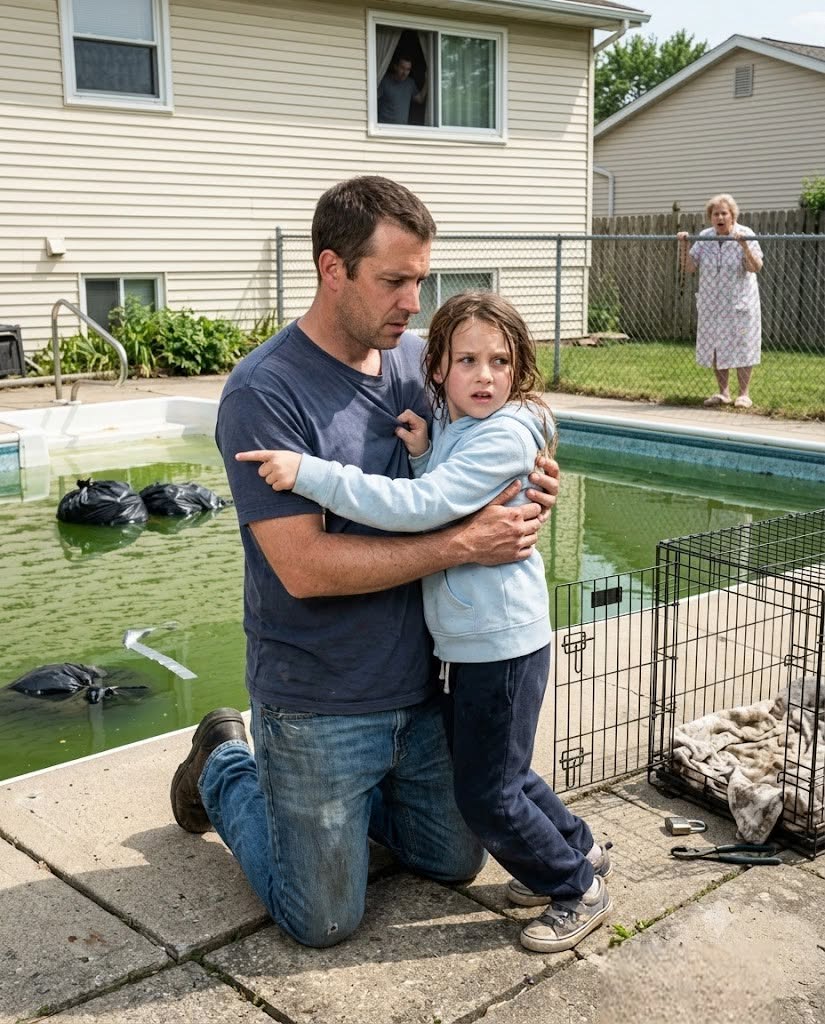 Then she looked at me.
“You came.”
The words were simple.
They did not forgive the days I had missed or the signs I had explained away.
They did not need to.
They gave me something more useful than forgiveness.
They gave me a rule.
When a child’s behavior changes, do not argue with the evidence because the truth is inconvenient.
When fear enters the room, do not call it attitude because the adults are embarrassed.
When someone you love goes quiet, listen before the silence becomes a locked door.
Peace can become a costume for cowardice.
I know that now.
I also know what courage looked like in that backyard.
It was not rage.
It was not revenge.
It was one hand holding my daughter and the other breaking the lock.
Then she looked at me.
“You came.”
The words were simple.
They did not forgive the days I had missed or the signs I had explained away.
They did not need to.
They gave me something more useful than forgiveness.
They gave me a rule.
When a child’s behavior changes, do not argue with the evidence because the truth is inconvenient.
When fear enters the room, do not call it attitude because the adults are embarrassed.
When someone you love goes quiet, listen before the silence becomes a locked door.
Peace can become a costume for cowardice.
I know that now.
I also know what courage looked like in that backyard.
It was not rage.
It was not revenge.
It was one hand holding my daughter and the other breaking the lock.