The hospital smelled like burnt coffee, bleach, and fear held behind professional voices.
My scrub top was damp between my shoulder blades after twelve hours on my feet, and my sneakers squeaked every time I shifted beside the nurses’ station.
My phone felt hot in my hand.
That morning, I had left my eight-year-old daughter, Olivia, with my mother.
By dinner, police were calling her name under porch lights.
My name is Megan, and I was thirty-four then, working nursing shifts and raising Olivia alone.
Her father had left when she was two, which meant our life had been built out of small systems that could not afford to fail.
I packed lunches before sunrise.
I braided her hair in the school pickup line when traffic made us late.
I kept the school calendar taped to the refrigerator and circled every early dismissal in red because one missed pickup could cost me a warning at work or make Olivia feel forgotten.
We were not dramatic people.
We were tired people.
There is a difference.
Olivia was a slight little girl with skinny elbows, a missing front tooth, and brown eyes that still expected grown-ups to mean what they said.
She loved strawberry yogurt, library day, and the pale blue jacket she wore even after the weather started warming.
When my mother, Catherine, offered to watch her during my longer shifts, I accepted.
Catherine lived in the four-bedroom house she had inherited from my grandmother.
The house had a broad driveway, a front porch, a curbside mailbox, and a backyard that looked safe enough from the street.
My younger sister, Hannah, lived there too with her children, Tyler and Madison, after her divorce.
I told myself Olivia would be with family.
I told myself cousins could become a second set of siblings.
I told myself the arrangement was temporary until I could afford something better.
The trust signal was simple and humiliating: I handed my mother a spare key to my life because I needed to keep my job.
She knew my shift schedule.
She knew which weeks rent left me with almost nothing.
She knew I could not easily argue with free childcare.
That knowledge should have made her gentler.
Instead, it made her certain I would keep coming back.
The first signs were small enough to excuse.
Olivia stopped running to the car when I picked her up.
She climbed into the back seat, buckled herself, and watched the neighborhood slide past without asking for music.
“How was your day, baby?” I would ask.
“Fine,” she would say, hiding both hands inside her hoodie sleeves.
Then the nightmares started.
She woke up crying into her pillow and asked whether she had to go back to Grandma’s house.
She described dishes stacked higher than her arms and vacuuming the downstairs while Tyler played video games.
She said Catherine made her wipe baseboards on her knees and carry laundry baskets that pressed red lines into her wrists.
I called my mother.
“Responsibility won’t kill her, Megan,” Catherine said. “You baby that child too much.”
I should have stopped the arrangement that day.
I know that now.
At the time, I heard my mother’s certainty and let it stand in for evidence.
Exhaustion can make bad explanations sound practical.
Then Olivia told me what her cousins had been saying.
Tyler called her stupid.
Madison called her ugly.
Both of them said her father had left because she was too much work.
I called Hannah.
She sighed before I had finished the first sentence.
“Kids are kids,” she said. “Olivia needs thicker skin.”
A child learns where to aim by watching which adults refuse to defend the target.
Tyler and Madison did not invent the shape of that house.
They learned it.
The breaking point came on a Tuesday in March.
A coworker had the flu, and I picked up an extra shift because the overtime would cover Olivia’s birthday cupcakes without pushing groceries onto a credit card.
At 6:18 a.m., I pulled into Catherine’s driveway.
Olivia stood on the porch in her pale blue jacket with her backpack hanging from one shoulder.
I kissed the top of her head.
“Be good,” I whispered.
She looked at me and said, “I’ll try not to make Grandma mad.”
I remember pausing with my hand on the car door.
I remember thinking I should ask what she meant.
Then I looked at the time.
That is the part mothers replay later—the ordinary second when instinct spoke and the clock answered louder.
At 2:36 p.m., Catherine texted me.
She’s fine. Don’t call. Busy day.
I read the message between patient rounds.
It was blunt even for my mother, and a cold pressure settled under my ribs.
Then an alarm sounded down the hall, the charge nurse called my name, and I put the phone away.
At 5:47 p.m., I called Catherine.
No answer.
At 6:12 p.m., I called again.
No answer.
At 6:31 p.m., Hannah picked up.
“Hey,” she said. “Is Olivia with you?”
The hospital sounds around me seemed to disappear.
“What?”
“I mean, I haven’t seen her all day.”
I pressed my palm against the nurses’ station.
“I’m at work,” I said. “What do you mean you haven’t seen her all day?”
Hannah began speaking too quickly.
Catherine had told Olivia to clean the downstairs bathroom.
Olivia said the laundry basket had already hurt her arms and she did not want to scrub the floor too.
Tyler laughed.
Madison called her lazy.
Catherine said she was tired of Olivia’s attitude.
Hannah stayed in the kitchen.
She told herself it was not her argument.
That is how cruelty gains a room.
One person acts, two people laugh, and another decides silence is neutrality.
It is not.
I asked the only question that mattered.
“Where is my daughter?”
Hannah went quiet.
In the background, I heard a cabinet close and Tyler ask where the television remote was.
Ordinary life was continuing inside the house where my child had vanished.
“Mom opened the door,” Hannah whispered.
My knees went weak.
“What happened next?”
“Olivia stepped outside.”
“And?”
“Mom shut it.”
I heard myself say Hannah’s name, but it sounded like someone else was speaking through me.
Then Hannah repeated the sentence that would stay in my body for years.
“We thought she was being dramatic.”
I called 911 at 6:38 p.m.
The dispatcher asked for Olivia’s full name, height, jacket color, last known location, and whether she had a phone.
She did not.
I told my supervisor my daughter was missing.
She said my name twice before I understood she was telling me to go.
I drove to Catherine’s house with both hands locked around the steering wheel and every red light feeling like an act of violence.
By the time I arrived, police cars lined the curb.
Neighbors stood in sweatshirts on their lawns while officers checked the backyard, the school playground, and the streets around the subdivision.
One officer wrote on a clipboard near the driveway.
Another called Olivia’s name toward the fence.
Catherine stood on the porch with her arms folded.
Hannah stood behind her crying.
Tyler and Madison watched through the front window.
For one ugly heartbeat, I pictured grabbing my mother by the shoulders and shaking the certainty out of her.
I pictured making her feel one ounce of what she had handed me.
I did not touch her.
I walked to the bottom of the porch steps.
“Where is my daughter?”
Catherine’s mouth tightened.
“Don’t start with me,” she said. “That girl needs discipline.”
“You put an eight-year-old outside.”
“She walked out.”
“You opened the door.”
Catherine lifted her chin.
“Lazy children don’t deserve shelter.”
The porch froze.
A neighbor lowered her hand from her mouth.
Hannah made a sound like she might be sick.
The officer stopped writing for half a second.
Nobody moved.
At 8:04 p.m., an officer asked me to confirm Olivia’s full name for the missing-child report.
At 8:19 p.m., they searched the school playground three blocks away.
At 8:41 p.m., a woman from the next subdivision called dispatch after seeing a small girl crying beside the ice machine at a gas station.
At 8:56 p.m., my phone rang.
They had found her.
Relief hit me so hard my knees almost gave out.
Then the officer’s voice changed.
“Ma’am, she’s being taken to the hospital. You need to come now.”
I drove back toward the building I had left less than three hours earlier.
The emergency entrance looked different when I was not arriving as an employee.
Every automatic door opened too slowly.
Every person in scrubs looked like someone who might know something they were not ready to tell me.
Detective Harper waited near the intake desk with a social worker.
“Olivia is safe,” Harper said. “She’s being evaluated.”
“I need to see her.”
“You will,” the social worker said. “But she told us some things, and we need to document them correctly.”
Document.
The word landed cold because I knew what it meant in a hospital.
A statement became a record.
A record became something that could not be laughed away at the next family gathering.
They led me into a small conference room off the ER hallway.
A paper coffee cup sat near the edge of the table.
The fluorescent lights buzzed.
Nurses moved past the narrow glass window while my life seemed to split into before and after.
Detective Harper opened a folder.
The police report number appeared at the top.
Below it were the timestamp, Olivia’s full name, Catherine’s address, and the phrase “missing juvenile located.”
The social worker slid another page toward me.
“This is what Olivia described,” she said.
My hands were shaking when I read the first line.
Grandma said she would put me outside before, but today she really did.
I read it twice.
Then I reached the next sentence.
Olivia had written that Catherine often threatened to send her out if she complained about chores.
She said Tyler and Madison repeated those threats as jokes.
She said she had tried to tell me, but every time I asked whether she wanted to go back, she worried I would lose my job if she said no.
That was the part that broke me.
My eight-year-old had been protecting my paycheck.
She had been measuring her fear against rent, groceries, and my exhaustion.
Children should never have to calculate the cost of telling the truth.
The social worker let me cry without filling the silence.
Detective Harper turned the page and pointed to the timeline.
At approximately 5:05 p.m., Catherine ordered Olivia to clean the bathroom.
At approximately 5:20 p.m., Olivia refused.
At approximately 5:25 p.m., Catherine opened the front door.
Nobody called me until 6:31 p.m.
For more than an hour, four people in that house knew an eight-year-old was gone.
I asked whether I could see Olivia.
This time, they said yes.
She was sitting upright on an exam bed in a hospital gown with a blanket over her legs.
Her pale blue jacket was folded on a chair.
Her cheeks were blotchy, and her hair had dried in uneven strands around her face.
When she saw me, she did not run.
She looked at the floor first.
That hesitation hurt more than any accusation could have.
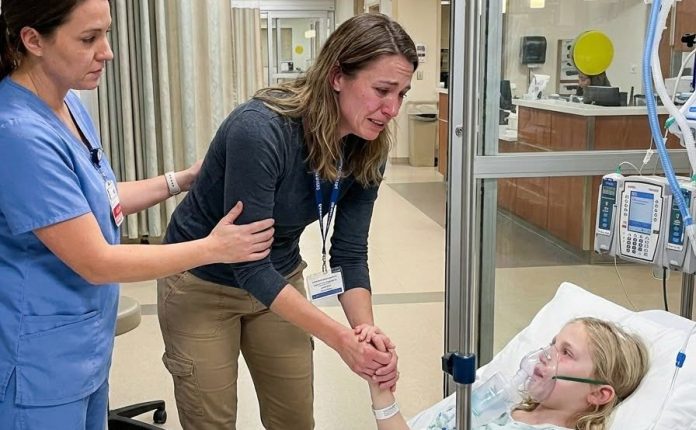
I crossed the room slowly and knelt beside the bed.
“Baby, I’m here.”
Her mouth trembled.
“Are you mad?”
“No.”
“Grandma said you would be.”
I put both hands around hers.
“I am mad,” I said. “But not at you.”
She searched my face as if she needed proof.
Then she whispered, “I didn’t want to scrub anymore. The basket hurt, and Tyler kept calling me stupid.”
“You never had to earn a place inside that house.”
She began crying.
“I thought you needed me to be good so you could work.”
That sentence stripped every excuse out of me.
I told her I was sorry.
Not the quick apology adults use to hurry children past their pain.
I told her I had seen the signs and let my need for help make me doubt what she was telling me.
I told her the adults had failed her.
I told her none of it was her fault.
She asked whether she had to go back.
“No,” I said.
It was the first promise I made that night.
It was also the easiest one to keep.
Detective Harper returned later and explained that the report would include Catherine’s statement, Hannah’s account, the search timeline, and Olivia’s interview.
The social worker documented the chores, the threats, the bullying, and the delayed call.
I did not argue about family reputation.
I did not ask them to soften the language.
I signed where they told me to sign and corrected the timeline when one minute was wrong.
Forensic details do not heal a child, but they stop adults from rewriting what happened.
At 11:43 p.m., Olivia was discharged into my care.
I carried her backpack.
She held my hand all the way through the parking lot.
Catherine called before we reached home.
I almost ignored it.
Then I answered because I wanted one part of the night to be unmistakable.
“You embarrassed me in front of the neighbors,” she said.
Not “Is Olivia okay?”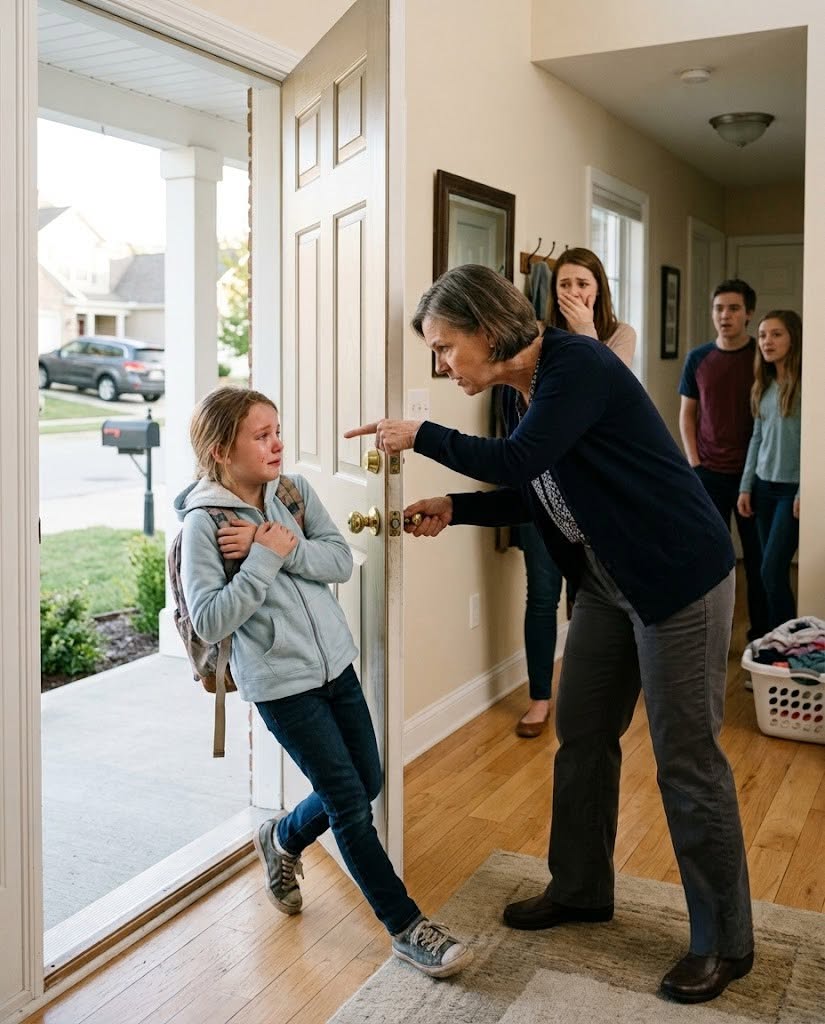 Not “I was wrong.”
Not even “I’m sorry.”
Embarrassment.
That was what mattered to her.
I stood beside my car under the parking lot lights and listened until she ran out of words.
Then I said, “You will never be alone with my daughter again.”
Catherine called me ungrateful.
She said family should handle things privately.
She said I was teaching Olivia to disrespect adults.
I ended the call.
The next weeks were difficult in the plain, expensive ways that do not fit neatly into dramatic stories.
I traded shifts.
I used school aftercare when I could.
I accepted help from people I had been too proud to ask before.
Some evenings, dinner was cereal and sliced bananas because that was all I had energy to make.
Olivia started meeting with a counselor.
At first, she spoke mostly about the gas station.
She remembered the hum of the ice machine and the cold metal wall against her back.
She remembered every car that slowed down and kept going.
Later, she began talking about Catherine’s house.
She described how the chores had grown whenever she complained.
She described Tyler and Madison watching to see whether any adult would stop them.
She described Hannah looking away.
Hannah sent me a long message two weeks after the incident.
She admitted she had heard Catherine threaten to put Olivia outside before.
She said she had convinced herself our mother was only talking.
She wrote, “I should have protected her.”
I believed that Hannah regretted it.
I also believed regret did not automatically restore access.
For months, I kept distance between her household and mine.
When we eventually spoke, it was in a public place and without the children.
I told her an apology was not the same as safety.
She nodded and cried.
I did not comfort her.
Catherine never gave me the apology I wanted.
She sent messages about respect, family loyalty, and how hard she had worked for everyone.
She spoke as if years of motherhood were credits she could spend against one terrified child.
I blocked her number.
People in the family chose sides.
Some said I had overreacted because Olivia had been found.
That sentence taught me how easily adults confuse survival with harmlessness.
Being found did not erase the hour she spent believing no one was coming.
Being physically safe did not make the threat acceptable.
And shelter was never a reward she had failed to earn.
Months later, Olivia and I drove past a house with a wide porch and a curbside mailbox.
She went quiet.
I asked whether she wanted to talk.
She shook her head, then reached for my hand across the center console.
I held it until the light changed.
Healing did not arrive as one big moment.
It came in ordinary choices.
I believed her the first time.
I stopped explaining other people’s cruelty for them.
I let phone calls go unanswered.
I made our apartment feel predictable.
I kept my promises small enough to prove.
On her ninth birthday, I bought the cupcakes with cash.
They were not fancy.
The frosting leaned to one side, and one of the plastic lids had cracked in the grocery bag.
Olivia laughed when she saw them.
That laugh did not erase what happened, but it reminded me that the story did not belong to Catherine’s porch forever.
A child learns where to aim by watching which adults refuse to defend the target.
A child also learns what safety feels like when one adult finally stops looking away.
I had looked away too long.
After that night, I did not again.
Not “I was wrong.”
Not even “I’m sorry.”
Embarrassment.
That was what mattered to her.
I stood beside my car under the parking lot lights and listened until she ran out of words.
Then I said, “You will never be alone with my daughter again.”
Catherine called me ungrateful.
She said family should handle things privately.
She said I was teaching Olivia to disrespect adults.
I ended the call.
The next weeks were difficult in the plain, expensive ways that do not fit neatly into dramatic stories.
I traded shifts.
I used school aftercare when I could.
I accepted help from people I had been too proud to ask before.
Some evenings, dinner was cereal and sliced bananas because that was all I had energy to make.
Olivia started meeting with a counselor.
At first, she spoke mostly about the gas station.
She remembered the hum of the ice machine and the cold metal wall against her back.
She remembered every car that slowed down and kept going.
Later, she began talking about Catherine’s house.
She described how the chores had grown whenever she complained.
She described Tyler and Madison watching to see whether any adult would stop them.
She described Hannah looking away.
Hannah sent me a long message two weeks after the incident.
She admitted she had heard Catherine threaten to put Olivia outside before.
She said she had convinced herself our mother was only talking.
She wrote, “I should have protected her.”
I believed that Hannah regretted it.
I also believed regret did not automatically restore access.
For months, I kept distance between her household and mine.
When we eventually spoke, it was in a public place and without the children.
I told her an apology was not the same as safety.
She nodded and cried.
I did not comfort her.
Catherine never gave me the apology I wanted.
She sent messages about respect, family loyalty, and how hard she had worked for everyone.
She spoke as if years of motherhood were credits she could spend against one terrified child.
I blocked her number.
People in the family chose sides.
Some said I had overreacted because Olivia had been found.
That sentence taught me how easily adults confuse survival with harmlessness.
Being found did not erase the hour she spent believing no one was coming.
Being physically safe did not make the threat acceptable.
And shelter was never a reward she had failed to earn.
Months later, Olivia and I drove past a house with a wide porch and a curbside mailbox.
She went quiet.
I asked whether she wanted to talk.
She shook her head, then reached for my hand across the center console.
I held it until the light changed.
Healing did not arrive as one big moment.
It came in ordinary choices.
I believed her the first time.
I stopped explaining other people’s cruelty for them.
I let phone calls go unanswered.
I made our apartment feel predictable.
I kept my promises small enough to prove.
On her ninth birthday, I bought the cupcakes with cash.
They were not fancy.
The frosting leaned to one side, and one of the plastic lids had cracked in the grocery bag.
Olivia laughed when she saw them.
That laugh did not erase what happened, but it reminded me that the story did not belong to Catherine’s porch forever.
A child learns where to aim by watching which adults refuse to defend the target.
A child also learns what safety feels like when one adult finally stops looking away.
I had looked away too long.
After that night, I did not again.