Three weeks after my divorce papers were signed, I rented a small pale-blue house on the edge of Cedar Falls, Iowa, and tried to pretend the quiet meant we were finally safe.
The house sat at the end of a narrow neighborhood street where people still left porch lights on and mailboxes leaned slightly toward the road.
It had hardwood floors that creaked under our socks, kitchen cabinets that smelled faintly of lemon cleaner, and a backyard lined with maples that turned gold when the sun dropped behind the fence.
After the last year of my marriage, even the sound of the refrigerator humming felt like mercy.
No doors slamming.
No careful silence before dinner.
No man standing in a doorway, using a calm voice to make cruelty sound like concern.
My daughter Emma was ten, and she had always noticed more than people expected.
She noticed when adults changed tone before they changed words.
She noticed when her father smiled in front of the mediator but squeezed his jaw so hard his cheek twitched.
She noticed when I said I was fine and then forgot to eat breakfast.
Since the divorce, that noticing had become sharper.
Not louder.
Sharper.
She watched everything in the new house.
The truck that rolled by twice in one hour.
The cupboard that popped open even after I shut it.
The back gate standing open on the second morning when I was almost certain I had clicked the latch the night before.
I kept telling myself we were both keyed up.
Your nervous system does not stop living in survival mode just because a judge signs paper.
It takes time for a body to believe the war is over.
The first few days looked normal from the outside.
We unpacked dishes.
We ate Chinese takeout on the living room floor because I still had not found the screws for the kitchen chairs.
Emma lined up her books on the window seat in her room, then took them all down again and stacked them in the closet.
That night, she asked if she could sleep with the hall light on.
I said yes.
I said yes to almost everything that week because every answer felt like a small promise.
Yes, you can keep the light on.
Yes, you can eat cereal for dinner.
Yes, we can leave the boxes until tomorrow.
Yes, this place will get better.
But she never once said she liked the house.
On the fourth afternoon, I was standing at the sink rinsing strawberries when she came into the kitchen.
Her hoodie sleeves were pulled over her hands.
Her bare feet made no sound on the floor.
She stood beside me for a long moment before speaking.
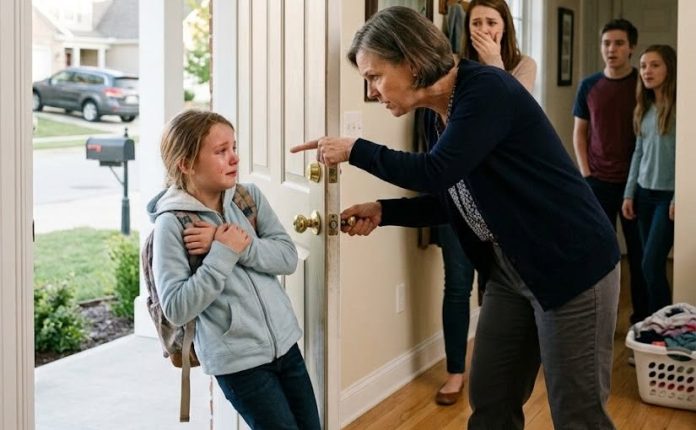
“Mom,” she said, very softly, “I don’t think we should stay here.”
I turned off the faucet.
Water dripped from one strawberry into the colander.
“Why?” I asked.
She looked past me toward the sliding glass door.
“I don’t know,” she whispered. “I just think we have to leave. Soon.”
I crouched in front of her and asked if somebody had bothered her.
At first, she shook her head.
Then she told me about the man.
She had seen him the day before near the back corner of the fence.
Dark jacket.
Baseball cap.
Standing too still.
When she looked right at him, he moved away.
A better mother might have called the police right then.
That is what I told myself later, when guilt started chewing through every memory.
But in that moment, I reached for ordinary explanations because ordinary explanations were easier to survive.
A utility worker.
A neighbor cutting through.
Someone in the wrong yard.
I checked the locks that night.
I pulled the blinds closed.
I made sure the little American flag on the porch was not twisted around the pole after the wind picked up.
Then I sat on Emma’s bed and told her new houses can feel strange until your brain gets used to them.
She looked at me with a seriousness that made her seem older than ten.
“It’s not the house,” she said.
The sentence stayed with me after she fell asleep.
It followed me into my room.
It sat beside me while I folded laundry I was too tired to put away.
It was still there at 2:17 in the morning when Emma grabbed my shoulder so hard it hurt.
“Mom,” she whispered. “Look out the window.”
Her face had no color in the hallway light.
For one second, I thought she had dreamed something.
Then I saw the way she was holding her breath.
I moved to my bedroom window and pulled the curtain back less than an inch.
A man was standing across the street beneath the dead streetlamp.
He was perfectly still.
He was staring straight at our house.
There was something in his hand.
At first, I thought it was a phone.
Then he lifted it, and moonlight caught a round piece of glass.
A camera.
Emma pressed against my side so tightly I could feel her shaking through my T-shirt.
The man was not wandering.
He was not lost.
He was there for us.
Some part of him knew we were watching because he tilted the lens with slow, deliberate care.
Then a white flash ripped through the dark.
He had taken our picture.
I yanked the curtain shut so fast the rod slammed against the wall.
Emma started crying.
My hands shook so badly I almost dropped my phone calling 911.
I gave the dispatcher our address, described the jacket, the hat, the height, and the exact spot where he had been standing.
I tried to keep my voice low because Emma was already terrified.
Every instinct in me wanted to scream.
By the time I looked again, he was gone.
The patrol car arrived twenty minutes later.
The officer swept the block with a flashlight.
He checked the alley.
He shined his beam along the fence line and across the little strip of grass between our house and the neighbor’s garage.
He found nothing.
Then he came back inside and asked questions that made my stomach tighten.
Was I in a custody dispute?
Was there an ex who might be angry?
Had anyone learned my new address too quickly?
I said no too fast.
He looked at me twice.
I had spent so long defending myself against my ex-husband’s version of reality that even with a police officer in my living room, I could feel the old reflex rise up.
Don’t sound dramatic.
Don’t look unstable.
Don’t give anyone a reason to say he was right.
The officer gave me an incident number and told me to call if anything else happened.
After he left, Emma would not let go of my hand.
We sat on the couch until dawn with every light in the house on.
The living room smelled like cold takeout boxes and fear.
At sunrise, I opened the front door for the newspaper and nearly screamed.
A large brown envelope was sitting on the doormat.
It had no stamp.
No return address.
No writing on the front.
Inside were six printed photographs.
The first showed me carrying a lamp from the moving truck on the day we arrived.
The second showed Emma standing alone on the porch with her stuffed rabbit under her arm, looking toward the driveway as if she already sensed someone there.
The third was taken through the slats of the backyard fence.
The fourth showed our kitchen window from so close outside that I could see my own hand resting on the counter.
The fifth showed Emma’s bedroom curtain from the yard.
The sixth was the photograph from the night before.
A white flash frozen against my window.
On the back of the last photograph, someone had written in hard block letters: STABILITY MATTERS.
For a moment, I could not move.
My ex-husband had used that phrase all through the divorce.
In mediation.
In emails.
In the family court hallway, while his lawyer stood beside him and he lowered his voice into that smooth, reasonable tone he used when he wanted me to look emotional.
Stability matters.
Emma needs consistency.
Stability matters.
A phrase can look harmless until you know how often it has been sharpened into a weapon.
I called the officer back using the number on the incident report.
This time, when he returned, I told him everything I had been too ashamed and too afraid to say at 3 a.m.
I told him about the custody threats.
I told him about the emails.
I told him my ex had spent months saying I was too anxious, too impulsive, too unstable to be Emma’s primary parent.
Then I told him how I found the rental.
My ex-husband’s sister had sent me the listing.
She said a friend of a friend had a quiet place available fast and cheap.
No bidding.
No waiting.
No hassle.
At the time, it felt like the first kind thing anyone from his family had done for me in months.
The officer’s expression changed the second I said that.
He asked for the sister’s name.
He photographed the envelope.
He bagged the pictures.
He wrote down the phrase on the back of the last photograph.
Then he asked Emma if she had noticed anything else.
She was sitting on the couch with her stuffed rabbit in her lap, twisting one ear between her fingers.
At first, she looked at me.
I nodded.
“Sometimes at night,” she whispered, “I hear something above my ceiling.”
The officer lowered his pen.
“What kind of something?”
Emma swallowed.
“Like somebody moving. But really slow. Like they stop when I sit up.”
The house seemed to shrink around us.
I looked toward the hallway.
Emma’s bedroom was at the back of the house.
The hallway closet sat just outside her door.
Inside that closet was the attic hatch.
I had barely looked at it since move-in.
It was one of those things you notice and dismiss because you are too busy carrying boxes and pretending your life has not just split down the middle.
But when the officer stood beneath it, I saw what I had missed.
Fresh scrape marks around the trim.
A broken arc in the dust where the panel had been opened recently.
A faint smudge on the pull cord, darker than the rest.
The officer told us to step back.
Emma grabbed my wrist so hard her fingernails bit into my skin.
My mouth went dry.
The officer reached up, hooked the cord with two fingers, and pulled.
The hatch shuddered open.
A gust of stale, warm air rolled into the hallway.
Then we heard it.
A slow scrape from somewhere above Emma’s bedroom.
The officer froze.
For one second, nobody moved.
Then he said, without taking his eyes off the dark square above us, “Ma’am, take your daughter to the front porch. Now.”
I did not argue.
I backed down the hallway with Emma pressed against me.
Dust drifted down and landed in her hair.
That tiny detail undid me more than almost anything else.
Not the photographs.
Not the message.
Dust in my child’s hair from a ceiling where someone might have been hiding.
We reached the entry table just as my phone buzzed.
Unknown number.
One image came through.
It was taken from above.
Through a vent.
Looking down at Emma asleep in her bed.
The timestamp in the corner read 1:43 a.m.
Then a second message appeared.
YOU WERE TOLD STABILITY MATTERS.
Emma saw it before I could turn the screen away.
Her knees softened.
She grabbed the doorframe with both hands.
The officer looked back, saw my face, and reached for his radio.
“Dispatch,” he said, voice low and controlled, “I need backup at this address immediately. Possible intruder in the attic. Child victim present.”
The ceiling above Emma’s room creaked.
Then a man’s voice whispered my name.
It was not my ex-husband’s voice.
That somehow made it worse.
Backup arrived in under six minutes.
Those six minutes felt longer than the entire divorce.
Two more officers came through the front door, one with a body camera clipped to his vest and one carrying a longer flashlight.
They moved us outside to the porch while they cleared the house.
Emma sat on the top step with her rabbit pressed under her chin.
I stood behind her with my hands on her shoulders and stared at the little flag beside the door snapping in the morning wind.
The neighborhood was waking up around us.
A garage door opened across the street.
Someone’s dog barked twice.
A school bus sighed at the corner.
It felt obscene that the world could keep being ordinary while my daughter’s bedroom was being treated like a crime scene.
Twenty-two minutes later, the first officer came back out.
His face had changed.
He did not look frightened anymore.
He looked angry.
Inside the attic, they found a folding camp chair positioned above the vent to Emma’s room.
They found a camera with a zoom lens.
They found snack wrappers, a half-empty water bottle, and a small battery pack.
They found a cheap prepaid phone.
They found a duffel bag with more printed photographs.
And tucked under the insulation near the far beam, they found a copy of my lease.
My name was circled.
Emma’s bedroom was marked in pen.
The man hiding in the attic had tried to crawl toward the back access panel when the officers went up.
He did not get far.
He was not a stranger in the way I had hoped a stranger would be.
He was the brother of the friend who supposedly owned the rental.
He had done odd jobs for my ex-husband’s family for years.
He had helped repair my ex-sister-in-law’s deck the summer before.
He had been at one of Emma’s birthday parties when she was seven.
I had handed that man a paper plate with cake on it and never thought about him again.
That is the part nobody tells you about betrayal.
Sometimes it does not arrive wearing the face you expect.
Sometimes it comes through a side door you left unlocked because someone you trusted told you the house was safe.
The police report took hours.
There were photographs of the attic.
Evidence bags.
Screenshots from my phone.
A formal statement from me.
A shorter one from Emma, taken gently, with a child advocate present later that day.
By evening, my ex-husband was calling.
Then texting.
Then emailing.
At first, he sounded outraged on our behalf.
Then he sounded confused.
Then, when the police asked him how a man connected to his family had my lease and knew which room belonged to our daughter, he stopped answering questions without a lawyer.
His sister claimed she had only forwarded the listing.
She said she had no idea who had access to the house.
She said everyone was making this into something ugly.
But ugly had already been sitting above my child’s bedroom at 1:43 a.m.
Ugly had already taken pictures through our fence.
Ugly had already written my ex-husband’s favorite phrase on the back of a photograph and left it at my front door.
Two days later, my attorney filed an emergency custody motion.
This time, I did not apologize for sounding afraid.
I brought the police report.
I brought the envelope.
I brought copies of the emails where my ex repeated that same phrase over and over.
Stability matters.
The judge read the first page, then the second.
My ex sat at the other table in a navy jacket, looking exactly the way he always looked when he wanted a room to believe he was the adult in it.
Calm.
Clean.
Patient.
But calm is not the same as innocent.
Clean is not the same as safe.
Patient is not the same as kind.
The emergency order was granted that afternoon.
Supervised visitation only, pending investigation.
No direct contact with me except through counsel.
No contact at all with Emma outside approved channels.
When the judge said those words, my ex looked at me for the first time without the mask fully in place.
There was anger there.
Not surprise.
Anger.
That told me more than any confession could have.
Emma and I never slept in that house again.
A victims’ services advocate helped us arrange temporary housing.
Friends from her school brought grocery bags and paper cups of coffee and a blanket Emma refused to let go of for almost a week.
For a while, she slept with the light on again.
Then with the door open.
Then with my hand resting beside hers until she drifted off.
Healing did not look dramatic.
It looked like checking locks without shame.
It looked like therapy appointments after school.
It looked like Emma choosing a new comforter for a room with no attic hatch above it.
Months later, she asked me if I had believed her that first day.
I wanted to say yes.
I wanted to be the mother who had known instantly.
But she deserved the truth.
“Not fast enough,” I said.
She looked at me for a long time.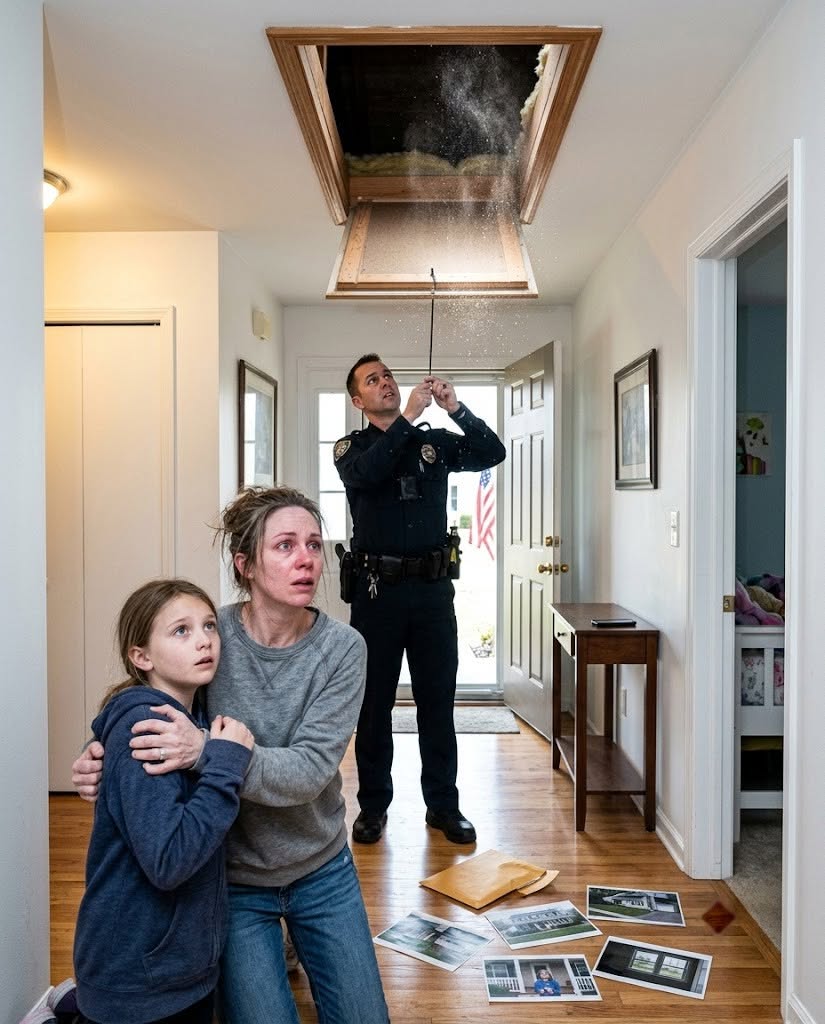 Then she nodded.
“But you did after,” she said.
I cried in the laundry room that night, quietly, into a towel I had just folded.
Because that is what saved me from drowning in guilt.
Not that I got everything right.
I did not.
But when the truth finally stood in front of me, I stopped defending the people who had made us afraid.
I stopped explaining away the open gate.
I stopped shrinking my voice so my ex could keep calling himself reasonable.
For months, he had told everyone stability mattered.
He was right about one thing.
Stability did matter.
But stability was not a pale-blue rental with hidden access and strangers above my daughter’s ceiling.
It was not a custody argument dressed up as concern.
It was not a phrase sharpened into a weapon.
Stability was my daughter sleeping through the night in a room where every wall had been checked.
It was her laughing again at breakfast.
It was me believing her the first time her body told the truth faster than the adults could prove it.
And it was the day she walked out to our new porch, looked at the small flag moving in the afternoon wind, and said, for the first time in months, “Mom, I like it here.”
Then she nodded.
“But you did after,” she said.
I cried in the laundry room that night, quietly, into a towel I had just folded.
Because that is what saved me from drowning in guilt.
Not that I got everything right.
I did not.
But when the truth finally stood in front of me, I stopped defending the people who had made us afraid.
I stopped explaining away the open gate.
I stopped shrinking my voice so my ex could keep calling himself reasonable.
For months, he had told everyone stability mattered.
He was right about one thing.
Stability did matter.
But stability was not a pale-blue rental with hidden access and strangers above my daughter’s ceiling.
It was not a custody argument dressed up as concern.
It was not a phrase sharpened into a weapon.
Stability was my daughter sleeping through the night in a room where every wall had been checked.
It was her laughing again at breakfast.
It was me believing her the first time her body told the truth faster than the adults could prove it.
And it was the day she walked out to our new porch, looked at the small flag moving in the afternoon wind, and said, for the first time in months, “Mom, I like it here.”