The person beside me was hospital social worker Rebecca Mills, who had arrived after the emergency physician learned Lily’s prescribed EpiPen remained unused for nearly forty minutes.
Rebecca read Daniel’s message twice.
Then she asked me to place my phone on the table without deleting, editing, or answering anything until she documented the screen.
“Your husband knows a report was made,” she said. “His first concern appears to be what you told us, not whether Lily survived.”
I looked through the glass wall toward my daughter.
Her oxygen mask had fogged slightly with each shallow breath, but the monitor beside her finally showed numbers moving in the right direction.
Daniel sent another message.
Claire says the neighbor exaggerated everything. Mom wants you to correct the story before this becomes a legal problem.
Rebecca photographed that message too.
I did not respond.
The evidence was arriving without anyone having to chase it.
At 4:38 that afternoon, Officer Marcus Reed entered the hospital carrying the bright red emergency bag the school had given Patricia.
Inside were Lily’s allergy plan, two prescribed epinephrine auto-injectors, antihistamine, her medical identification card, and written emergency instructions.
Both auto-injectors were unused.
The allergy plan had one sentence highlighted in yellow.
ADMINISTER EPINEPHRINE IMMEDIATELY AND CALL 911.
Patricia had been holding the answer while my daughter’s throat tightened.
Officer Reed placed the sealed bag on the counter and asked whether Lily could speak.
The doctor said not yet.
He interviewed the school nurse, Mrs. DeLuca, and me separately while another officer drove to the lake club.
Daniel, Patricia, and Claire were still sitting beneath a rented cabana when the officers arrived.
The other children were eating ice cream.
According to the incident summary I received later, Patricia initially claimed Lily had developed a mild rash after leaving school.
Claire said Lily had never struggled to breathe while they were present.
Daniel said he believed his mother had administered medication before they left.
Then the officers separated them.
Their stories stopped matching.
The school nurse had written the time beside every action.
At 1:06, Lily reported itching in her mouth and tightness in her throat after eating a cookie from a classroom celebration.
At 1:08, the nurse called Patricia, who had been authorized to collect Lily because Daniel and I were both working.
At 1:11, the nurse administered the school’s emergency epinephrine and instructed a staff member to call 911.
Patricia arrived while the call was being placed.
She insisted she would drive Lily to urgent care herself and said an ambulance would frighten her unnecessarily.
The nurse told her Lily required emergency evaluation because symptoms could return after the first dose.
Patricia signed Lily out at 1:19.
She accepted the red emergency bag and promised to drive directly to the hospital.
She did not.
The lake club’s entrance system recorded Patricia’s vehicle entering at 1:47.
Mrs. DeLuca’s doorbell camera showed the same vehicle stopping outside her home at 2:03.
Patricia helped Lily from the passenger seat.
My daughter could barely stand.
On the recording, Mrs. DeLuca asked whether she should call an ambulance.
Claire answered from the back seat.
“She already had medicine. She’s making herself worse by panicking.”
Then Patricia placed the red emergency bag beside Mrs. DeLuca’s front door and told her to call me if Lily continued “performing.”
The vehicle left twelve seconds later.
That was their timeline.
Not confusion.
Not a misunderstood rash.
Not adults making one hurried mistake.
They had received instructions from a medical professional, watched Lily worsen, carried emergency medication, refused an ambulance, and abandoned her with an unprepared neighbor.
Mrs. DeLuca brought Lily inside, found my number on the medical card, and called three times before realizing my phone was silenced.
She tried Patricia next.
Patricia rejected two calls.
Claire answered the third and told Mrs. DeLuca that everyone had already paid for the cabana.
At 2:24, Lily collapsed beside the couch.
Mrs. DeLuca called 911.
Paramedics administered another dose of epinephrine and began oxygen before transporting her to the emergency room.
The hospital physician later explained that allergic reactions could return or intensify even after initial treatment.
That was why the nurse had insisted on ambulance transport and medical monitoring.
Patricia had not misunderstood the instructions.
She had rejected them.
At 5:12, Daniel finally arrived at the hospital.
He was still wearing swim shorts beneath an expensive linen shirt, and the lake club’s blue admission band remained around his wrist.
I met him outside Lily’s room.
He attempted to embrace me.
I stepped back.
“Is she awake?” he asked.
“She almost died.”
His face tightened.
“I know that now.”
“You knew she was having an allergic reaction before you entered the lake club.”
“Mom said the school gave her medication.”
“The nurse said to call 911.”
He rubbed both hands across his face.
“You weren’t there. Everyone was talking at once. It didn’t seem as serious as they’re making it sound.”
I looked at the wristband.
Our daughter was receiving oxygen while he still carried proof that he had chosen swimming pools and lunch reservations over returning for her.
“Who is making it sound serious?” I asked. “The nurse, the paramedics, the emergency physician, or the child who could not breathe?”
Daniel lowered his voice.
“Can we discuss this without turning it into an attack on my family?”
That sentence ended something inside me.
“This is not an attack on your family,” I said. “This is your family being investigated for what they did to our daughter.”
He glanced toward Rebecca and Officer Reed, who stood several feet away.
Then he asked whether I had shown them his messages.
I did not answer.
His expression told me he already knew.
The physician allowed Daniel into Lily’s room only after Rebecca explained that the child’s condition must remain the priority.
Lily opened her eyes when he approached.
Daniel whispered her name.
She turned her face toward me.
It was a small movement, but he saw it.
For ten years, Lily had run toward her father whenever he entered a room.
That evening, she moved closer to the rail beside my chair.
Daniel stood at the foot of the bed with both hands hanging uselessly at his sides.
“I thought Grandma was helping you,” he said.
Lily’s voice was barely audible beneath the mask.
“She said I would ruin the trip.”
Daniel closed his eyes.
I did not rescue him from that sentence.
Children often say the truth without cushioning it for the adults who failed them.
Rebecca asked Daniel to leave while the medical team adjusted Lily’s treatment.
In the hallway, he began crying and said he had not understood how sick she was.
Officer Reed asked one question.
“When Mrs. DeLuca called and said Lily was getting worse, why didn’t you leave the lake?”
Daniel stopped crying.
He looked toward the floor.
Then he said Patricia had assured everyone the neighbor was overreacting.
Officer Reed repeated the question.
Daniel admitted he did not want to create a confrontation in front of Claire’s children.
My daughter’s emergency had become less important than preserving a pleasant afternoon for everyone else.
At 6:03, Rebecca presented a temporary safety plan while the child-welfare assessment continued.
Patricia and Claire would have no direct or unsupervised contact with Lily.
Neither could collect her from school, attend medical appointments, or enter her hospital room.
Daniel could visit Lily at the hospital, but he could not remove her, make medical decisions alone, or bring his relatives near her.
The plan was temporary.
Daniel treated it like a personal betrayal.
“You’re restricting me from my own child?”
Rebecca remained calm.
“We are responding to documented decisions made today. Cooperation will be considered during the assessment.”
He looked at me.
“You agreed to this?”
“I requested stronger protection.”
His mouth opened.
Nothing came out.
Patricia arrived twenty minutes later with Claire behind her.
Hospital security stopped them near the elevators before they reached the pediatric floor.
I could hear Patricia demanding to speak with “the hysterical mother who started this.”
Claire threatened to report the hospital for refusing a grandmother access to her granddaughter.
Security asked them to leave.
They refused.
Officer Reed walked toward the elevators and informed them that continuing to disrupt the unit could result in removal from the property.
Patricia finally lowered her voice.
She pointed toward me through the glass doors.
“You always wanted an excuse to take Lily away from us.”
I walked closer but remained on the protected side of the doors.
“You left her struggling to breathe because you had reservations.”
“She had already received medication.”
“And the nurse told you symptoms could return.”
Patricia’s expression sharpened.
“The other children should not lose their day because Lily has an allergy.”
There it was.
Not an apology.
Not confusion.
A calculation.
My daughter’s life had been weighed against a luxury reservation, and Patricia still believed the reservation deserved consideration.
Claire tried to pull her away, but Officer Reed had heard every word.
So had Rebecca.
So had Daniel.
Patricia realized it seconds too late.
Her face changed as she looked toward her son.
“Daniel, explain what I mean.”
He stared at her.
For once, he could not translate cruelty into concern.
Security escorted Patricia and Claire from the building.
Daniel remained in the hallway, still wearing the blue wristband.
I returned to Lily.
She slept through most of the night while I sat beside her with one hand resting near the blanket.
At 2:16 in the morning, Daniel texted from the waiting area.
I made a terrible mistake. Please don’t end our family because of one day.
I read the message beneath the dim hospital light.
Then I answered.
Our family almost ended because you ignored your daughter’s emergency. What happens next will depend on whether you protect her or keep protecting excuses.
The message showed Read.
Daniel did not respond.
Lily remained hospitalized for two nights.
Her breathing stabilized, but she startled whenever someone touched the red emergency bag near her bed.
She asked whether Grandma was angry because the ambulance had ruined the lake trip.
I told her Grandma’s feelings were not her responsibility.
“You did nothing wrong,” I said. “Your allergy is not bad behavior, and needing help does not make you difficult.”
She watched my face carefully.
“Dad stayed at the lake.”
It was not a question.
“Yes.”
“Did he know?”
I refused to lie.
“He knew you were sick. He says he did not understand how dangerous it was.”
Lily turned toward the window.
“But I told him.”
Four words.
That was the piece Daniel had omitted.
Before Patricia left her at Mrs. DeLuca’s house, Lily had called him from the back seat.
She told him her chest hurt and asked him to come.
Daniel had said, “Listen to Grandma. We’ll see you later.”
The call lasted thirty-seven seconds.
His phone records confirmed it.
When confronted, Daniel admitted hearing Lily wheeze but said Patricia had insisted anxiety was making the reaction sound worse.
The safety assessment changed immediately.
My attorney filed for temporary custody protections before Lily left the hospital.
We submitted the medical records, school timeline, doorbell recording, messages, phone logs, and Daniel’s admission.
The judge did not decide our entire marriage during one emergency hearing.
She issued temporary orders designed to protect Lily while the evidence was reviewed.
Lily remained with me.
Daniel’s visits were supervised.
Patricia and Claire were prohibited from contacting her pending further proceedings.
All medical decisions followed Lily’s written allergy plan and physician recommendations.
Daniel was ordered not to interfere with emergency treatment or delegate Lily’s care to his relatives.
Patricia called the order “legal kidnapping.”
Claire posted online that I had manipulated a child’s illness to punish my husband’s family.
Their posts disappeared after my attorney sent preservation notices.
Screenshots did not.
Several relatives contacted me, saying Patricia had always believed allergies were exaggerated because “children used to eat everything.”
I asked whether they had known she ignored a school nurse and refused to return when Lily’s breathing worsened.
The calls became shorter after that.
Nobody wanted to defend the complete timeline.
Patricia could survive inside general language like misunderstanding, panic, or family conflict.
Specific minutes destroyed her story.
The school nurse’s first injection.
The signed release.
The lake club entry.
The doorbell recording.
The rejected calls.
The unused EpiPens.
Lily’s thirty-seven-second plea to her father.
The medical record documenting how close we came to losing her.
Claire’s life did not collapse because I made a speech.
It collapsed because investigators learned she operated a small after-school program from her home.
Parents trusted her with children who had asthma, diabetes, and severe allergies.
The licensing agency opened a review after receiving the documented incident.
Claire insisted Lily had not been enrolled in her program and therefore the incident should not affect her work.
The investigator disagreed.
The concern was not where Lily had been registered.
The concern was whether Claire understood emergency duties and could be trusted to follow medical instructions when convenience conflicted with safety.
Her program was temporarily suspended during the review.
Families withdrew before a final decision arrived.
Patricia lost something she valued even more than money.
Control.
Daniel stopped forwarding her messages after beginning court-ordered parenting education and individual counseling.
When she appeared outside his office demanding that he “fix” the case, he asked security to remove her.
He told me afterward, as if expecting praise.
I gave him none.
Protecting Lily after a judge required it did not erase abandoning her when she asked him directly.
Still, accountability had to begin somewhere.
Daniel eventually provided a complete written statement.
He admitted Patricia had dismissed Lily’s symptoms throughout the drive and Claire had argued that returning to school would make them lose the cabana deposit.
He also admitted choosing silence because challenging his mother had always created days of punishment, accusations, and family pressure.
“That explains your weakness,” I told him during mediation. “It does not excuse what your weakness did to Lily.”
He nodded.
For the first time, he did not argue.
The prosecutor’s office reviewed the evidence for possible child-endangerment charges.
The process took months, not hours.
Patricia and Claire eventually accepted responsibility through negotiated misdemeanor resolutions that included probation, mandatory education, and restrictions on caring for Lily.
Daniel was not charged, but the family court maintained supervision until he completed required counseling and demonstrated that he could follow the emergency plan without consulting Patricia.
Our marriage did not survive.
People expected me to say the allergic reaction destroyed it.
It did not.
The reaction revealed what was already there.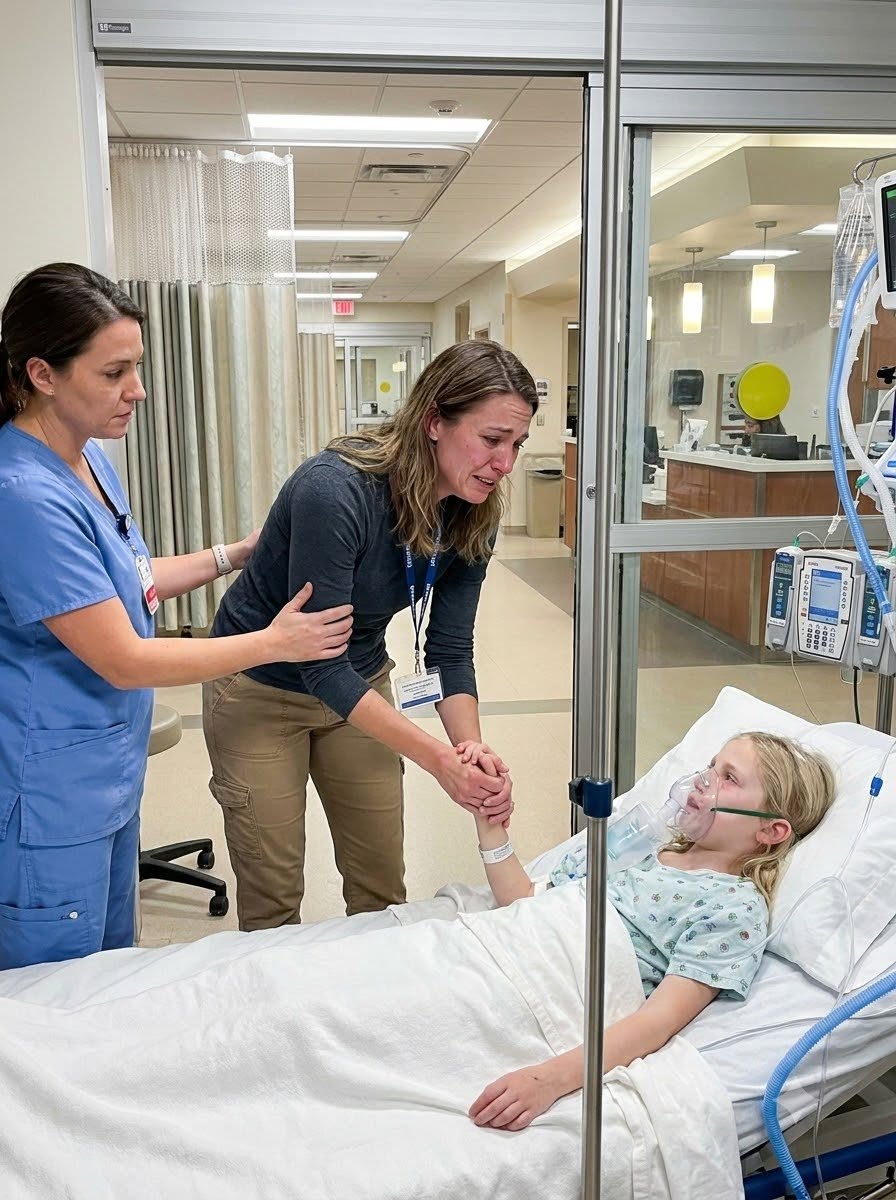 Daniel had spent years allowing his mother to redefine every boundary as disrespect and every objection as hysteria.
I had mistaken his avoidance for peace.
Lily’s hospital bed showed me the price of that peace.
Six months later, Daniel began seeing her without a supervisor for short daytime visits.
Before the first one, he demonstrated how to use both types of prescribed epinephrine devices.
He recited the emergency plan without hesitation.
Then he handed Lily his phone and showed her where emergency contacts were saved.
“If you say you cannot breathe,” he told her, “I call 911 first. I do not ask anyone else what they think.”
Lily looked toward me.
I nodded.
She agreed to go.
Trust did not return because Daniel apologized.
It returned in inches, through repeated choices made correctly when nobody was watching.
Patricia sent birthday cards, gifts, and letters claiming grandparents should not be erased for one mistake.
I returned every package unopened.
One mistake is forgetting a lunchbox.
One mistake is taking the wrong exit.
Patricia made a chain of decisions while a child’s breathing deteriorated.
She rejected medical advice.
She transported Lily away from help.
She abandoned her with a neighbor.
She ignored calls.
She protected a reservation.
Then she blamed the child.
A year after the lake trip, Lily attended a classmate’s birthday party.
Before entering, she showed the host’s mother her allergy kit and explained exactly what to do.
Her voice did not shake.
The woman listened, placed the kit in an accessible location, and repeated the emergency steps back to her.
Lily smiled.
It was a small moment, invisible to everyone who believed safety appeared automatically because adults claimed to love a child.
I knew better.
Love without action had nearly killed her.
When Lily returned home, she placed the red bag on the kitchen counter and wrapped both arms around my waist.
“The mom believed me,” she said.
I held her tightly.
“She should.”
That became the rule in our home.
Lily did not have to become blue, collapse, or nearly die before an adult treated her words as important.
She only had to say she needed help.
The people who abandoned her wanted everyone to believe I destroyed their lives with three phone calls.
I did not.
I gave a timeline.
Their own choices did the rest.
Daniel had spent years allowing his mother to redefine every boundary as disrespect and every objection as hysteria.
I had mistaken his avoidance for peace.
Lily’s hospital bed showed me the price of that peace.
Six months later, Daniel began seeing her without a supervisor for short daytime visits.
Before the first one, he demonstrated how to use both types of prescribed epinephrine devices.
He recited the emergency plan without hesitation.
Then he handed Lily his phone and showed her where emergency contacts were saved.
“If you say you cannot breathe,” he told her, “I call 911 first. I do not ask anyone else what they think.”
Lily looked toward me.
I nodded.
She agreed to go.
Trust did not return because Daniel apologized.
It returned in inches, through repeated choices made correctly when nobody was watching.
Patricia sent birthday cards, gifts, and letters claiming grandparents should not be erased for one mistake.
I returned every package unopened.
One mistake is forgetting a lunchbox.
One mistake is taking the wrong exit.
Patricia made a chain of decisions while a child’s breathing deteriorated.
She rejected medical advice.
She transported Lily away from help.
She abandoned her with a neighbor.
She ignored calls.
She protected a reservation.
Then she blamed the child.
A year after the lake trip, Lily attended a classmate’s birthday party.
Before entering, she showed the host’s mother her allergy kit and explained exactly what to do.
Her voice did not shake.
The woman listened, placed the kit in an accessible location, and repeated the emergency steps back to her.
Lily smiled.
It was a small moment, invisible to everyone who believed safety appeared automatically because adults claimed to love a child.
I knew better.
Love without action had nearly killed her.
When Lily returned home, she placed the red bag on the kitchen counter and wrapped both arms around my waist.
“The mom believed me,” she said.
I held her tightly.
“She should.”
That became the rule in our home.
Lily did not have to become blue, collapse, or nearly die before an adult treated her words as important.
She only had to say she needed help.
The people who abandoned her wanted everyone to believe I destroyed their lives with three phone calls.
I did not.
I gave a timeline.
Their own choices did the rest.