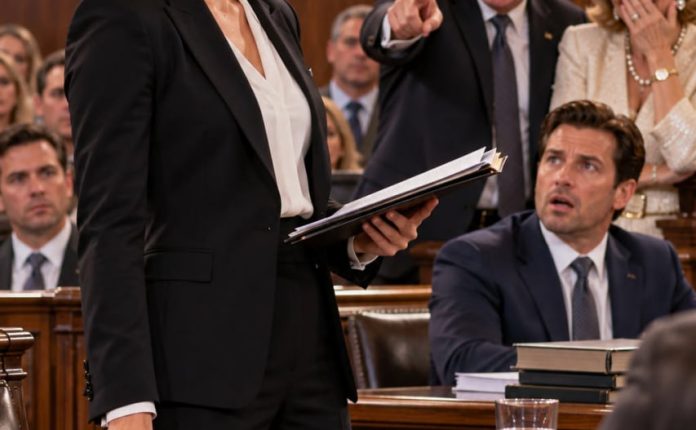
My father-in-law laughed before the judge entered.
It was a warm, expansive sound, the one he used at dinners when someone else had made an expensive mistake.
“Not even a lawyer,” Richard said, looking at the vacant chair beside me. “Well, that tells us something.”
His wife had laughed first.
Vivian’s version was smaller, tucked behind her fingertips. Her diamond bracelet slid down her arm as she leaned toward him, and I heard the words “poor thing.”
Preston sat between his attorneys with his ankle resting on his opposite knee.
I had seen him sit like that during negotiations at our dining table, back when he said my presence helped clients relax. His posture suggested nothing unexpected could happen while he was comfortable.
I placed my leather briefcase beneath the table.
The corner had a deep scrape from a military transport flight. Preston had once offered to replace it with something more feminine.
I had said no.
Apparently there were some parts of myself I had managed to keep.
Across the aisle, three lawyers arranged their materials. Martin Voss, the lead attorney, had silver hair, a narrow face, and the habit of placing his fingertips together before speaking. The other two watched him for cues.
My table held a legal pad, a pen, and a glass of water.
I checked the clock.
Nine seventeen.
Twenty-one days earlier, at that same hour, my husband had moved the butter dish away from my plate and set down a stack of divorce papers.
He had dressed for work already. Gray suit. Blue tie. The watch I bought him after he became a regional director.
“We should handle this sensibly,” he said.
Outside, someone was cutting the neighbor’s grass. The smell came through the kitchen window, damp and green.
I remember noticing it because the rest of the room suddenly felt artificial, like a model kitchen in a house neither of us occupied.
“What is this?”
“You can see what it is.”
I looked at the top page.
He had begun the divorce process. His lawyers had also prepared an agreement he wanted me to sign and an application asking the court to enforce an earlier agreement I had supposedly made.
The earlier agreement was new to me.
“You should read everything before you call anyone,” he added.
“Who would I call?”
His eyes moved toward my phone.
“A friend. Someone who gets you upset.”
He went to refill his coffee.
That, more than the papers, told me how long he had been preparing. He had already rehearsed my reaction and assigned responsibility for it to someone who wasn’t there.
I read while he stood at the counter.
The proposal gave me a short period to leave the house. It described nearly everything valuable as his separate property. It treated a large transfer from our joint savings as part of a debt owed to his father.
It offered a payment that would cover a rental deposit and several months of ordinary expenses.
In return, I would release my claims and confirm the validity of an agreement dated six years earlier.
“You believe I brought nothing into this marriage?”
Preston stirred his coffee even though he drank it black.
“You took care of the house.”
“I took care of more than a house.”
“We don’t have children, Amelia. Let’s not turn this into something it isn’t.”
For a moment I couldn’t answer.
He had chosen the one absence in our marriage we had both grieved, then used it to erase the work that remained.
I closed the first folder.
“And the savings?”
“That’s explained.”
“It’s described. That isn’t the same thing.”
His spoon stopped moving.
The previous autumn, four hundred eighty thousand dollars had left our joint account.
The balance had grown over years: my pay during our first year of marriage, money I had brought into the household and later mixed with our savings, his salary and bonuses, investment proceeds, and the money we had set aside while postponing a larger house.
When I noticed the transfer, Preston said it was a temporary investment through his father’s company.
Richard later called it a bookkeeping matter.
I asked for the paperwork.
I received reassurances.
Now the money appeared in a schedule connected to an alleged six-hundred-twenty-thousand-dollar family loan.
“Your father lent us money?”
“You benefited from the arrangement.”
“What arrangement?”
He pushed another page toward me.
At the bottom was my name.
For several seconds I studied it without moving.
The shape looked familiar. The long first stroke. The tight loop in the final letter. But the line beneath it slanted faintly, as though the image had been taken from another page.
“Where did this come from?”
“Our files.”
“When did I sign it?”
“The date’s right there.”
September fourteenth, six years earlier.
The agreement purported to have been signed at Richard’s office in Virginia. It surrendered claims to certain assets and acknowledged obligations arising from advances made by his family.
Richard’s name appeared as a witness.
I read the date again.
Then I looked at Preston.
“You don’t remember every document you’ve signed,” he said.
“No,” I answered. “I don’t.”
He exhaled.
I watched him mistake the pause for surrender.
After he left, I remained at the kitchen table until the mower next door went quiet.
I didn’t cry immediately. I washed the plate, rinsed the cup, and put the butter back in the refrigerator.
Then I walked upstairs.
Behind the winter coats was a cupboard Preston rarely opened. My footlocker stood at the back, beneath an old blanket.
He had carried it into that cupboard six years earlier, shortly after I left active service.
“What’s in here, bricks?” he had asked.
“Old work.”
“Then why keep it?”
I remembered telling him I wasn’t ready to decide what belonged in the past.
Now I knelt beside it.
Inside were orders, photographs, letters, a battered mug, and a black folder containing the records I had thought I would someday show him properly.
Captain Amelia Carter.
Judge Advocate.
In the photograph on top, I stood outside a military courthouse in Germany, my hair pulled back so severely that the skin beside my eyes looked tight.
Nora Bell was next to me, holding two paper cups.
I could remember the coffee. Bitter, almost burned. We had stayed late preparing for a hearing and missed dinner.
That photograph wasn’t evidence of where I had been on the date in Preston’s agreement.
But it reminded me where to look.
I had married Preston during leave seven years earlier. We spent the next year managing distance while I finished my overseas assignment.
He visited once.
After I left active service, I moved into the life he had already begun arranging for us.
He knew I was a lawyer.
He knew I had served in the Army.
Somehow, over the years, those facts had become smaller each time he repeated them.
At first I was an Army attorney.
Then I had worked in military legal services.
Eventually, in front of his parents, I had “done some administrative work overseas.”
I corrected that description during our second Christmas together.
Vivian asked whether military offices used the same qualifications as ordinary law firms.
Before I could finish answering, she remembered the dry cleaning.
Preston said, “Mom doesn’t mean anything by it.”
That became the explanation for almost everything.
His mother didn’t mean anything by asking whether I understood the wine list.
His father didn’t mean anything by calling my former salary pocket money.
Preston didn’t mean anything by saying I had stopped working because our marriage mattered more.
I had left active service after a difficult final year. I wanted time to recover, take the local professional requirements seriously, and decide what kind of legal work I wanted next.
Then Preston’s mother had surgery.
Then his father developed a heart condition.
Then Preston began traveling constantly.
There was always a reason the next season would be better for me to return.
I had kept my original state license active, completed my education requirements, and paid my dues. Preston once glanced at the renewal notice and asked whether it was a veterans’ association.
I had started explaining.
His phone rang.
Sitting beside the footlocker, I called Nora.
She answered on the fifth ring.
“Amelia?”
Just my name. No qualification. No explanation of whose wife I was.
“I need to locate an archived duty record.”
There was a pause.
“What happened?”
I told her enough.
When I gave her the date, she drew in a breath.
“You were here. We were in proceedings that week.”
“I remember.”
“You chaired the case conference on the thirteenth.”
“And I was counsel at the hearing the next morning.”
Nora went quiet.
“Tell me what they say you signed.”
I read the relevant passage.
She didn’t interrupt.
When I finished, she said, “Don’t send me any protected case material. I’ll help you identify the records office and the public docket information. You’ll need proper copies.”
It was the first sensible thing anyone had said to me all day.
By evening, I had made a list.
Orders showing my assignment.
Travel records establishing when I had returned to the United States.
A certified record of my appearance in the military courtroom on September fourteenth.
I also wanted the original alleged agreement, its source, and the financial records behind the claimed loan.
Wanting those things and obtaining them were different tasks.
Military experience had taught me how to follow evidence. It had not turned me into an expert in every civilian family court rule.
The following morning, I called local attorneys.
The first had a conflict.
The second quoted a retainer I could not pay from the money currently available to me.
The third could see me in twelve days.
By then Preston had changed the password on the account we used for household bills.
I still had a modest account of my own. I could buy groceries and put fuel in my car. I could not casually fund a prolonged legal fight.
When I asked him to restore access, he said the lawyers wanted to avoid confusion.
“Whose confusion?”
“Don’t start.”
“I’m asking about money that paid our bills last week.”
“Send requests through Martin.”
Martin Voss did not represent me. His office made that clear in a courteous email.
I wrote back requesting a copy of the application, the documents filed in support, and the records needed to understand the agreement.
I used short sentences.
I asked separate questions.
I saved everything.
Richard called that afternoon.
“Preston says you’re making this harder than it needs to be.”
“I’m trying to understand what I’m being asked to accept.”
“He’s giving you a generous start.”
“A start?”
“You’re still young enough to establish yourself.”
I looked at the garden through the kitchen window. I had planted the lavender along the path because Vivian said the yard needed softening.
“Did you witness me signing the agreement?”
He waited a fraction too long.
“It was years ago.”
“Your name is on it.”
“Amelia, families sign things. You don’t build a crisis around every piece of paper.”
“Do you remember being there?”
His tone changed.
“You should be careful before accusing people.”
“I asked what you remember.”
He ended the call.
I wrote down the time and the words while they were fresh.
Not because I expected a dramatic confession. Because I had spent seven years allowing uncomfortable conversations to dissolve into arguments about my tone.
This time I wanted the words to remain where they belonged.
I moved into the guest room.
Preston watched from the landing as I carried in a pillow.
“You don’t need to make a statement.”
“I need sleep.”
He stood there a moment longer.
“Dad’s upset.”
“I noticed.”
“He’s done a lot for us.”
“What did he lend us?”
“We’ve already discussed that.”
“No. You’ve told me there’s an explanation.”
His jaw moved.
For a second I thought he might sit down and tell me something true.
Instead, he said, “You always do this. Take one detail and act like it matters more than the whole relationship.”
I looked at the divorce papers on the bed.
“Some details determine what the relationship was.”
He left.
Over the following two weeks, records arrived in uneven batches.
A formal response came from the military records office. Another document required a second request. Nora located the appropriate docket and put me in contact with someone authorized to provide a certified extract without disclosing unrelated case information.
I didn’t receive a magical file containing everything I needed.
I received a date, a location, my name, and an official record of my presence.
That was enough to begin.
I also examined the scanned agreement more closely.
The faint gray line beneath my name was not present beneath Preston’s.
There was a tiny black mark beside the final letter, a printing defect I recognized without immediately remembering why.
I searched our old household folders.
Insurance forms. Medical releases. Bank authorizations.
On an authorization I had signed two years earlier, I found the same mark.
The same sloping line.
It was not proof by itself that someone had copied my name from that page. A forensic examiner would need to assess the files and their history.
But it told me what to ask for.
I requested the native electronic file underlying the scan and the original paper agreement.
Martin’s office replied that the original had not yet been located.
Richard called again.
This time I let the call go to voicemail.
He said there was no need to “dig through private family records.”
I listened twice.
Then I saved it.
Three nights before the hearing, I nearly stopped.
The records lay in neat piles on the guest bed. My neck hurt from reading. I had eaten crackers for dinner because I didn’t want to pass Preston in the kitchen.
I could imagine signing.
Not believing him. Not agreeing.
Just ending the daily effort of holding my ground.
There would be a small apartment somewhere. Work of some kind. A version of the story his family would tell over dinner while I tried to rebuild quietly.
Maybe I could live with that.
My phone rang.
Nora’s kettle was shrieking in the background.
“Have you eaten?”
“Yes.”
“What?”
I looked at the empty sleeve of crackers.
She sighed.
“Get something with a fork.”
“I’m not hungry.”
“I didn’t ask.”
That almost made me laugh.
Then she said, “You don’t have to prove you’re capable by doing every part alone.”
“I can’t afford counsel for all of this yet.”
“Then get advice for what you can. Do the hearing carefully. Ask for what you need. But don’t make solitude part of the strategy.”
I rubbed the indentation left by my ring.
“What do you want from this?” she asked.
“I want them to stop telling me what I signed.”
“More specifically.”
“I want an accurate record.”
“Good. Start there.”
The following afternoon, I paid for a limited consultation with Lila Serrano, a family lawyer whose office was above a pharmacy.
She read the application without making reassuring noises.
Then she asked me what I understood the hearing to cover.
“Preston wants the court to treat the agreement as controlling and restrict temporary financial relief on that basis.”
“And what are you asking for?”
“To prevent reliance on a disputed document. To preserve the financial records. To address access to funds while the dispute is examined.”
She nodded.
“Stay there.”
I showed her the military records.
Her expression sharpened, but she didn’t smile.
“This is serious. It does not mean you should accuse everyone in the room of a crime.”
“I know.”
“And an attack on the agreement doesn’t automatically decide property classification, support, or the rest of the divorce.”
“I know that too.”
“Good. Judges appreciate people who know where their argument ends.”
We discussed the practical requirements for the hearing. I prepared copies, organized exhibits, and filed what I needed to file.
Lila could not take over the full case without funding. She told me what she could do, what she couldn’t, and what questions I should reserve.
It was a relief to hear limits spoken honestly.
The night before court, rain struck the guest room window.
I slept in pieces.
At dawn I ironed my navy jacket on a folded towel because Vivian had borrowed our ironing board weeks earlier and never returned it.
I made toast.
I ate it standing beside the sink.
Preston came downstairs as I was closing my briefcase.
“Are you really going through with this?”
“With what?”
“This approach.”
I looked at him.
He glanced at the case, then my jacket.
“You could have made things easier for yourself.”
“I’m trying to.”
For the first time, he seemed unsure what I meant.
Now the bailiff asked everyone to rise.
Judge Rebecca Morrison entered carrying a thin folder. She settled into her chair, reviewed the appearances, and looked toward me.
“Mrs. Hale, have you had an opportunity to retain legal representation?”
“Yes, Your Honor.”
“And you intend to represent yourself at this hearing?”
“Yes.”
There was movement behind me.
I did not turn.
Martin Voss stood.
He spoke evenly, presenting his concern as assistance.
“This is a relatively straightforward matter. We would not want Mrs. Hale’s lack of counsel to introduce unnecessary complications.”
Judge Morrison looked at him for a moment.
“Mrs. Hale’s choice does not relieve either party of the obligation to support their position.”
“No, Your Honor.”
She turned a page.
I opened my briefcase.
Richard’s laughter stopped.
The clasp sounded louder than I expected. I removed one folder and placed it beside my pad.
“Is there a preliminary matter?” the judge asked.
“Yes, Your Honor. I dispute the authenticity of the agreement on which the application relies.”
Martin said I had received the document with the disclosures.
“Receipt does not establish execution,” I answered.
Preston looked at me.
It wasn’t the words themselves that startled him. He had heard me speak precisely before, usually while helping him prepare for a difficult call.
He had never expected to be the person on the other side of that precision.
Judge Morrison asked whether his counsel possessed the original agreement.
Martin acknowledged that they had a scanned copy supplied by their client.
“Then refer to it as a copy,” she said.
One of the younger lawyers began writing.
Vivian folded both hands in her lap.
The room had not become friendly. I was still alone at my table. My hands were cold, and the water beside me trembled when I touched the glass.
But the application was no longer moving past the disputed page as though it were settled history.
Judge Morrison faced me.
“Explain the basis for your objection.”
I stood.
There were several things I could have said about my husband, his father, the missing money, the seven years compressed into pages that barely acknowledged my existence.
None belonged first.
I looked at the date on the agreement.
Then I looked at the judge.
“The agreement they want this court to enforce says I signed it in Virginia on September fourteenth, but certified Army records place me in a military courtroom in Germany that day, serving as counsel.”
END PART 1