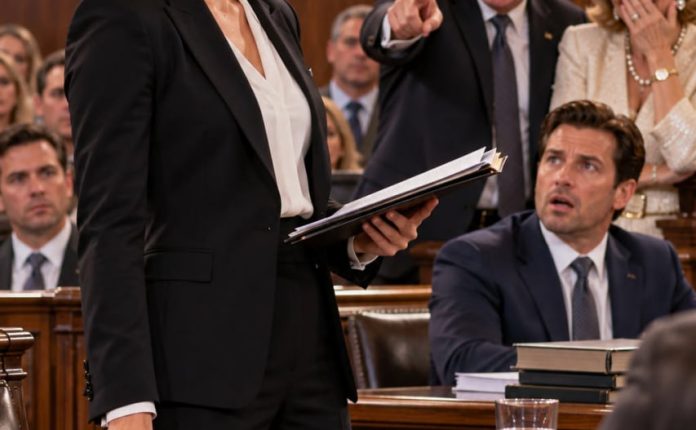
Lila did not move.
“Tell me exactly what you mean.”
Preston stared at the table.
“He said he needed something showing how she signed.”
“Why?”
“To complete the paperwork.”
“What paperwork?”
“The agreement.”
Calvin requested a break.
The room emptied in careful stages.
The court reporter stopped her machine. Lila closed the folder but kept one finger between the pages.
I remained seated until Preston and his attorney had left.
There was a half-empty bottle of water in front of him. He had worried the label loose during the questioning.
I watched the strip of paper curl upward.
All those years, I had thought understanding would arrive as a feeling.
Some unmistakable force that would settle every question at once.
Instead, it arrived through ordinary objects.
A copied page.
A date.
A loose water bottle label beside the place where my husband had admitted supplying my name.
Lila turned toward me.
“We can take a longer break.”
“No.”
“You don’t need to decide immediately.”
“I’m all right to continue.”
She waited.
“I’m not all right,” I corrected. “But I can continue.”
When Preston returned, he looked at me before sitting.
There was something pleading in his expression.
For years, that look had drawn an answer from me before he asked the question.
I faced the documents.
Under further questioning, he described the conversations that preceded the filing.
Richard had told him the family should have protected its assets years ago.
There had been discussions about an agreement during our first year of marriage, but no completed agreement signed by me.
Preston remembered the subject.
I remembered it too.
He had mentioned his father’s suggestion during a late-night call while I was overseas.
I said any financial agreement would require time, disclosure, and independent advice.
Preston said we would discuss it after I came home.
We never did.
A conversation about a possible agreement had become, in Richard’s telling, an agreement that should have been completed.
Then an agreement everyone supposedly understood.
Finally, a document with my name on it.
Preston said he had not watched the page being assembled.
Lila asked whether he knew I had not signed it in his father’s office on the stated date.
He lowered his head.
“Yes.”
“Before it was submitted to your attorneys?”
“Yes.”
“Before it was filed?”
“Yes.”
I pressed both feet against the floor.
There was no misunderstanding left to preserve.
He had not been careless with a fact he failed to check.
He had known the central fact was false and relied on my exhaustion to keep it from being examined.
“Why did you proceed?” Lila asked.
Preston’s answer was almost inaudible.
“I thought she would settle.”
She asked him to repeat it for the record.
He did.
That evening, I walked through the neighborhood around my apartment until the streetlights came on.
I passed a little house with an open window. Someone inside was chopping vegetables. A radio played softly.
I wanted that ordinary life so badly it embarrassed me.
A room where someone’s hands could be occupied with dinner instead of hiding a transfer, drafting an accusation, or searching a statement for the next problem.
When I reached home, Nora had left a message.
I called her back.
“He knew.”
She didn’t ask which part.
“I’m sorry.”
“I keep going back through everything.”
“Of course.”
“The trip he canceled. The account password. The questions he stopped answering.”
“Amelia.”
“What?”
“You don’t have to solve the whole marriage tonight.”
I sat on the kitchen floor.
For the first time since the breakfast papers, I cried without trying to keep the sound small.
Nora stayed.
She didn’t fill the silence with lessons.
When I could breathe properly, she asked whether I had locked the door.
I checked.
Then I made tea.
The next stage took months.
There were supplemental disclosures, amended positions, contested requests, and negotiations that failed because Richard still believed repetition could repair the record.
The alleged debt changed shape.
First it was a formal family loan.
Then a collection of advances.
Then a moral obligation Preston felt toward his father.
Samuel followed the numbers without trying to decide what sort of men they were.
That was useful work.
The company expenses could not reasonably be treated as loans made to our household merely because Richard had paid them.
The gifts had been described as gifts at the time.
And the transfer from our savings had purchased an interest that needed to be included in the marital financial picture.
There were legitimate distinctions too.
Some of Preston’s business interests predated our marriage.
Some family assets were not mine and never had been.
Lila explained those boundaries without hesitation.
I did not want Richard’s life.
I wanted the court to stop accepting his account of mine.
The project connected to our missing savings was in trouble, but it was not worthless.
A valuation required more than taking the original transfer and dividing it in half. There were obligations, changing market conditions, and documents concerning the interest Preston held.
For a while, I hated hearing qualifications.
Then I realized they were part of what I had asked for.
An accurate record included facts that did not flatter me.
At the evidentiary hearing, the courtroom looked smaller than it had the first time.
Perhaps I was less occupied with measuring the distance between our tables.
Lila sat beside me.
Calvin sat beside Preston.
Richard had separate counsel because his own conduct and records had become part of the dispute.
Vivian came too.
She wore a plain dark suit and no bracelet.
I noticed the absence before I noticed her face.
Judge Morrison began by defining what would be addressed.
The authenticity and attempted use of the purported agreement.
The disputed financial disclosures.
Requests for appropriate remedies and fees.
The court would not decide every remaining detail of the divorce that day.
There was comfort in knowing where the proceeding began and ended.
The document examiner testified first.
She explained the matching image of my name, the printing defect, the relationship between the source authorization and the purported agreement, and the limitations of her conclusions.
Calvin questioned her about what an electronic file could establish.
She answered without defensiveness.
She could identify features inconsistent with an independently signed page.
She could explain the recovered file history.
She could not tell the court what every person had been thinking.
The distinction made her more convincing.
Then the certified military records were addressed.
There was no dispute left about where I had been.
There had never been a second Amelia Carter wandering through Richard’s office while I sat in Germany.
No remote signing arrangement had been described in the document.
No alternative execution date was supported by an original.
No original appeared.
Preston testified.
He did not deny sending the authorization to his father.
He did not deny knowing I had been overseas.
At one point Calvin asked whether he had relied on Richard’s assurances.
“Yes,” Preston said.
Lila stood for questions.
“Did your father tell you that Amelia had signed the agreement?”
“Yes.”
“Did you know that the stated event had not occurred?”
Preston looked toward the gallery.
Richard sat rigidly.
“Yes.”
“So whatever assurances you received, you knew the document did not accurately describe its execution.”
“Yes.”
There was no triumph in hearing it.
I had once loved the sound of his voice saying my name.
Now I was listening for whether he would tell the truth when a truthful answer cost him something.
He managed it in pieces.
Richard was harder.
He spoke as though the court had been summoned to misunderstand him.
The agreement reflected the family’s longstanding expectations.
Preston had contributed the meaningful income.
I had enjoyed a comfortable standard of living.
There were business realities outsiders would not appreciate.
Judge Morrison interrupted once.
“Mr. Hale, answer the question you were asked.”
His attorney touched his arm.
He pulled it away.
Lila asked whether he witnessed me signing the agreement.
“No.”
“Did you know your name appeared as a witness?”
“Yes.”
“Did you authorize that representation?”
“I approved the document.”
“Knowing you had not witnessed Amelia sign it?”
“I believed it put in writing what was fair.”
Lila paused.
“You understood that your belief about fairness was not the same as Amelia’s consent?”
Richard glanced at me.
For a moment I saw genuine anger without the coating of manners.
“She was leaving the family.”
I felt Lila’s stillness beside me.
“Your son initiated the divorce,” she said.
“That doesn’t change what she was trying to take.”
“What had she demanded when you approved this document?”
He said nothing.
“At that point, had she made any property demand?”
“No.”
“Had she filed any claim against you personally?”
“No.”
“Had she even received the divorce papers?”
“No.”
The ventilation hummed.
Richard looked toward Vivian.
She was watching her hands.
Lila asked one final question.
“When you approved a page falsely representing that Amelia agreed to surrender rights, what opportunity did you give her to agree or refuse?”
Richard’s attorney objected.
After a short exchange, the question was permitted in a narrower form.
“Did you ask Amelia to sign the agreement you approved?”
“No.”
Lila sat down.
I had imagined him shouting.
Part of me had wanted that. It would have made his conduct easier for everyone to recognize.
Instead, he folded his hands and looked offended.
The ordinary appearance of him was harder to bear.
This was the man who had carved Thanksgiving turkey while telling me to stop worrying about the savings.
The man whose prescriptions I had collected.
The man who had accepted my company in waiting rooms, my cooking, my careful remembrance of the foods he could no longer eat.
He had known how to receive care from someone he did not consider entitled to an answer.
When it was my turn, I spoke about the marriage.
Not as a closing argument.
As a sequence of things I could truthfully describe.
My service during our first year.
The move after I left active duty.
The work I postponed.
The contributions to the accounts.
The requests for information after the transfer.
The conversation at breakfast.
Calvin asked whether I was legally trained.
“Yes.”
“Experienced in investigating documents?”
“Yes.”
“Would it be fair to say you were better equipped than many people to recognize a concern?”
“Yes.”
He nodded.
“So you were not unable to protect your interests.”
Lila objected to the characterization.
The judge allowed him to rephrase.
“Were you capable of reading financial documents during your marriage?”
“Yes.”
“Then why didn’t you insist on reviewing the underlying business records before this dispute?”
I looked at Preston.
He was watching me.
“Because I believed the person I married when he told me the money was safe and the records would follow.”
I turned back toward Calvin.
“I should have insisted. That does not mean I agreed to what happened.”
He asked a few more questions.
I answered them.
When I returned to my seat, my knees were unsteady.
Lila slid the water toward me without looking away from the judge.
The decision was not a speech.
Judge Morrison discussed the evidence, the admitted facts, and the matters still requiring resolution.
She found that I had not executed the purported agreement.
It could not be enforced against me.
She found that Preston knowingly relied on a materially false account when presenting it.
She addressed the incomplete financial disclosures and the need to correct the treatment of the transferred funds.
There would be appropriate consequences for the unnecessary expense and proceedings caused by that conduct.
Specific fee and sanction amounts required further submissions.
Questions about any separate investigation would be handled through proper channels, not decided by an accusation in the divorce courtroom.
I listened closely.
The care of it mattered.
No one was being asked to believe me because I had worn a uniform.
The evidence had been tested.
The people who submitted the page had been asked what they did.
The answer was now part of the record.
When we stood to leave, Richard remained seated.
Vivian waited beside him.
Preston walked past my table, stopped, and looked as though he might speak.
Calvin quietly directed him toward the door.
Outside, Lila asked whether I needed a minute.
“Yes.”
We sat on a bench away from the elevators.
A clerk wheeled a cart of files past us.
Somewhere down the corridor, a child asked when they could go home.
“I thought that would feel like an ending,” I said.
“It is an ending to one question.”
“And the rest?”
“We finish it.”
That was what we did.
The financial settlement came later, after corrected disclosures and independent analysis.
We sold the house.
The investment interest was included in the overall accounting at a negotiated value informed by the records and valuation work.
The supposed family loan was not assigned to me as though I had accepted it.
Preston made concessions on allocation, liquidity, and fees that reflected the evidence and the damage his conduct had caused.
I did not receive a second share of the same money by counting both the transferred savings and the investment as separate assets.
Samuel made certain of that.
There was enough complexity without adding a victory that existed only on paper.
When the final schedules arrived, I checked them with him line by line.
He waited while I asked questions.
Nobody sighed.
Nobody said a man who understood money had already handled it.
That experience was so simple I nearly missed its importance.
Richard’s consequences extended beyond our case, though not because I set out to destroy his company.
The recovered documents and corrected accounts exposed inconsistencies relevant to a pending financing review.
The lender required additional information and independent verification.
An expansion Richard had been discussing for months was delayed.
He told people I had damaged the business out of spite.
But other people had seen the orders.
The accountant could read the ledger.
The lender could compare what it had been told with what existed.
Richard’s habit of calling scrutiny disloyalty did not work as well outside his dining room.
Some business relationships cooled.
Others continued under stricter terms.
Employees went to work. Projects still required attention. There was no convenient collapse that punished everyone in proportion to their guilt.
What changed was Richard’s ability to make an unsupported statement and expect everyone to arrange their lives around it.
Preston stepped away from an anticipated role in the family’s next expansion.
Whether that was his decision or a condition imposed by others, I never learned.
For once, I allowed a question about the Hales to remain unanswered.
Vivian contacted me near the end of the summer.
She asked to meet at a café.
I nearly declined.
Then I realized I wanted to hear her without a dinner to serve or a husband beside me.
She arrived early.
Her bag rested on the chair where she expected me to sit.
When she saw me, she moved it quickly.
“I’m sorry,” she said before the server came.
I put my keys on the table.
“For what?”
She looked toward the window.
“For how everything happened.”
I waited.
“I wish the families could have handled it privately.”
“There weren’t two families negotiating, Vivian.”
She pressed her lips together.
“You know what I mean.”
“I used to tell myself that all the time.”
The server approached.
We ordered tea.
Vivian watched the spoon beside her cup.
“I didn’t know about the document until after Preston had it.”
“Before the filing?”
“Yes.”
“What did you do?”
She swallowed.
“I told Richard it seemed risky.”
I sat back.
“Risky for whom?”
She didn’t answer.
I had not expected a complete apology. Still, the absence hurt.
“You laughed at me in court,” I said.
Her eyes filled.
“I was nervous.”
“So was I.”
She looked up.
That seemed to reach her more directly than anything about the money.
“I thought Preston had made arrangements,” she said.
“He had.”
“I didn’t understand how bad it was.”
“Did you ask me?”
“No.”
The tea arrived.
For a while, we let it cool.
Then she said, “I kept thinking, if I contradicted Richard in front of everyone, I would make it worse.”
“For me?”
She looked down.
“No.”
It was the first answer she gave without protecting herself.
I appreciated it.
It did not restore the years.
“I don’t know what you want me to say,” she whispered.
“I’m not here to give you the words.”
She nodded slowly.
When we left, she did not reach for a hug.
I was grateful for that small recognition of distance.
Preston wrote a letter after the divorce became final.
He sent it through the arrangement our lawyers had established for remaining personal property.
No demand for a call.
No suggestion that his father had forced his hand.
For the first time, he wrote that he had known I did not sign the agreement.
He wrote that he had expected pressure to succeed because it had succeeded before.
I read that sentence several times.
It explained more of our marriage than the expensive reports.
There were things I still wanted to ask him.
When had disappointment become contempt?
Had he ever missed the person I was before I began accommodating everyone?
Did he understand that leaving me alone at a table was not the same as finding me helpless?
But I no longer believed every question required his participation before I could move forward.
I wrote a short reply.
I acknowledged that he had finally described his own choice accurately.
I told him the remaining matters could continue through counsel.
Then I put his letter away.
I did not forgive him on a deadline.
I did not make anger the only thing I carried.
In September, I rented a small office two afternoons a week.
Not a grand return.
I began with professional refreshers, local requirements, conversations with practitioners who knew the work I wanted to do, and the uncomfortable task of admitting where my knowledge needed updating.
Lila introduced me to a clinic serving veterans and military families.
I started under the clinic’s structure, taking matters suited to my competence and seeking supervision where I needed it.
My first client arrived with documents in a grocery bag.
He apologized for how disorganized they were.
“It’s all right,” I told him.
He looked at the framed photograph on the shelf.
The one outside the military courthouse.
“Were you Army?”
“Yes.”
“What did you do?”
“I was a lawyer.”
I heard the ease in my answer.
No apology for the past tense.
No effort to make it smaller.
We emptied the bag onto the desk and began putting the papers in order.
That afternoon, Nora came to see the office.
She brought the dented mug from my footlocker. I had left it at her house during the move.
“You need something ugly in here,” she said.
“I have a secondhand filing cabinet.”
“That’s respectable. This is ugly.”
She put it on the shelf beside the photograph.
I bought a modest house the following spring.
Two bedrooms. A narrow porch. Kitchen windows overlooking a yard that needed work.
The inspection report was longer than I wanted.
I read every page.
When the contractor explained the repairs, he looked directly at me.
I chose what to do first.
There was no revelation in that, no audience, no polished sentence that stopped a room.
Just a person asking what I wanted done in my own home.
On the first night, I ate at a small table near the kitchen window.
The furniture truck had not yet arrived. My plate sat on a folded dish towel.
Rain began after dark.
For a moment the sound took me back to the guest room, the jacket on the towel, the briefcase waiting beside the door.
I could see the courtroom exactly.
Vivian hiding her smile.
Richard looking at the empty chair.
Preston touching his watch.
I had once imagined that remembering them would always make me feel exposed.
That night, the memory settled differently.
I remembered how frightened I had been.
I remembered going anyway.
My old leather briefcase stood beside the table, its scraped corner facing the room.
The latch still caught unless I pressed it carefully.
I could afford a new one now.
I reached down, closed it properly, and left it where it was.
THE END
This story is a work of fiction. Its characters and events are invented and are not presented as verified real-world facts.
END PART 3
Disclaimer: This fictional story was created with AI assistance for entertainment. Names, characters, dialogue, and events are fictional. Any resemblance to actual people or events is coincidental.