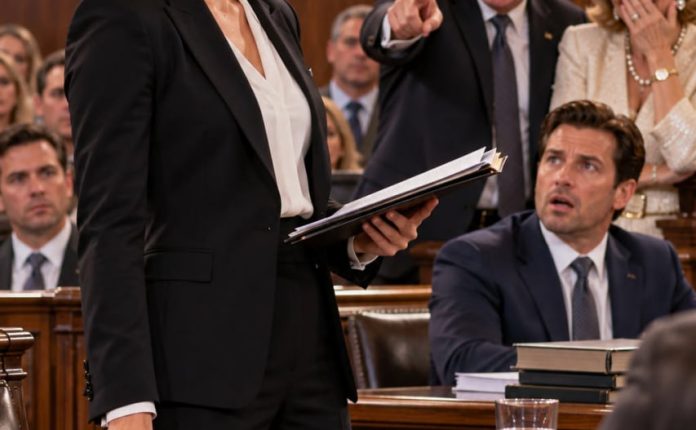
No one laughed after that.
Martin Voss turned toward Preston. His youngest associate stopped writing with the pen still touching the page.
Behind them, Richard sat forward.
Judge Morrison held out a hand.
“Let me see the records.”
I provided the copies in the manner we had arranged, identifying the certified documents and the passages relevant to my location.
My voice sounded steady.
My body had not received the message. A muscle beneath my shoulder blade kept tightening, and I pressed my thumb against the edge of the folder to stop myself rubbing it.
The judge read.
Martin read.
Preston stared at the table.
“This record identifies you as Captain Amelia Carter,” Judge Morrison said.
“Yes, Your Honor. Carter is my name before marriage. The accompanying records establish the connection.”
“And you served as an Army attorney?”
“Yes.”
A chair moved in the gallery.
I knew without looking that it was Richard.
Martin asked for time to confer.
The judge allowed a brief pause.
Preston leaned toward him immediately. Richard began to rise, but Martin held up a palm without turning.
That small gesture kept my attention longer than it should have.
For seven years, Richard had entered every conversation whenever he wished. He interrupted contractors, servers, doctors, his wife, his son.
Now someone had told him to remain seated.
Martin stood again.
“Your Honor, we need to investigate this discrepancy.”
“Discrepancy is one word for it,” the judge said. “The document identifies a specific place, a specific date, and a witness. Mrs. Hale has provided records directly contradicting that account.”
“We are not asking the court to disregard those records.”
“Then the proposed agreement cannot be treated as an established basis for relief today.”
He nodded.
She turned to the underlying application.
The hearing continued.
That was the part no one would have imagined from the silence after my sentence.
There was no sudden declaration that I had won the divorce. No bailiff approached Preston with handcuffs. No one awarded me his family’s company.
Instead, the judge asked practical questions.
What funds were available?
What payments were due?
What had happened to the joint account?
Why was an alleged family debt being used to describe a transfer that had initially been presented to me as an investment?
Some answers were incomplete.
Others contradicted the papers.
When Martin requested a chance to obtain instructions, Judge Morrison allowed it but made clear that the disputed agreement would not control her interim decisions.
By the end of the hearing, the application to rely on that agreement had been denied.
The court directed preservation of relevant records and set a schedule for production and further proceedings.
Temporary arrangements addressed household expenses and access to funds. The issue of fees would be considered on proper submissions.
I wrote down each direction.
I had imagined relief as warmth.
It felt more like realizing a door had been unlocked while I was still too tired to push it.
In the corridor, Vivian reached me first.
“Amelia.”
I kept walking toward the benches beside the elevators.
“Why didn’t you tell us?”
I stopped.
“Tell you what?”
“That you were an actual lawyer.”
A woman carrying a sleeping toddler passed between us.
I waited until she had gone.
“I did.”
Vivian looked wounded.
“Not in a way we understood.”
Richard joined us before I could answer.
“You ambushed your husband.”
“The document was filed in court.”
“You knew what I meant.”
“Yes,” I said. “I do.”
His face reddened.
Martin approached and asked to speak with Preston privately.
Richard turned toward him.
“I can clear this up.”
“Please send any relevant records to my office,” Martin said.
It was courteous.
It was also a boundary.
Preston stood several feet away, staring at my briefcase.
“You were planning this.”
“I was preparing for the hearing.”
“For weeks?”
“Since you gave me the papers.”
He looked almost offended that I had used the same time he had used.
I left before the conversation could become another debate about whether I was entitled to remember what had happened.
Outside, the rain had stopped.
Water dripped from the courthouse awning onto a dark patch of pavement.
I sat in my car and called Nora.
“How did it go?”
“They’re not relying on the agreement for now.”
“Good.”
“I was shaking.”
“Of course you were.”
“I thought I’d feel different.”
“You probably need lunch.”
I laughed then, unexpectedly and without grace.
She stayed on the phone while I found somewhere to eat.
Two days later, I returned to Lila Serrano’s office.
This time there were enough temporary funds available to begin putting the case in proper hands. We agreed on a scope of work and reviewed what remained unresolved.
She studied the hearing notes.
“You did what you needed to do.”
“I keep thinking I should have asked him another question.”
“Which him?”
That stopped me.
There were too many men whose explanations had become my responsibility.
Lila placed a clean pad between us.
“Let’s separate what you know from what you suspect.”
We spent the next hour doing exactly that.
I knew I had not signed the agreement.
I knew I had been overseas on its stated date.
I knew four hundred eighty thousand dollars had left our joint savings.
I knew Richard’s name appeared beneath a witness statement.
I suspected my name had been lifted from a household authorization.
I suspected the debt schedule concealed the true purpose of the transfer.
I did not yet know who created the document, who instructed them, or what Preston had told his attorneys.
Lila drew a line beneath the last point.
“We will find out through records.”
I moved out that weekend.
Not because the court ordered me to leave. Because I could no longer sleep in a house where every floorboard announced Preston’s movements.
A friend from my licensing course had a furnished apartment above her detached garage. The kitchen contained two pans, three mismatched mugs, and a refrigerator that hummed whenever I tried to sleep.
The first night, I opened every cupboard.
I don’t know why.
Perhaps I needed to establish that nothing inside belonged to someone who could use it against me.
When I packed the house, Preston appeared in the guest room doorway.
“You’re taking the footlocker?”
“Yes.”
“I thought most of that was old paperwork.”
“It is.”
He looked at the bare mattress.
“You could have told me you were unhappy.”
I folded a sweater.
“I told you I wanted to work.”
“That isn’t the same thing.”
“I told you I needed access to our accounts. I told you I wanted your father to stop speaking for both of us.”
“We had a good life.”
I set the sweater in the suitcase.
“We had good furniture.”
He looked away.
For a moment I felt the familiar urge to soften what I had said.
Then I remembered him moving the butter dish to protect his papers.
I finished packing.
The first substantial financial production arrived two weeks later.
Lila engaged a forensic accountant named Samuel Ortiz.
Samuel wore reading glasses on a cord and asked questions in a voice so mild people sometimes answered before realizing what they had admitted.
He began with the transfer.
Four hundred eighty thousand dollars had moved from our savings to a business account controlled by Richard’s development company.
The bank description called it a capital contribution.
The divorce schedule called it repayment of family advances.
“That distinction matters,” Samuel said.
“Can it be both?”
“Not without a clear explanation and supporting records.”
He asked for the company ledger, the related investment documents, and the records supporting the alleged loan.
Richard objected through counsel.
The objections described privacy, commercial sensitivity, burden, and irrelevant family affairs.
Lila narrowed the requests where appropriate and pursued the rest.
It took time.
During that time I learned how often exhaustion masquerades as doubt.
On good mornings, I could read an email and see exactly what needed answering.
On bad mornings, a request for one more statement made me want to return to bed.
I wasn’t ashamed of the work.
I was ashamed of how much of myself I had spent avoiding it for years.
Nora visited one Saturday with groceries and a screwdriver.
“Why the screwdriver?”
“You said the chair wobbles.”
“I could fix a chair.”
“I know. Sit down.”
While she tightened the legs, I unpacked tomatoes and bread.
She had silver at her temples now. I had missed the gradual arrival of it.
“How did I let this happen?”
She kept working.
“What part?”
“All of it.”
“That’s too large a question.”
“The money. The way they spoke to me. Preston deciding I was someone who couldn’t read her own life.”
Nora tested the chair.
“You were married to him. You weren’t investigating him.”
“I knew better.”
“You knew documents could be false. You didn’t know your husband would hand you one over breakfast.”
I stood with a tomato in my hand.
She looked up.
“Put that down before you turn it into sauce.”
I did.
We ate at the repaired table, and for an hour she told me stories about people whose problems had nothing to do with mine.
I had forgotten how restful ordinary conversation could be.
The electronic records were less restful.
Martin’s office confirmed that the purported agreement had reached them as a PDF supplied by Preston.
The firm had relied on his account of its origin.
Once the military records emerged, they requested the original and clarification. Neither arrived.
The firm subsequently sought to withdraw, explaining only what it could properly place before the court. Lila told me not to interpret the withdrawal as proof of any particular private conversation.
“We don’t need to guess what his lawyer told him,” she said. “We need what he did.”
Preston retained different counsel.
His new attorney, Calvin Reed, was quieter than Martin and less inclined to describe the case as straightforward.
Meanwhile, an independent examiner assessed the files produced under the preservation process.
The scanned page had no traceable original.
The visible image of my name matched the household authorization I had located, including the slight slope and the small printing defect.
The relevant electronic material also showed that the agreement file had been assembled shortly before Preston served me.
A recent file date, by itself, could reflect scanning or routine handling. The examiner was careful about that.
The stronger finding concerned the page’s construction and the matching image.
Lila read the report twice.
“Now we ask who supplied the source.”
I remembered the authorization.
Two years earlier, Preston had asked me to sign it so he could deal with a household account while I was visiting Nora.
I had signed at the kitchen counter.
He had scanned it with his phone.
Nothing secret.
Nothing unusual.
A small act of trust that had outlived the purpose for which I gave it.
That evening, Preston called.
Under Lila’s guidance, I was keeping financial discussion in writing or through counsel. I answered because his message said he wanted to arrange collection of some books.
He didn’t mention the books.
“Dad’s company has private records in that production.”
“I’m not discussing the requests.”
“You don’t understand what this could affect.”
“Then have your lawyer explain it to mine.”
“Amelia.”
I recognized the tone.
It had once made me feel chosen. In later years it meant he expected me to rescue him from the consequences of a conversation he didn’t want to finish.
“There’s a financing review coming up,” he said.
I looked at the small kitchen window. A moth kept striking the glass from outside.
“What are you asking me?”
“Just think about who else could be hurt.”
I waited.
“Employees,” he added. “People who had nothing to do with us.”
“Neither did I, apparently.”
“That’s unfair.”
I closed my eyes.
“No. What happened to me was unfair. This is a request for records.”
I ended the call.
I told Lila about it the next morning.
She made a note, then returned us to the financial documents.
“His father’s business problems do not establish your claim,” she said. “They also don’t erase it.”
Samuel’s next findings explained why Preston was worried.
The alleged six-hundred-twenty-thousand-dollar family loan was supported by a schedule assembled from several unrelated expenses.
Some were costs Richard’s company had paid on a development project.
Some were transfers between business entities.
A smaller group concerned gifts his parents had made during our marriage: a vacation, furniture, repairs they insisted on paying for.
There was no consistent loan agreement, repayment history, or accounting that matched the debt Preston wanted attributed to us.
Then Samuel found something more concrete.
After the four-hundred-eighty-thousand-dollar transfer, an internal investment schedule credited Preston with a corresponding economic interest in one of the projects.
It had not appeared in his initial disclosures.
The investment might prove valuable or worthless. That required examination.
But it existed.
The money had not simply vanished into expenses.
It had been exchanged for something Preston claimed in his own name.
I sat very still while Samuel explained it.
For months, I had worried that the missing savings represented a mistake we would have to absorb.
Now I understood that Preston had expected me to accept both the disappearance of the money and an alleged debt that diminished what remained.
“Does this mean he owns more of the company?” I asked.
“It means he has an interest we need to value and classify,” Samuel said. “We should not jump beyond the documents.”
His restraint helped.
Every precise answer made it easier to bear the next question.
Richard’s deposition took place on a Tuesday in a conference room with windows that could not be opened.
He arrived wearing the suit he used for bank meetings.
Vivian came with him but waited outside.
I sat beside Lila.
I was not there to conduct the questioning. That was one of the hardest useful decisions I made.
I knew the facts. I knew how to ask questions.
I also knew Richard could still make my pulse climb by looking at me as though I had disappointed a roomful of reasonable people.
Lila began with ordinary background.
His role in the company.
His involvement in the transfer.
The records supporting the claimed debt.
Richard answered expansively whenever he could remain general.
Families helped one another.
Business arrangements were complicated.
Preston had always been expected to assume more responsibility.
Lila let him finish.
Then she placed the alleged agreement in front of him.
“Is that your name on the witness line?”
“Yes.”
“Did you see Amelia Hale sign this document?”
“I saw a number of documents around that time.”
“Did you see her sign this one?”
“It was six years ago.”
“Where were you?”
“At my office, as it says.”
“Who else was present?”
“Preston.”
“And Amelia?”
“Obviously.”
Lila allowed the answer to settle.
Then she showed him the certified record of my appearance in Germany.
He read the top half.
“I can’t speak to military paperwork.”
“Can you speak to whether you saw her in Virginia that day?”
“I’ve already answered.”
“You have given two answers. One describes uncertainty. The other places her in your office.”
His attorney objected to the form.
Lila rephrased.
“Do you have an independent memory of Amelia signing this document?”
Richard looked at me.
There it was again: the expectation that I would help him through an awkward moment.
I kept my hands still.
“No,” he said finally.
“Did you have that memory when you represented yourself as a witness?”
“I believed it reflected our understanding.”
“Whose understanding?”
“The family’s.”
“Was Amelia part of that understanding?”
“She benefited from everything we built.”
“That wasn’t my question.”
He shifted in his chair.
By the end of the session, he had stopped describing an event he witnessed.
He described a document he believed should exist because, in his view, its terms were fair.
Those were different things.
Outside, Vivian stood when the conference room door opened.
“How long can this possibly take?” she asked.
No one answered her.
Preston’s deposition followed two days later.
He looked tired.
For months I had imagined exhaustion might make him honest.
It did not.
At first he said the agreement came from his father’s records.
Then he said he remembered discussing something similar during our first year of marriage.
Then he said he might have confused a draft with a signed copy.
Lila asked whether he had read the version submitted with his application.
“Yes.”
“Did you believe Amelia signed it?”
“At the time.”
“What caused that belief?”
“My father said it was in the records.”
“Did you ask Amelia?”
“I didn’t think I needed to.”
“You were married to her during the overseas assignment described in these records?”
“Yes.”
“You communicated with her during that assignment?”
“Yes.”
“Did you know she was an Army attorney?”
He looked at me.
“Yes.”
The word landed more heavily than I expected.
Not because it revealed something new.
Because he had been willing to let everyone else treat it as something I had concealed.
Lila turned to the household authorization.
“Did you scan this document?”
“I might have.”
“Did you send a copy to your father?”
“I don’t remember.”
She showed him the recovered email.
His address.
Richard’s address.
The attachment.
A message written nine days before he placed divorce papers beside my breakfast plate.
Preston read it.
Calvin Reed leaned forward, then settled back.
“Does that refresh your memory?” Lila asked.
Preston rubbed his palms together beneath the table.
“Yes.”
“Why did you send it?”
He glanced toward his attorney.
“You can answer the question,” Calvin said.
Preston’s throat moved.
“Dad said he needed an example.”
“An example of what?”
For several seconds I heard only the ventilation above us.
Then my husband looked at the scanned page bearing the name I had trusted him with.
“My signature wasn’t enough,” he said. “He asked me to send hers.”
END PART 2