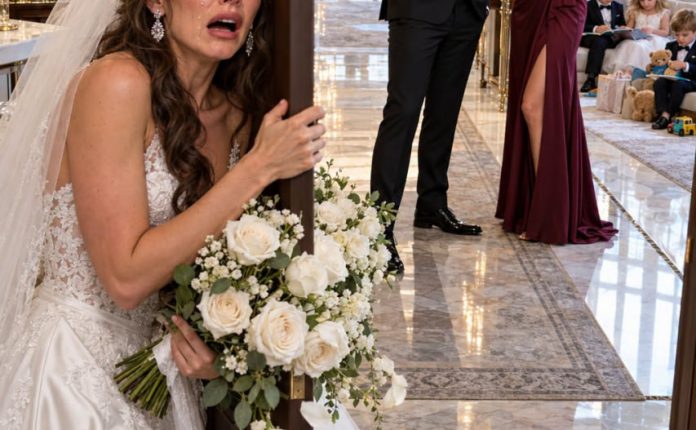
At 3:50 on a Saturday afternoon in October, I was standing barefoot in the back hallway of Alder Grove Community Church, holding my wedding shoes by their silver straps, when I heard my fiancé make a promise that belonged to me.
“Don't worry about daycare anymore,” Grant told his sister. “Mara will watch all three kids starting Monday.”
The ceremony was scheduled for four o'clock.
For several seconds, I remained outside the fellowship room, wondering whether I had misunderstood him.
Then Brenna laughed.
“Does she actually know that?”
“She knows how important family is,” Grant replied. “Once we're married, she'll come around.”
I pressed one hand against the painted cinder block wall.
The corridor smelled faintly of floor polish and the chrysanthemums someone had arranged near the sanctuary entrance. A few minutes earlier, the pastor's assistant had told me Grant wanted to speak privately before the ceremony.
I had slipped away from the bride's room, carrying my shoes because the backs were rubbing against my heels.
I thought he was nervous.
I had imagined finding him alone, straightening his tie, and surprising him with a kiss.
Instead, I heard the man I was about to marry confidently explain to another woman how my life would be organized without my participation.
“She starts that promotion Monday,” Brenna said. “Won't her company be expecting her?”
“Mom thinks she can request leave.”
“Did Mara agree?”
“Not exactly.”
“Grant.”
“Listen, Brenna. Once the wedding's over, it'll be different. She won't want to make a big issue out of helping family.”
His voice carried the casual certainty of someone discussing a delivery schedule.
Brenna lowered hers.
“What if she refuses?”
Grant chuckled.
“She isn't going to embarrass herself and everyone else over a little babysitting.”
A little babysitting.
Three children. Five weekdays. An arrangement beginning less than forty-eight hours after our wedding.
I looked at the white envelope tucked beneath my arm. Inside were the vows I had written the night before.
I had spent almost an hour deciding how to describe partnership without sounding sentimental.
One sentence said that I would protect Grant's dreams with the same care I hoped he would give mine.
Now I wondered whether he had ever considered my dreams worth protecting.
My name is Mara Ellison. I was thirty-four years old, employed by Cedarline Mutual Insurance in Columbus, Ohio, and about to begin the most significant assignment of my professional life.
For nearly a decade, I had worked as a property claims adjuster.
It was not a glamorous profession. Much of my working day involved photographs of water damaged ceilings, contractor estimates, inspection reports, insurance policies, and conversations with people who wanted answers to complicated questions.
But I liked the work.
I liked finding patterns in evidence. I liked explaining difficult decisions clearly. And I liked knowing that my salary paid my mortgage, maintained my savings, and gave me the ability to make choices without asking anyone's permission.
On Monday morning, I was due to report at eight o'clock as a senior complex claims specialist.
The promotion came with supervisory responsibilities, a substantial raise, and a chance to help train newer adjusters handling complicated losses.
I had competed against eleven applicants.
Grant knew all of that.
Three weeks earlier, when I received the official offer, we had celebrated at a Thai restaurant on High Street.
I remembered the uneven wooden table, the rain collecting along the window, and the way Grant raised his glass.
“To the hardest working woman I know.”
He had smiled warmly.
“I'm proud of you, sweetheart.”
I believed him.
That was the hardest part to understand as I stood outside the fellowship room.
I had evidence of his affection.
I also had evidence of his dishonesty.
And both seemed to belong to the same man.
Fourteen months earlier, I met Grant Hensley at a housewarming party in Clintonville.
A coworker named Elise had dragged me there on a Friday evening when I would rather have stayed home with a book and leftover pasta.
Grant stood near the kitchen counter, holding a paper plate and trying to rescue a piece of bruschetta that was sliding off its bread.
He was thirty-six, managed regional accounts for a building supply company, and possessed an easy conversational manner that made strangers feel included.
When Elise introduced us and mentioned my job, he smiled.
“So you get paid to be suspicious of people.”
“I get paid to know when something doesn't add up.”
“Sounds dangerous.”
“Only for people who don't add up.”
He laughed, nearly dropping his plate.
We spoke for most of the evening.
He asked questions and listened to the answers. He remembered details without turning them into performances of attentiveness.
The following morning, he called when he said he would.
Our first breakfast lasted almost four hours.
We talked about work, books, childhood vacations, disappointing relationships, and the peculiar comfort of old neighborhood diners.
Grant remembered that I disliked cilantro.
He remembered that my mother collected antique cookbooks.
He remembered my long abandoned ambition to visit the coast of Maine in October.
After several relationships in which ordinary courtesy seemed permanently unavailable, Grant's thoughtfulness felt uncomplicated.
He brought soup when I had the flu.
He helped my mother fix a kitchen cabinet.
When a violent thunderstorm knocked out electricity in my neighborhood, he arrived with flashlights and sandwiches.
I did not fall in love with him because of one grand gesture.
I fell in love through a collection of small ones.
My mother, June Ellison, approved of him.
That mattered more than I admitted at the time.
June had worked as a public librarian for thirty-two years. She was practical, observant, and difficult to impress with polished manners.
She had raised me alone after my father died when I was thirteen.
We were close without being constantly involved in each other's decisions.
When she first met Grant, she watched him repair the stubborn hinge on her kitchen cabinet without being asked.
Later, she sent him home with chicken soup.
“That man notices what needs doing,” she told me.
I thought she was right.
What neither of us understood was that Grant noticed what needed doing for the people who expected him to solve their problems.
Eventually, he began expecting me to participate in those solutions.
Grant's family lived on the northwest side of Columbus.
His mother, Odessa, managed family gatherings with the precision of a military operation. She assigned dishes, selected arrival times, and could make a person feel guilty for bringing the wrong kind of dinner rolls.
His father, Victor, was quieter.
He worked part time after retiring from a commercial printing company and generally preferred listening to family conversations rather than directing them.
Grant's younger sister, Brenna Vale, lived about fifteen minutes away with her husband, Micah, and their three children.
Sophie was seven, Noah was five, and little Evie had just turned three.
Micah worked rotating shifts maintaining electrical systems at a manufacturing plant.
His schedule changed frequently, and Brenna was forever adjusting pickup arrangements, daycare hours, and after school activities.
I liked the children.
Sophie enjoyed drawing houses with complicated staircases.
Noah could identify construction vehicles from remarkable distances.
Evie approached every adult with the expectation that someone would eventually produce a snack.
During our first Christmas together, I bought them books and spent an afternoon helping Sophie assemble a miniature dollhouse.
I did not consider loving children the same thing as agreeing to become their daily caregiver.
Neither did I imagine anyone would confuse the two.
In the beginning, the Hensleys' closeness seemed admirable.
Grant picked up groceries for his mother when she was ill.
Victor repaired things at Brenna's house.
Brenna occasionally brought food to her parents.
They showed up for birthdays, school concerts, and hospital appointments.
My own extended family was smaller and less organized. Their constant involvement with one another looked reassuring.
Yet there were moments I noticed without fully understanding.
One Sunday, Brenna called Grant during our anniversary dinner because Noah had developed a fever.
Micah was at work.
She wanted Grant to drive over and stay with her children while she went to the pharmacy.
I suggested she ask Victor, who lived five minutes away.
Grant frowned.
“Dad's already settled for the evening.”
“So are we.”
He looked genuinely surprised.
“It's my sister, Mara.”
We left before dessert.
Another time, Odessa asked me to prepare an elaborate birthday dinner for Victor because I worked from home two days a week.
When I explained that remote work still required me to work, she smiled.
“Of course, dear. You're always so conscientious.”
She said it as though my reluctance were a charming personality flaw.
Grant later told me his mother simply loved having me included.
I wanted to believe that.
Once, after Brenna asked me to collect Sophie from school on a day I had a late meeting, Grant called me easygoing because I eventually agreed.
I remembered being pleased by the compliment.
Standing in the church hallway, I realized how often he used it immediately after I gave up something I wanted.
Grant proposed in March.
He chose an ordinary Wednesday evening in my kitchen.
I was cooking salmon, and he had arrived carrying flowers and a small paper bag from a bakery I loved.
He had intended to make a romantic speech, but the oven timer interrupted him.
Then the fish began burning.
He laughed, dropped to one knee beside the stove, and opened a velvet box.
“Mara, I know this isn't exactly how I planned it.”
I started laughing too.
He took my hand.
“But I know I want to spend my life with you. Will you marry me?”
I said yes before he finished the question.
We ate slightly burned salmon and bakery cake on the living room floor.
At the time, it felt perfect.
We originally planned a small wedding for the following June.
Fewer than forty guests.
A garden ceremony if the weather cooperated.
A relaxed dinner afterward.
No expensive decorations, no enormous bridal party, and no pressure to turn our marriage into a competition.
We intended to save for several months and take our honeymoon in Maine.
In May, everything changed.
Odessa announced during Sunday dinner that the Hawthorne, a well regarded reception venue, had unexpectedly become available on October seventeenth.
She had already paid a deposit.
Grant called it an extraordinary opportunity.
I asked why we needed to rush.
“It's only five months earlier,” he replied.
“That's five months of planning, Grant.”
“Mom wants to help.”
“I know, but I thought we were doing this together.”
He kissed my forehead.
“We are. Let her enjoy herself.”
Odessa promised to handle the florist, catering, and venue arrangements.
I reluctantly agreed.
Two days later, I checked the Hawthorne's booking calendar while researching photographers.
October seventeenth was marked as reserved.
According to the publicly available calendar, the booking had been entered on March twenty-ninth.
That was barely two weeks after our engagement.
I showed Grant.
He barely glanced at the screenshot.
“Mom must have placed a hold.”
“Then why did she say another couple canceled?”
“Maybe that's what the venue told her.”
“But it was already reserved.”
He exhaled.
“Mara, are you investigating our wedding now?”
The question made me feel foolish.
I apologized.
I told myself that October was a perfectly reasonable month to get married.
We were happy. Our families were happy.
Why should the date matter?
By late summer, however, I began noticing the Hensleys' unusual interest in my work.
Brenna asked repeatedly whether my company allowed unpaid leave.
Odessa wanted to know how much notice Cedarline required before someone changed positions.
Grant suggested that married couples sometimes benefited from one partner working a more flexible schedule.
I explained that my new position would probably require more office hours, not fewer.
He nodded.
“We'll figure things out.”
I thought he meant household chores, vacation plans, and the ordinary practical arrangements of marriage.
He meant something else.
In early September, Brenna told us her daycare center was increasing fees.
She looked exhausted.
Micah had been working extra shifts, and their monthly expenses were rising.
I sympathized.
I even offered to help her compare childcare programs near her house.
She thanked me and changed the subject.
A week later, Grant asked whether I had ever considered leaving the insurance industry.
“Why would I?”
“You work hard. You're always dealing with other people's disasters.”
“I like my job.”
“I know. I just wonder whether you'd be happier with something less demanding.”
I laughed.
“Grant, I'm about to get promoted.”
He kissed my temple.
“Of course you are.”
I heard encouragement.
Now I understood he had been testing an idea.
The week before the wedding, Odessa came over carrying a folder of seating charts and vendor receipts.
As I made coffee, she looked at my home office.
“You have such a lovely setup here.”
“Thank you.”
“Plenty of room, too.”
“For what?”
She smiled.
“Oh, nothing. Just thinking aloud.”
I did not ask another question.
That afternoon, she requested a spare key in case someone needed to deliver flowers while I was away.
I refused gently, explaining that the florist could contact me directly.
She looked disappointed.
Grant later told me I had embarrassed her.
I apologized again.
By the time our wedding day arrived, I had apologized for so many harmless boundaries that I barely recognized them as boundaries anymore.
The morning itself began beautifully.
My mother came to my house before nine.
She brought coffee, a small box of pastries, and the pearl earrings my grandmother had worn on her wedding day.
I cried when she opened the box.
June smiled and handed me a tissue.
“Don't ruin your makeup before we get started.”
We spent the morning with Elise and two other friends, getting ready in a small room at the church.
There were photographs, laughter, misplaced hairpins, and the kind of nervous excitement that makes ordinary objects difficult to find.
At three thirty, the photographer took pictures of my dress.
At three forty-five, the pastor's assistant said Grant wanted a private moment.
At three fifty, I heard the promise.
And suddenly fourteen months of memories began arranging themselves into a pattern.
I stepped away from the fellowship room.
Inside, Brenna spoke again.
“Mom said she'd handle the paperwork.”
Grant asked whether everything was prepared.
“Mostly. I just need to get Mara's part finished.”
“Don't let her see it before the wedding.”
I felt cold.
Not frightened in the dramatic way I might have expected.
My thoughts became unusually precise.
There was paperwork.
There was a planned start date.
There was an agreement I had never reviewed.
And at least three people knew about it.
I walked to the bride's room.
June was standing beside the mirror, fastening her necklace.
She turned when I entered.
“Mara?”
I placed my shoes on the chair.
For a moment, I could not speak.
Then I repeated what I had heard.
My mother listened without interrupting.
When I finished, she asked one question.
“Did Grant ever discuss this arrangement with you?”
“No.”
“Then you aren't walking down that aisle until he does.”
Someone knocked.
Odessa entered before we answered.
She wore a plum colored dress, gold earrings, and a tightly controlled smile.
“Everyone's seated. Mara, we need to get moving.”
June stepped beside me.
“We need to discuss Monday.”
Odessa's smile changed slightly.
“What about Monday?”
“Grant promised that Mara would care for Brenna's children.”
“Oh, that.”
She laughed as though we had mentioned a misplaced bouquet.
“We'll work through the details after the wedding.”
“What details?” I asked.
“Scheduling, meals, transportation. Nothing complicated.”
“I have a job.”
“Of course you do, sweetheart.”
“A new job that begins Monday.”
“Positions come and go. Children only grow up once.”
I stared at her.
“You're talking about my career as though it's disposable.”
“Don't be dramatic.”
My mother crossed her arms.
“Odessa, did Mara agree to any of this?”
“Grant said she understood family responsibilities.”
“He told you I agreed?” I asked.
Odessa hesitated.
“He said you'd be reasonable.”
There was that word again.
Reasonable.
Easygoing.
Flexible.
Every compliment seemed to describe my willingness to accommodate someone else's needs.
I asked who had prepared the paperwork.
Odessa began discussing how expensive childcare had become.
I interrupted.
“Who prepared it?”
She looked toward the door.
“Brenna has been under tremendous pressure.”
“That doesn't answer me.”
“Mara, we have guests waiting.”
“Then they can wait.”
Odessa's face tightened.
My mother reached into her handbag.
“There's something you need to see.”
She opened a text message from Odessa dated three days earlier.
It asked June to encourage me to take extended leave from Cedarline following the wedding.
According to the message, Grant and I had discussed it already.
Odessa wrote that I was nervous about requesting time off and needed reassurance.
June had replied that she would not interfere with my employment decisions.
Odessa responded with a sentence that made my throat tighten.
“Once Monday's enrollment is confirmed, Mara won't have much choice.”
I read it twice.
“What enrollment?”
Odessa said nothing.
My mother looked at her steadily.
“You told me Mara had agreed.”
“I thought she had.”
“That's not what the message says.”
Odessa reached toward the phone.
“June, that was a private conversation.”
“So is my daughter's future.”
Outside, the organ music stopped.
We could hear people moving in the sanctuary.
I looked down at my wedding dress.
The ivory satin was gathered neatly at my waist. My grandmother's pearl earrings rested against my neck. Someone had spent nearly an hour arranging my hair.
Everything about me was prepared for a ceremony.
Nothing about my life was prepared for what the Hensleys had decided.
I took off my engagement ring.
The small indentation it left on my finger looked oddly unfamiliar.
June noticed.
She did not comment.
Instead, she opened the door.
“I'm getting Grant.”
Odessa caught her sleeve.
“Please don't make a scene.”
My mother looked at her hand.
“Let go.”
Odessa released her.
A few moments later, Grant appeared, followed by Brenna.
He wore the charcoal suit we had chosen together.
His tie was slightly crooked.
For one foolish instant, I wanted to straighten it.
Then I saw the folded manila envelope beneath Brenna's arm.
“What's wrong?” Grant asked.
I looked directly at him.
“Monday.”
His eyes moved toward his sister.
It lasted less than a second.
But I saw it.
“Sweetheart, whatever you've heard, we can discuss it afterward.”
“No.”
He blinked.
“No?”
“We discuss it now.”
Odessa moved closer.
“Mara, you're putting everyone in an uncomfortable position.”
“I'm uncomfortable too.”
Grant held out his hand.
“Please trust me.”
I looked at his open palm.
“I did.”
He lowered it.
Brenna shifted behind him.
I pointed to the envelope.
“Show me what's inside.”
She looked at Odessa.
“Brenna,” I said, “please.”
With trembling fingers, she opened the clasp.
The first page was titled Family Childcare Agreement.
The second listed a proposed payment.
The third identified me as the primary caregiver for Sophie, Noah, and Evie.
There were spaces for emergency contacts, authorized school pickups, and the hours the children would be in my care.
Every weekday.
Seven thirty in the morning until five thirty in the afternoon.
A fifty hour workweek.
The proposed compensation was two hundred dollars a week.
I turned the page.
My name appeared beneath the words Designated Caregiver.
Beside it, someone had written October seventeenth.
Our wedding date.
I looked at Grant.
“Why is my name on this?”
He swallowed.
“We were going to talk.”
“When?”
“After the ceremony.”
“After I legally married you?”
“Don't say it like that.”
“How should I say it?”
Brenna began crying.
“I didn't know he hadn't told you everything.”
Grant turned sharply.
“Brenna, stop.”
She wiped her face.
“You said Mara understood.”
“I said we'd work it out.”
“Then why did Mom tell the school she would handle pickup?”
The room became silent.
I looked down at the paperwork again.
A separate sheet carried the name of Sophie's elementary school and a proposed authorized pickup arrangement.
It was not an approved school form.
It was a draft prepared by the family.
But the date was unmistakable.
Monday.
Odessa tried to explain that nothing was final.
I asked why they had chosen my name before asking me.
Nobody answered.
I looked at the clock.
Four twelve.
The ceremony was already late.
Grant glanced at the doorway.
“Can we please get married first?”
His question settled over the room.
He was not asking whether I wanted to marry him.
He was asking me to preserve the appearance of a wedding while he postponed the truth until it would be harder to escape.
I looked at the papers, then at the man I loved.
“Tell me why your mother booked this wedding for October,” I said.
Grant went still.
Odessa's expression changed.
For the first time that afternoon, I knew I had asked a question they were genuinely afraid to answer.
END PART 1