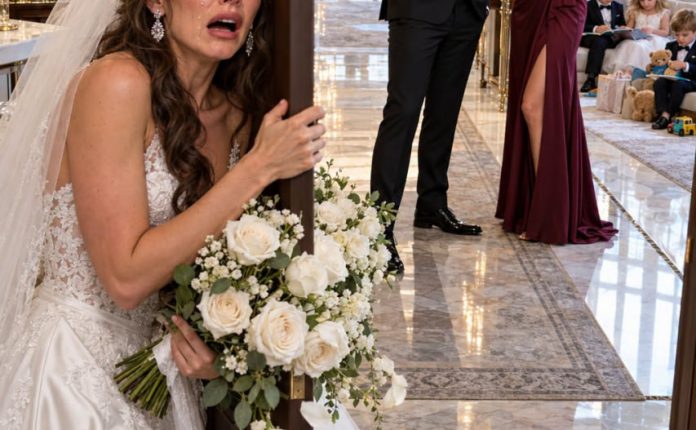
Grant followed me into Pastor Bennett's office and closed the door.
My mother remained in the hallway with Brenna.
I wanted to hear his explanation without an audience.
For several seconds, we stood on opposite sides of the pastor's desk.
Grant looked exhausted.
His tie was loosened, and a thin line of perspiration had formed near his hairline.
I remembered helping him choose that suit.
We had spent an afternoon at a department store arguing cheerfully about charcoal and navy.
I remembered him looking at me from the dressing room doorway and saying he wanted to look like a man worthy of marrying me.
Now neither of us knew where to begin.
Finally, he spoke.
“I made a mistake.”
I waited.
“I should've discussed the childcare arrangement with you.”
“Yes.”
“But I didn't think you'd react like this.”
I looked at him.
“How did you think I would react?”
“I thought you'd understand the situation.”
“You thought I'd resign from my new position?”
“I never said resign.”
“You told Brenna I'd start Monday.”
“We could've figured out the job details.”
“Grant, stop.”
He fell silent.
I pulled out a chair.
My wedding dress made sitting awkward. I gathered the fabric over my knees and looked at him.
“I need you to tell me the truth without explaining why I shouldn't be upset.”
He sat opposite me.
For the first time, his expression softened.
“Okay.”
“Did you know in March that Brenna needed childcare beginning in October?”
“Yes.”
“Did your mother reserve the Hawthorne because of that?”
“Partly.”
“Did you know she had reserved it before she told me?”
“Yes.”
“Did you let me believe another couple had canceled?”
He stared at his hands.
“Yes.”
I nodded.
Each answer hurt, but at least they were answers.
“Did you expect me to take leave from Cedarline?”
“Yes.”
“How long?”
“We were hoping six months.”
I looked up.
“Six months?”
“Maybe less.”
“Who is we?”
He said nothing.
I leaned back.
“Grant.”
“Mom and Brenna and me.”
I closed my eyes.
He continued quickly.
“Brenna was overwhelmed. Micah couldn't change his schedule. Daycare was becoming impossible. Mom suggested that once we were married, we could help.”
“By using my house and my time.”
“By working together.”
“You were not offering your time.”
“I have a full time job.”
“So do I.”
He shifted in his chair.
“But your employer offers leave.”
“Not six months of guaranteed leave for an arrangement like this.”
“We didn't know that.”
“Because nobody asked me.”
He looked away.
There it was again.
The center of the problem.
They did not know whether their plan was practical because they had never discussed it with the person expected to carry it out.
He began talking about Brenna's financial situation.
I listened.
The daycare center had increased its fees.
Micah's rotating shifts complicated pickups.
Brenna had looked for less expensive arrangements but had trouble finding openings for all three children.
Odessa had tried helping for several weeks but found it exhausting.
Grant had offered money occasionally.
His parents had already contributed more than they could comfortably afford.
It was a genuine family difficulty.
I did not doubt that.
But when I asked why they had not discussed a professional caregiver, alternate schedules, or other support, Grant gave the same answer repeatedly.
“Those options cost money.”
I looked at him.
“And my time doesn't?”
He frowned.
“Of course it does.”
“Then why did you decide it was the cheapest solution?”
He looked down.
I waited.
Eventually, he said, “Because I thought you'd want to help.”
“I probably would have helped in some way.”
“Then what's the difference?”
“The difference is that helping is something I choose.”
He rubbed his forehead.
“Mara, you're making this sound like we were trying to control you.”
I looked at the closed door.
“Weren't you?”
His expression tightened.
“No.”
“You arranged the wedding around a childcare deadline.”
“We wanted to get married anyway.”
“You encouraged me to accept a promotion while planning for me to leave it.”
“I thought you could delay the start.”
“You never asked.”
“We were going to.”
“When?”
He said nothing.
I leaned forward.
“You told Brenna I wouldn't back out because I wouldn't want to embarrass myself.”
Grant stared at me.
I repeated the words.
Slowly.
Exactly as I had heard them.
He looked ashamed.
For a moment, I saw the man who had once driven through a snowstorm to bring my mother medication.
“I shouldn't have said that.”
“No.”
“I was frustrated.”
“With whom?”
“With everything.”
I waited.
He exhaled.
“With Brenna always needing help. With Mom calling every day. With the wedding costs. With the feeling that I can't keep everyone happy.”
There was an honesty in his answer I had not expected.
For a moment, compassion rose in me.
Grant was not imagining the pressure.
His mother did demand things.
His sister did need support.
He had spent years serving as the dependable son and brother.
But somewhere along the way, he had decided that marrying me would provide another person who could carry those demands.
Instead of changing the family pattern, he had planned to extend it.
“Grant,” I said, “you cannot solve everyone's problems by giving them my life.”
He looked at me with reddened eyes.
“I know.”
I wanted that to be enough.
I wanted those two words to erase the forms, the concealed date, and his confidence that I would accept the arrangement once the ceremony was over.
But I could not forget how long he had kept the secret.
I asked another question.
“Why did your mother want my financial information?”
He looked genuinely confused.
“What?”
“She asked Mom about my mortgage and whether I could take a year away from work.”
He leaned back.
“Mom worries about money.”
“Why does she need to know about mine?”
“Because we're getting married.”
I stared at him.
“That doesn't make my finances a family discussion.”
He looked uncomfortable.
“We were talking about how we'd manage if you stopped working.”
“And nobody mentioned those conversations to me?”
He shook his head.
“Grant, were you planning to tell me after the wedding that your family had already decided what our household could afford?”
He rubbed both hands over his face.
“I didn't think of it like that.”
I believed him.
That frightened me more than if he had admitted some elaborate scheme.
He had thought about daycare costs, his sister's exhaustion, his mother's worry, and his own obligations.
He had not seriously considered the impact on me.
I was not absent from his plans.
I was present as a resource rather than a person.
A knock interrupted us.
Pastor Bennett opened the door slightly.
“I'm sorry. June asked me to tell you that the guests are becoming concerned.”
Grant stood immediately.
“Then we need to get out there.”
I remained seated.
He looked at me.
“Mara?”
I folded my hands.
“I don't know whether I can marry you.”
The words were quieter than I expected.
Grant stopped.
For several seconds, he simply stared.
Then he crossed the room.
“Please don't say that.”
“I'm trying to be honest.”
“We love each other.”
“I know.”
“We've built something good.”
“I know.”
“Then don't throw it away over this.”
I looked up.
“You think this is just about childcare.”
He knelt beside my chair.
“I know you're upset. But we can fix this. I'll tell Brenna the arrangement is off.”
I swallowed.
“Would you?”
“Yes.”
“Right now?”
He nodded.
“Of course.”
“Then call her in.”
He hesitated.
“Can't we do that after the ceremony?”
I looked at him.
His face changed as he realized what he had done.
He had just offered to cancel the plan.
But even now, he wanted the wedding first.
I stood.
“I need to speak with Brenna.”
Grant rose too.
“Mara, please.”
I opened the door.
Brenna sat on a wooden bench beside my mother.
Odessa stood nearby, speaking sharply into her phone.
Victor had arrived.
He was standing a little apart from the others, looking tired.
He saw me and approached.
“Mara.”
“Hello, Victor.”
He looked at my face.
“I'm sorry.”
I did not know how much he understood.
“Did you know about the childcare plan?”
He nodded.
“I knew Brenna needed help. I knew Odessa wanted you to watch the children.”
“Did you think I'd agreed?”
He hesitated.
“I asked Grant.”
“What did he say?”
“He told me it was being discussed.”
I looked toward Grant.
Victor followed my gaze.
“I should have asked you directly,” he said.
His admission was simple.
It contained no excuse.
I appreciated it more than he probably realized.
Brenna stood.
“Mara, I never wanted to hurt you.”
I looked at her.
“Then help me understand something.”
She nodded.
“When did you first find out Grant was arranging for me to care for the children?”
“Back in April.”
I felt my stomach tighten.
April.
A month before Odessa announced the October venue.
“What did he tell you?”
Brenna wiped her face.
“He said you were wonderful with the kids. That you had a good job and a comfortable house. That after the wedding, you might want a break from work.”
I stared at her.
“He said I wanted a break?”
“He said you were considering it.”
“Did you ask me?”
She lowered her eyes.
“No.”
“Why not?”
“Because I believed him.”
Her answer was believable.
But it did not completely excuse her.
I remembered the questions she had asked all summer.
My leave policy.
My new schedule.
Whether the children liked my house.
She had opportunities to verify what Grant said.
She had chosen not to.
“Brenna, the children deserve reliable childcare,” I told her. “They do not deserve adults making arrangements that might collapse because nobody asked the caregiver.”
She began crying.
“I know.”
I looked at the envelope she still held.
“Have you already canceled the daycare renewal?”
She nodded.
“The deadline passed Friday.”
I stared at her.
“So you have no confirmed childcare for Monday?”
“No.”
“And you were depending on me?”
She nodded again.
My chest tightened.
This was the real leverage.
Not the wedding guests.
Not the dress.
Not the venue deposit.
Three young children needed supervision when their parents went to work.
By allowing Brenna to cancel her existing arrangement, Grant and Odessa had created a practical emergency.
They expected me to feel responsible for resolving it.
I looked at Grant.
“You knew she had let the deadline pass?”
He nodded slowly.
“Brenna said it would be fine.”
“You told her it would be fine.”
He said nothing.
Victor stepped closer.
“Brenna, could you call the daycare and see whether they'll still accept the renewal?”
She shook her head.
“They're closed.”
“Leave a message,” he said. “Call first thing Monday.”
Odessa lowered her phone.
“That doesn't solve Monday morning.”
Victor looked at her.
“Then we'll solve Monday morning.”
She frowned.
“How?”
“I can take the children for part of the day. Micah can see whether anyone can change shifts. You and I can split the rest until they find care.”
Odessa looked horrified.
“I can't watch three children all week.”
Victor nodded.
“Neither can Mara.”
Nobody spoke.
It was the first time anyone had stated that plainly.
Odessa turned toward Grant.
“Do something.”
I watched his expression.
He looked from his mother to his sister to me.
It was the same familiar triangle I had witnessed for months.
A family problem.
Odessa's demand.
Grant's responsibility.
Except this time, I was not going to make the choice easier for him.
He finally faced his mother.
“Mara isn't taking care of the kids Monday.”
Odessa's face darkened.
“Grant.”
“No.”
Brenna covered her mouth.
Grant continued.
“We should have asked her. We didn't. That's on us.”
A faint hope rose in me.
For the first time, he seemed to understand.
Odessa stared.
“After all the arrangements we've made?”
“They were wrong.”
I almost reached for him.
Then he looked at me.
“There. It's handled.”
I hesitated.
He came closer.
“Can we get married now?”
The hope disappeared.
He had corrected the practical arrangement.
But he seemed to believe that canceled paperwork erased months of dishonesty.
I looked at my mother.
She did not move.
She would not decide for me.
That was one of the reasons I trusted her.
“Grant,” I said, “I need more than you canceling something you never had permission to arrange.”
He closed his eyes.
“What else do you want?”
“I want to know whether you see me as an equal partner.”
“Of course I do.”
“Then why didn't I get a vote?”
He opened his eyes.
“Because I knew you'd probably say no.”
The sentence arrived without hesitation.
He seemed surprised by it himself.
I stared at him.
There was the truth.
Not a misunderstanding.
Not a forgotten conversation.
Not a harmless assumption.
He had concealed the plan because he expected me to reject it.
And he wanted the marriage completed before I had the opportunity.
I took a step back.
Pastor Bennett stood near the office doorway.
I turned toward him.
“Could we speak privately for a moment?”
He nodded.
Grant reached for my arm.
“Mara.”
I looked at his hand.
He released me.
Inside the office, I sat down.
Pastor Bennett remained standing beside the window.
I could hear the faint murmur of guests through the sanctuary wall.
“I think I know what I need to do,” I said.
He waited.
“I just don't know how to do it.”
He pulled a chair closer.
“Tell me what you're considering.”
I looked at the ring in my palm.
“I don't think I can marry him today.”
Saying it aloud made my chest ache.
For months, I had imagined this afternoon as the beginning of my married life.
I had already sent thank you notes for bridal shower gifts.
My name appeared on place cards.
Our friends had driven from other cities.
My mother had bought a new dress.
There was a cake waiting at the Hawthorne.
And yet none of those things could answer the question Grant had created.
Could I trust him to respect my choices when my choices disappointed his family?
Pastor Bennett spoke quietly.
“You don't have to decide whether you'll love Grant forever. You only have to decide whether you can make these promises today.”
I looked at him.
“I still love him.”
“I believe you.”
“He's not a terrible person.”
“Perhaps not.”
“He's done good things for me.”
“I'm sure he has.”
“Then why does this feel so final?”
The pastor considered the question.
“Because the issue isn't whether Grant loves you. It's whether he's willing to act honestly when your wishes conflict with his.”
I looked at the ring.
There was no simple way to solve that in a few minutes.
I needed time.
Grant wanted a wedding.
I wanted trust.
Those were not the same thing.
I stood.
“I need to tell him.”
The pastor opened the door.
Outside, Grant was pacing.
He stopped when he saw me.
I approached him slowly.
“Grant, I'm not going through with the ceremony today.”
His face drained.
“What?”
“I can't marry you under these circumstances.”
He stared.
“Mara, please.”
“I'm not saying this to punish you.”
“Then why?”
“Because I don't trust the choices you've made.”
His eyes filled with tears.
“I love you.”
“I love you too.”
“Then marry me.”
I shook my head.
“Love isn't enough if I don't get to make decisions about my own life.”
Odessa made a small sound of disbelief.
Victor stepped beside her.
“Let them talk.”
Grant looked toward the sanctuary.
“What am I supposed to tell everyone?”
I swallowed.
“The truth.”
He shook his head.
“I can't stand up there and explain all this.”
“I don't expect you to.”
“Then what?”
I turned toward Pastor Bennett.
“Would you tell our guests that the ceremony isn't happening?”
He nodded.
“Of course.”
Grant stood motionless.
I looked at him one final time.
“I wanted to marry you today.”
His mouth trembled.
“I know.”
“That wasn't an act.”
“I know.”
“But I can't marry someone who planned to use the ceremony to make my consent irrelevant.”
He looked down.
For once, he had no argument.
The organ did not begin again.
Pastor Bennett walked toward the sanctuary.
I heard the doors open.
Then his voice, gentle and measured, carried into the room.
The wedding was canceled.
END PART 3