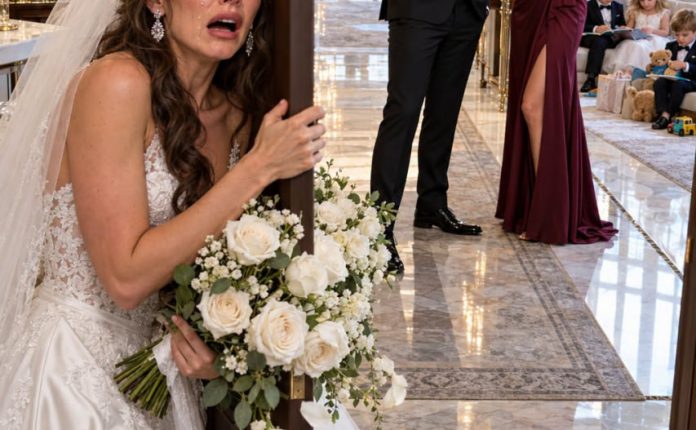
The first sound I heard after Pastor Bennett announced the cancellation was a chair scraping against the sanctuary floor.
Then came murmuring.
A few voices rose in confusion.
Someone asked whether I was ill.
Someone else wanted to know whether the ceremony was merely postponed.
I stood in the hallway beside my mother, holding the skirt of my wedding dress away from the floor.
For a moment, I felt an absurd urge to fix something.
To answer the guests.
To straighten the flowers.
To tell the organist she could stop waiting.
To do anything that would make the situation appear less disorderly.
June touched my arm.
“You don't have to manage everyone else's reaction.”
I looked at her.
“I know.”
But knowing and feeling were different things.
I had spent months making sure this wedding would be pleasant for everyone.
Now I was responsible for an announcement that had left sixty-two people wondering what had happened.
Or perhaps I wasn't responsible.
Perhaps the responsibility belonged to the people who had made honest vows impossible.
The thought was new enough that I needed to sit with it.
Grant remained near the pastor's office.
He had stopped arguing.
His expression was blank, and he held his phone without looking at it.
Brenna stood beside Victor.
Odessa had disappeared into the sanctuary.
I knew what she was doing before I heard her voice.
“It's a misunderstanding,” she told someone. “The bride is under a great deal of pressure.”
My mother stiffened.
I closed my eyes.
There it was.
The first explanation.
Not that Grant had concealed an arrangement requiring me to surrender my career.
Not that his family had booked our wedding to coincide with a childcare deadline.
I was under pressure.
I was emotional.
I had misunderstood.
I looked at June.
“I need to say something.”
She nodded.
“Then say it.”
I walked toward the sanctuary doors.
My legs felt strangely heavy.
The satin of my dress brushed against the wooden frame as I stepped inside.
Guests turned.
Some rose immediately.
Elise was sitting near the front, her face pale.
A cousin I had not seen in years pressed a hand to her mouth.
Odessa stood beside the second pew speaking to an older woman.
When she saw me, she stopped.
I had imagined walking down that aisle toward Grant.
Instead, I stood at the back, alone except for my mother.
I did not want to humiliate anyone.
I did not want the guests to choose sides.
But I refused to let an inaccurate explanation become the only one they heard.
“I'm sorry,” I said.
The room became quiet.
“I know many of you traveled to be here. I appreciate that more than I can explain.”
My voice shook.
I paused.
“I learned today that Grant and members of his family had made an important decision about my employment and my time without consulting me.”
Odessa made a small movement.
I continued.
“They expected me to become the daily caregiver for three children beginning Monday. That would have prevented me from starting a new position I have worked very hard to earn.”
Someone whispered.
I kept my eyes on the back pew.
“I don't blame the children. I don't blame anyone for needing childcare. But I cannot enter a marriage in which decisions about my life are made without my consent.”
I took a breath.
“I still care about Grant. This is painful for both of us. But the ceremony will not take place.”
Silence followed.
Then Elise stood.
She walked down the aisle and came to my side.
“Come on,” she whispered. “Let's get you somewhere quiet.”
I nodded.
As we turned, I saw Victor standing near the sanctuary entrance.
He looked at me with an expression I could not quite interpret.
Then he gave a small nod.
It was not approval of the canceled wedding.
It was acknowledgment.
That mattered.
Outside, Elise guided me toward the bride's room.
“What do you need?” she asked.
I almost said I was fine.
Instead, I told the truth.
“I need to get out of this dress.”
She smiled faintly.
“That we can do.”
My mother joined us.
Between them, they helped remove the dress, the veil, and the carefully arranged pins from my hair.
I changed into the dark green sweater and black trousers I had worn to the church that morning.
My grandmother's earrings remained in place.
I looked in the mirror.
Without the wedding dress, I appeared suddenly ordinary.
It was a relief.
Elise folded the dress into its garment bag.
“Do you want me to take this?”
“Please.”
“What about the flowers?”
“Give them to the church.”
“The favors?”
“I don't care.”
She nodded.
No lecture.
No dramatic speech.
Just practical help.
I loved her for it.
By five fifteen, the sanctuary was nearly empty.
The reception venue still expected our guests.
Odessa had paid the deposit and arranged the catering.
Grant asked whether we should let everyone have dinner anyway.
I told him that was his family's decision.
The reception had been planned by Odessa.
I was not going to organize its cancellation while grieving the marriage that had not happened.
My mother drove me home.
I sat in the passenger seat holding my phone.
Messages were already arriving.
Some were kind.
Some were confused.
A few asked whether the situation could be repaired.
I did not answer most of them.
At a red light, June looked toward me.
“Are you hungry?”
I shook my head.
“You should eat something eventually.”
“I know.”
She did not push.
When we reached my house, I noticed a small cardboard box on the porch.
It contained a wedding gift delivered earlier that morning.
The shipping label read Mr. and Mrs. Grant Hensley.
I stared at it.
June picked it up.
“We can deal with that another day.”
Inside, my house smelled of lavender soap and the cinnamon candle I had lit before leaving.
Everything was exactly as I had left it.
My shoes stood beside the door.
The mail waited on the kitchen counter.
Two mugs sat in the drying rack.
For months, I had thought of this house as the place where Grant and I would begin married life.
Now it was simply my home again.
I sat at the kitchen table.
June made tea.
Eventually, I began to cry.
Not because I regretted my decision.
Because I had loved the future I thought we were building.
I cried for the mornings we would not share.
For the honeymoon we would not take.
For the children we had vaguely discussed.
For the confidence I had felt when Grant proposed beside the stove.
For the embarrassment of walking into church as a bride and leaving without a husband.
My mother let me cry.
When I finally stopped, she handed me a clean tissue.
“I keep thinking about those kids,” I said.
“Of course you do.”
“They have nothing to do with this.”
“No.”
“What if Brenna has no one Monday?”
June looked at me.
“Then Brenna and Micah will have to find an arrangement. You can care about the children without becoming responsible for every decision their parents make.”
I nodded.
It sounded simple when she said it.
But I had spent months learning to associate kindness with yielding.
It would take time to separate them.
That evening, Grant called six times.
I did not answer.
At seven thirty, he sent a message.
I'm sorry. I handled everything badly. Please talk to me.
I read it.
Then I set the phone down.
Another message arrived.
I told Brenna the childcare arrangement is over. You don't have to worry about Monday.
I wanted to believe him.
But the last sentence bothered me.
You don't have to worry.
As though worrying were the problem.
As though the arrangement existed only in my imagination until he canceled it.
I wrote back.
Grant, I need space. Please don't come to my house tonight. We can discuss our belongings and the wedding expenses later.
He replied almost immediately.
I love you.
I looked at the words for a long time.
Then I turned off my phone.
Sunday morning was gray and cold.
I woke before six, despite having slept poorly.
My wedding dress hung in the guest room.
The garment bag made a faint rustling sound whenever the heating system turned on.
I made coffee.
At eight, my mother arrived with breakfast.
She had gone home the previous night but insisted on coming back.
We ate toast and scrambled eggs in comfortable silence.
Around nine, my phone rang.
It was Brenna.
I hesitated.
Then I answered.
“Hello?”
“Mara?”
Her voice sounded exhausted.
“Hi, Brenna.”
“I'm sorry to call.”
I waited.
“I wanted to tell you something about yesterday.”
I sat down.
“Okay.”
“I know I should have asked you directly about the childcare arrangement. I knew Grant was making promises for you. I didn't know how much he was hiding, but I knew I should've checked.”
I listened.
She took a shaky breath.
“I was desperate. I let myself believe it would work because I wanted it to.”
That was the first time anyone in the Hensley family had acknowledged responsibility without immediately explaining why I should excuse it.
“Thank you for saying that,” I told her.
She began crying.
“I'm really sorry.”
“I believe you.”
There was a pause.
Then she said, “Micah was furious when I told him.”
I leaned back.
“With whom?”
“Mostly Grant and me.”
She gave a small, miserable laugh.
“He said he couldn't believe we made plans around someone who hadn't agreed. He asked what we would've done if you got sick or changed your mind after a week.”
It was a reasonable question.
One nobody seemed to have considered.
“Did you find care for Monday?” I asked.
“Not completely.”
My stomach tightened.
“Dad's taking Sophie to school. Micah swapped part of his shift. Mom agreed to stay with Evie for a few hours. Noah's going to my neighbor's in the afternoon.”
“That sounds complicated.”
“It is.”
She hesitated.
“Mara, I'm not calling to ask you to help.”
I closed my eyes.
“Thank you.”
“I mean it. You've already done enough.”
We spoke a little longer.
Before hanging up, she said she had contacted the daycare center and left a message asking whether the canceled places could be restored.
I hoped they could.
Not because it would make me responsible for less.
Because three children deserved consistency.
After the call, I sat quietly.
June watched me from across the table.
“How was that?”
“Better than I expected.”
She nodded.
“Sometimes people surprise us.”
I looked toward the guest room.
“Yes.”
Later that afternoon, Victor called.
He apologized for his silence during the months leading up to the wedding.
He told me he had known Odessa wanted me to help with the children, but he had believed Grant was discussing it with me.
“I should've asked you myself,” he said.
“You couldn't have known everything.”
“No,” he answered. “But I knew enough to be uneasy.”
His honesty mattered.
He did not ask me to reconsider the wedding.
He did not defend Grant.
He simply acknowledged that the family's expectations had become unreasonable.
Then he told me something I had not known.
“Odessa has been worried about Brenna for a long time. She sees Grant as the person who can always make things work.”
“I know.”
“And Grant has never been good at telling her no.”
“I noticed.”
Victor sighed.
“I should've helped him learn.”
I sat with that sentence after we hung up.
Family patterns do not develop overnight.
Grant had spent years being praised for solving problems.
The Hensleys had grown accustomed to his sacrifices.
But being unable to disappoint his family did not give him permission to sacrifice someone else.
On Monday morning, I woke at five forty-five.
For a moment, I forgot what had happened.
Then I remembered the empty ring box on my dresser.
The wedding dress in the guest room.
The messages I had not answered.
I lay still.
At six, I got up.
I made coffee.
I chose a navy blazer, charcoal trousers, and comfortable shoes.
At seven fifteen, I drove toward Cedarline Mutual.
The roads were damp from overnight rain.
School buses moved through the neighborhoods.
I passed a daycare center where parents were carrying small children through the entrance.
For an instant, I thought of Sophie, Noah, and Evie.
Then I continued driving.
At seven fifty-two, I parked outside the office.
My new supervisor, Denise Harper, met me near the reception desk.
She was a tall woman with cropped gray hair and a habit of speaking directly.
“Mara,” she said, smiling. “Ready for your first day?”
I thought about the wedding that had not happened.
About the career I had nearly been pressured to abandon.
About Grant's promise in the fellowship room.
Then I answered.
“Yes.”
Denise handed me a folder.
“Good. We've got a complicated file waiting for you.”
I smiled.
“That's what I'm here for.”
As we walked toward the elevator, my phone vibrated.
A message from Grant.
I know today matters to you. I hope it goes well.
I looked at the screen.
For the first time in days, I did not feel an urgent need to reply.
I put the phone away.
The elevator doors opened.
I stepped inside.
END PART 4