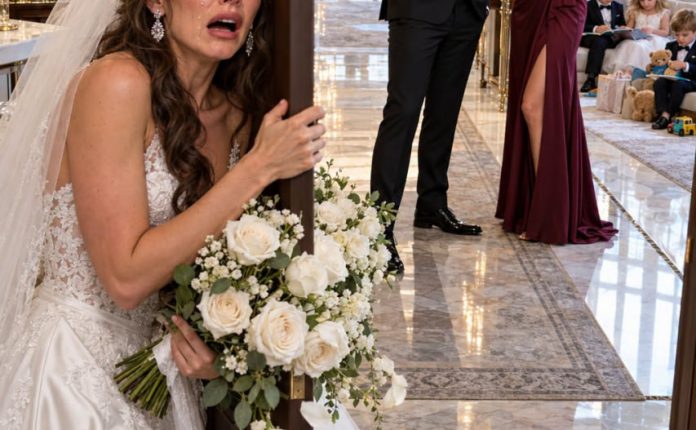
My first week in the new position was difficult for reasons that had nothing to do with the work.
I understood complicated claims.
I knew how to review damaged property photographs, interpret policy language, and question estimates that seemed inconsistent.
What I did not know was how to conduct an ordinary professional conversation while carrying the private knowledge that my wedding had collapsed two days earlier.
On Monday, I attended orientation.
On Tuesday, I met the adjusters I would help supervise.
On Wednesday, I reviewed a commercial property file involving storm damage and disputed repair costs.
On Thursday, I spent nearly an hour explaining a coverage decision to a contractor who disagreed with every sentence.
It was normal work.
I was grateful for it.
My desk had a window overlooking a parking lot bordered by maple trees.
Their leaves had begun turning orange and red.
At lunchtime, I sometimes watched people cross the pavement carrying coffee or folders.
They looked absorbed in ordinary problems.
For a few minutes, I could forget about my own.
Denise noticed I was quieter than usual.
On Wednesday afternoon, she stopped beside my desk.
“Everything okay?”
I hesitated.
“My wedding was canceled over the weekend.”
Her expression changed.
“Oh, Mara.”
I looked down.
“I'm sorry. I didn't want to bring personal problems into work.”
She pulled up a chair.
“You don't need to apologize for having a life.”
I smiled weakly.
She waited.
I explained only what I was comfortable sharing.
There had been a serious disagreement.
My fiancé had made decisions affecting my employment without consulting me.
I had chosen not to proceed with the ceremony.
Denise listened.
Then she said, “I'm glad you're here. And if you need a personal day, tell me.”
I thanked her.
After she left, I sat for a long moment looking at the folder on my desk.
I had spent years working toward this position.
For most of that time, I had imagined success as a promotion letter, a higher salary, or a more challenging assignment.
Now success felt like something quieter.
I had arrived.
Nobody had taken my choice away.
On Friday evening, Grant asked whether we could meet.
He suggested the Thai restaurant where we had celebrated my promotion.
I could not bear the thought of sitting at that table.
Instead, I proposed a small coffee shop near a public library.
He agreed.
We met Saturday morning.
A week after our wedding was supposed to take place.
Grant arrived early.
He stood when I entered.
He looked tired.
There were dark circles beneath his eyes, and his usually neat hair needed trimming.
For a moment, I wanted to put my arms around him.
Instead, I sat opposite him.
“Hi,” I said.
“Hi.”
We ordered coffee.
Neither of us touched it immediately.
Grant looked at my hands.
“You're not wearing your ring.”
“No.”
He nodded.
“I guess I shouldn't have expected you to.”
I waited.
He took a breath.
“I've spent the whole week thinking about what happened.”
“Me too.”
“I keep remembering the things I said.”
His voice shook.
“Especially what I said to Brenna about you not backing out.”
I looked at him.
“That hurt.”
“I know.”
“It wasn't just the words. You were counting on me feeling trapped.”
He closed his eyes.
“Yes.”
The admission was painful to hear.
But I appreciated it.
“I thought once we were married, you would see the childcare arrangement as something we had to work through together,” he continued.
“You mean something I would have to accept.”
He nodded.
“Yes.”
We sat quietly.
The espresso machine hissed behind the counter.
A woman near the window laughed at something on her phone.
Ordinary Saturday life continued around us.
Grant stared at his cup.
“I never thought of myself as someone who would manipulate you.”
I answered carefully.
“I don't think you woke up one morning and decided to become a cruel person.”
He looked relieved.
“But you did decide that my consent was less important than getting the outcome you wanted.”
The relief vanished.
He nodded slowly.
“I did.”
I looked at him.
“Why?”
He took several moments to answer.
“Because I knew you'd say no.”
“I might have offered another kind of help.”
“I know that now.”
“You knew I cared about the children.”
“Yes.”
“You knew how hard I worked for my promotion.”
“Yes.”
“And you still thought marriage would make me give it up.”
He looked down.
“I thought being married meant we'd put family first.”
“Whose family?”
He did not answer.
I continued.
“My mother needed help after her knee surgery. I arranged time off, hired someone for the afternoons, and worked from her house when I could. I didn't tell you to leave your job.”
“I know.”
“When your father had pneumonia, you spent weekends helping him. I brought food and drove him to an appointment. Nobody had to force me.”
Grant nodded.
“That's true.”
“Those were choices we made together. That's what partnership looked like to me.”
He rubbed his eyes.
“I kept thinking if I could solve Brenna's problem, everyone would finally stop fighting.”
I understood.
That did not make his choice acceptable.
“Grant, you were trying to make your mother happy by making me responsible.”
He stared at the table.
“Yes.”
We spoke for nearly two hours.
He told me Brenna had managed to restore two childcare places, though not all three.
Micah had arranged temporary shift changes.
Victor was helping with school pickups.
Odessa had agreed to watch Evie twice a week.
None of it was ideal.
But they were finding solutions.
Real solutions.
Solutions that required the people responsible for the children to make difficult decisions themselves.
I felt relieved.
“How's Brenna?” I asked.
“Embarrassed.”
“I understand.”
“She says she should've talked to you directly.”
“She should have.”
Grant looked at me.
“Mom's upset with you.”
I smiled faintly.
“I imagine she is.”
“She thinks you could've handled things privately.”
I looked at him.
“Everyone kept asking me to handle things privately after making decisions about me privately.”
He gave a tired laugh.
“Yeah.”
Then he became serious.
“I told her to stop blaming you.”
I looked at him.
“Thank you.”
It was something he should have done months earlier.
But I could still acknowledge it.
Grant reached into his jacket pocket.
He removed a small envelope.
“I brought this.”
Inside was a list of wedding expenses.
Venue deposits.
Catering fees.
Photography charges.
Flowers.
The dress alterations I had paid for.
He had calculated which costs were refundable and which were not.
“I don't expect you to cover anything my family arranged,” he said. “I'll handle the cancellation fees we agreed to share.”
I looked through the pages.
They were organized and careful.
I appreciated the effort.
But even while reading them, I understood that practical responsibility was only part of what had been missing.
Grant could learn to cancel contracts.
He could apologize.
He could tell his mother no.
The harder question was whether I could trust him again.
He seemed to understand that too.
“Mara,” he said quietly, “is there any chance we can try again?”
I looked at him.
The question hurt.
I had imagined our married life in so much detail.
Sunday breakfasts.
Evenings on the porch.
A trip to Maine.
Family holidays.
Growing older together.
Those images did not disappear simply because I had learned something painful.
“I don't know,” I answered.
He nodded.
“I'll do whatever it takes.”
I looked at him carefully.
“Don't make promises because you're afraid of losing me.”
He swallowed.
“I mean it.”
“I believe you mean it right now.”
He looked down.
I continued.
“But you meant your proposal too. You meant it when you said you supported my promotion. And you still made these decisions.”
He said nothing.
“I need to see who you are when someone you love asks you to do something you don't want to do.”
His eyes filled.
“I understand.”
I wasn't certain he did.
But for the first time, he seemed willing to consider that understanding would require more than one conversation.
We left the coffee shop separately.
He did not ask to kiss me.
I was grateful.
Over the following weeks, Grant and I exchanged occasional messages about practical matters.
He collected the belongings he had brought to my house.
I returned the wedding gifts that could be returned.
Our friends helped notify vendors and guests.
Some refunds came quickly.
Others took weeks.
The photographer kept the nonrefundable deposit but sent us the engagement portraits as promised.
I opened the folder one evening.
There we were in a park during late summer.
Grant stood behind me, his arms around my waist.
I was laughing at something he had said.
The photograph was beautiful.
I did not delete it.
I put it in a folder I would not open for a while.
I had learned that a happy photograph could be genuine without proving the future would be happy too.
My mother came over often.
Sometimes we talked about Grant.
Usually, we did not.
We cooked dinner, watched old movies, and argued about whether her antique cookbook collection required another shelf.
One evening, she arrived carrying a small cardboard box.
Inside were my grandmother's pearl earrings.
“I thought you might want these back,” she said.
I smiled.
“I thought you were keeping them.”
“They're yours now.”
I held them carefully.
“I wore them to a wedding that didn't happen.”
June sat beside me.
“You wore them on a day you made an important decision.”
I looked at the earrings.
For a long time, I had associated that day with embarrassment.
Now, gradually, I was beginning to associate it with something else.
I had listened to what I heard.
I had asked questions.
I had refused to surrender my choices because people were waiting.
Those actions had been painful.
But they had been mine.
In November, Brenna called again.
She told me the children were settled into a new childcare arrangement.
Sophie was attending an after school program.
Noah had a place at a smaller center.
Evie spent part of the week with a licensed home daycare provider near Brenna's workplace.
Micah had negotiated a more predictable rotation for several months.
The arrangements were not as inexpensive as they had hoped.
But they were manageable.
Brenna sounded different.
Less frantic.
More direct.
“I wanted to thank you for not blaming the kids,” she said.
“I never did.”
“I know.”
She hesitated.
“And I'm sorry for how we treated you.”
I leaned against the kitchen counter.
“Thank you.”
She asked whether I might want to see the children someday.
I thought about Sophie and her elaborate drawings.
About Noah's enthusiasm for trucks.
About Evie's sticky hands reaching for another cracker.
“I'd like that eventually,” I said. “But I need some distance right now.”
“I understand.”
For once, I believed she did.
After we hung up, I realized I had not spent the entire conversation feeling guilty.
I had not offered to solve anything.
I had listened, answered honestly, and respected my own limits.
It felt unfamiliar.
It also felt good.
December arrived.
Grant sent me a Christmas card.
Inside, he wrote that he had begun counseling and was trying to understand why he found it so difficult to disappoint his mother and sister.
He apologized again.
There was no request for forgiveness.
No plea to reconsider our relationship.
Just an acknowledgment of what he was doing.
I appreciated that.
I wrote a short note thanking him and wishing him well.
I did not suggest meeting.
By then, I had begun to recognize an important difference between caring about someone and building a life with them.
I still cared about Grant.
I hoped he would grow.
I hoped he would develop healthier relationships with his family.
I hoped he would eventually understand that love did not require managing other people into compliance.
But I no longer felt responsible for guiding him through that process.
He had to choose it himself.
At work, my new position became increasingly demanding.
I supervised difficult claims, trained two younger adjusters, and traveled occasionally for regional meetings.
Some days were exhausting.
Some days I questioned whether I was good enough.
But I had earned the opportunity to find out.
In January, Denise called me into her office.
She reviewed my first three months and told me she was pleased with my performance.
“You've handled a difficult transition well,” she said.
I thought of everything she did not know about the transition.
“Thank you.”
She smiled.
“We're glad you accepted the position.”
I left her office carrying a folder of assignments.
For several seconds, I stood by the window overlooking the parking lot.
The trees were bare.
A thin layer of snow edged the pavement.
I remembered the moment outside the fellowship room when I had heard Grant promise away my Monday.
I had been terrified of what refusing would cost.
Now I knew.
It had cost a wedding.
It had cost a relationship I once believed would last a lifetime.
It had cost the comfort of a future I had carefully imagined.
But agreeing would have cost something too.
My work.
My independence.
My confidence that my choices mattered.
Perhaps, eventually, my ability to recognize myself.
I did not feel triumphant.
I felt sad.
I also felt certain.
When spring arrived, my mother suggested we take a short trip.
“Somewhere you've always wanted to go,” she said.
I smiled.
“Maine?”
“Why not?”
We arranged a week in October, when the coast would be cool and the leaves would be turning.
I had originally planned to visit Maine with Grant on our honeymoon.
For a while, I wondered whether going would feel like walking through the remains of an old dream.
Then I decided a place did not belong to the person I had intended to visit it with.
It could become part of a different memory.
In October, almost a year after the canceled wedding, June and I stood beside a rocky stretch of coastline.
The sky was pale gray.
Wind lifted the ends of her scarf.
Below us, waves struck the dark rocks and withdrew, leaving thin ribbons of white foam.
We had spent the morning exploring small shops and eating clam chowder in a restaurant overlooking the harbor.
My mother stood with her hands in her coat pockets.
“Are you glad we came?”
I looked toward the water.
“Yes.”
She smiled.
We stood quietly.
After a while, she asked, “Do you ever regret what happened with Grant?”
I thought about the question.
I regretted that he had lied.
I regretted that the wedding had become a public disappointment.
I regretted the pain we had caused each other.
But those were not the same as regretting my decision.
“I regret that it happened,” I said. “I don't regret leaving.”
June nodded.
She did not tell me she was proud.
She did not turn the moment into a lesson.
She simply slipped her arm through mine.
We walked toward the harbor as the wind grew colder.
I thought of my house waiting in Columbus.
My work.
My friends.
The life that had continued after the wedding did not.
I did not know whether I would marry someday.
I did not know whether another relationship would ask me to trust someone as deeply as I had trusted Grant.
But I knew more clearly what trust required.
It required honesty before the decision.
Respect when two people disagreed.
And the willingness to hear no without treating it as betrayal.
Ten minutes before my wedding, I had heard a man promise that I would take care of three children beginning Monday.
For a moment, I had believed my future was collapsing.
What I could not see then was that the future I was losing had already been built around choices I had never made.
The life I kept was less certain.
It was also mine.
THE END
Disclaimer: This is a fictional story created for entertainment and reflection. Characters, conversations, locations, and events are presented as part of an imagined narrative. Any resemblance to actual people or events is coincidental.
END PART 5
Disclaimer: This fictional story was created with AI assistance for entertainment. Names, characters, dialogue, and events are fictional. Any resemblance to actual people or events is coincidental.